Kids interview Pierre de Fermat
by Charactorium · Pierre de Fermat (1607 — 1665) · Sciences · 5 min read
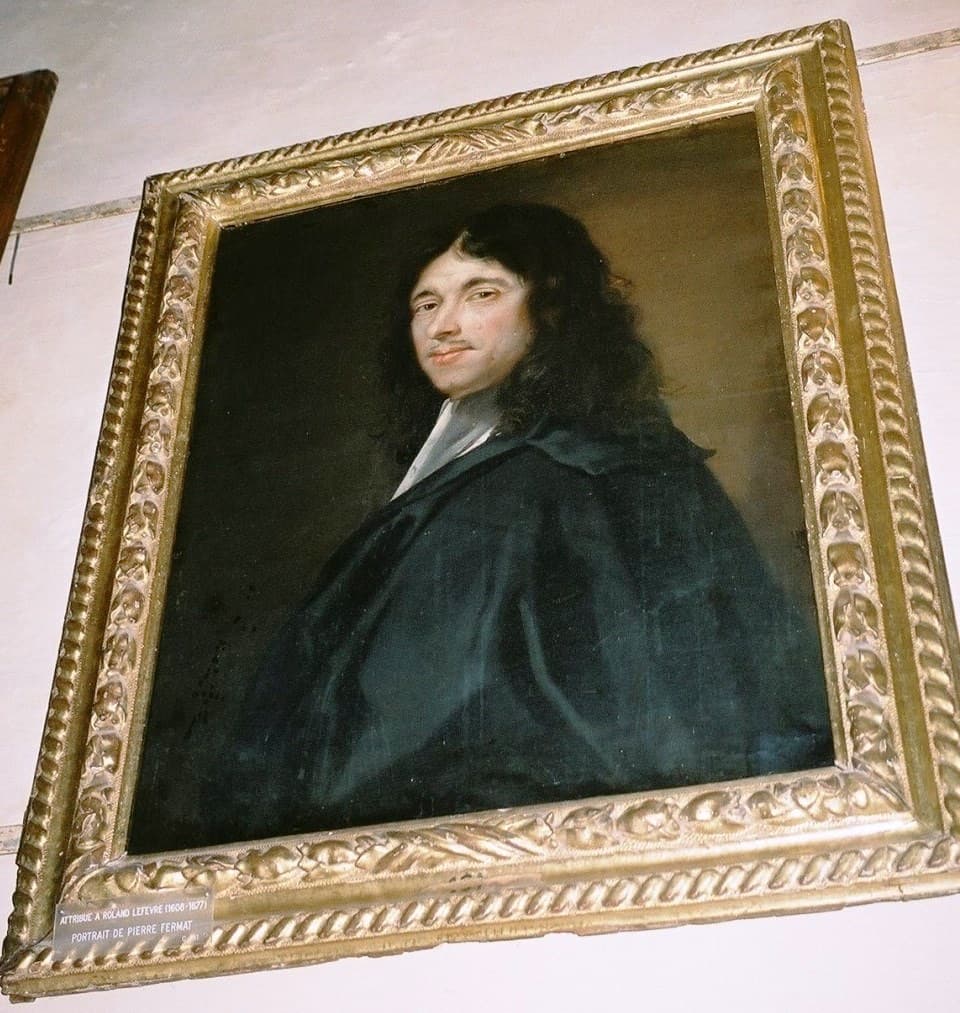
That morning, two fifth-graders on a discovery field trip push open the door of an old study in Toulouse. By candlelight, a magistrate in a black robe sets down his quill and smiles at them: Pierre de Fermat had been waiting for them.
—What was your real job, actually? Were you a math teacher?
Oh no, my child! By day, I was a counselor at the Parlement of Toulouse. Imagine a great court where disputes and crimes are judged. I wore a heavy black robe and a square cap, like all magistrates. I had even bought my office: in my time, you paid for such a position; it was called an office. In the afternoon, I deliberated on serious cases with my colleagues. Mathematics? That was my secret garden, my evening pastime. No one paid me for it. I did theorems as others do gardening.
Mathematics were my secret garden, not my profession.
—And in the evening, how did you do your math without light?
You know, evening fell and everything grew dark. Imagine a room with only one small flame: a tallow candle, made from fat, which smelled strong and smoked. I would settle into my study filled with books. By that flickering light, I covered sheets with calculations. And above all, I wrote long letters in Latin to other scholars across Europe. That's how I worked, hunched over my pages, late into the night. My eyes grew tired, but my mind danced with numbers.
A single candle, and a whole world of numbers before me.
—Is it true that you wrote something super important in the margin of a book?
It is absolutely true, and it still makes me smile! I had a book I loved, the Arithmetica by an ancient named Diophantus. One evening, near a calculation, I had a magnificent idea. But the margin, that little white border around the text, was too narrow. So I scribbled in Latin that I had a wonderful proof, but that "the margin is too small to contain it". I never thought it would cause such a stir! Scholars searched for that proof for 358 years, until a certain Andrew Wiles, long after my time.
The margin was too small to contain my proof.
—But why did you never publish your discoveries for real?
Ah, that's a good question, my child. You see, I hated disputes and honors. Imagine someone who finds a treasure but absolutely doesn't want to be applauded in the village square. That was me. I preferred to slip my discoveries into letters to my learned friends. It was a game, almost a challenge: 'Here is a puzzle, can you solve it?' Consequently, almost nothing was printed during my lifetime. My true works are my bundles of letters. Without them, I would have been forgotten entirely.
I hid my treasures in letters, not in books.
—Who did you write to? Did you have learned friends?
Yes! And the most precious was Blaise Pascal. In 1654, we wrote to each other to solve a curious puzzle. Imagine two players betting money. The game stops before the end: how to divide the stakes fairly? It was called the problem of points. Each on our own, Pascal and I found the answer. In a letter, I explained that one player should receive eleven parts out of sixteen. Without knowing it, we were inventing something brand new: the calculus of chances, what is now called probability.
Dividing the stakes of an interrupted game: that's how probability is born.
—Is that stuff about games useful in real life?
More than you think, my child! At first, Pascal and I were just talking about dice games and stakes. It seemed like mere amusement for idle people. But think: knowing how to measure what is probable, what has a chance of happening, is valuable for all of life. For merchants, for those who take risks, for understanding the uncertain future. Our little correspondence of 1654 on the problem of points opened a huge door. As often, you start by playing, and you end up discovering a serious truth.
You start by playing dice, you end up measuring the future.
—Did you have a rival? Someone who annoyed you?
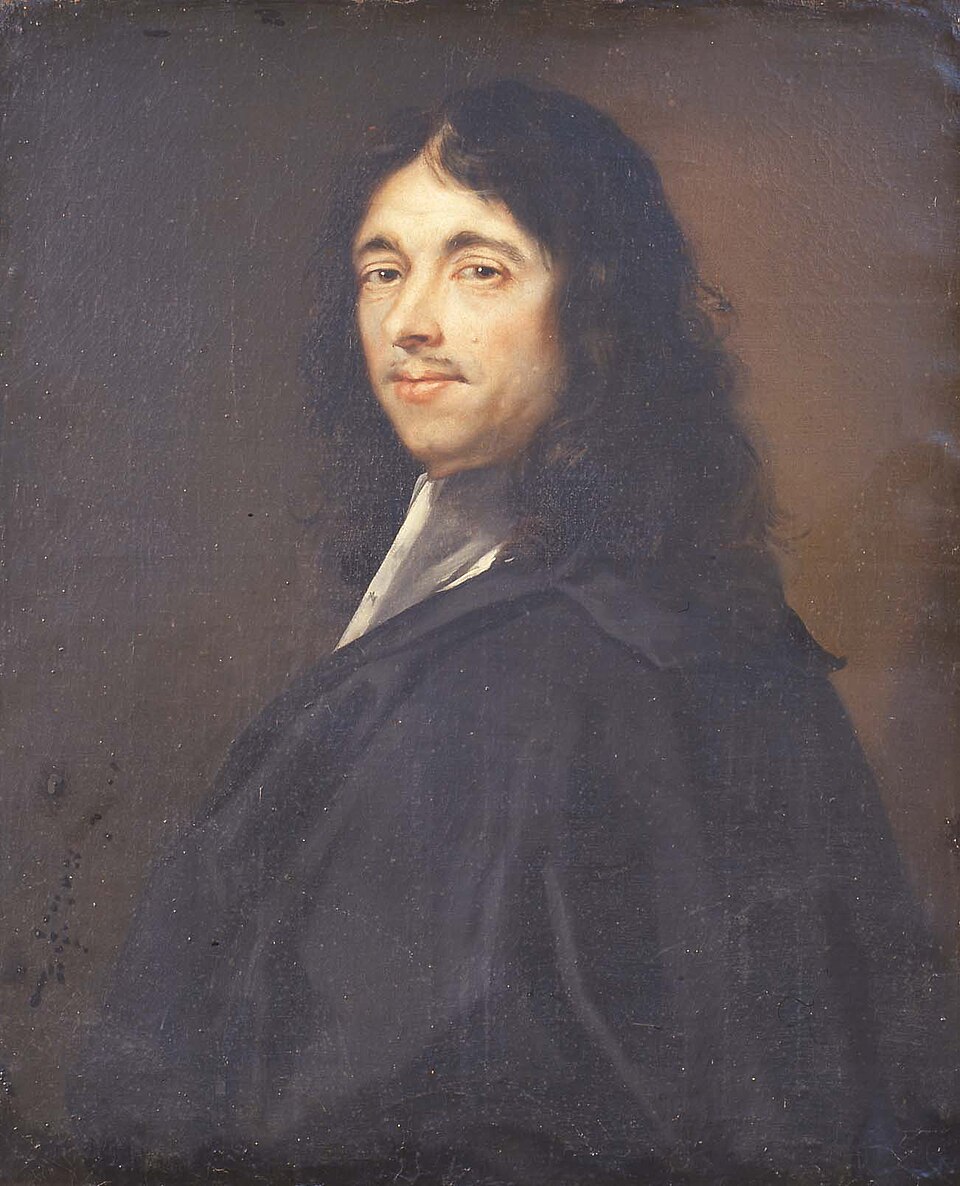
Ah... Descartes. A very great mind, but we did not get along at all! Imagine: we had each independently invented almost the same thing: a way to draw curves with equations. Descartes was jealous. He looked for errors in my work to belittle me. Our letters crossed, sometimes sharp! Everything passed through a good monk, Father Mersenne, nicknamed the letter box of Europe: he received our mail and forwarded it to everyone. All learned Europe followed our quarrel like a serial.
Two minds invent the same thing, and squabble their whole lives.
—How did correspondence between scholars work in your time?
It was slow and wonderful at the same time, my child. Imagine: no wire, no distant voice, nothing. Just sheets covered in ink, carried by horsemen on roads for weeks. For an idea to travel from Toulouse to Paris, you had to be patient. The heart of it all was Father Mersenne's cell in his Paris convent. He received letters from scholars everywhere and copied them for others. Thanks to him, even alone in my corner of the south, I conversed with the greatest minds of Europe.
An idea took weeks to travel, carried by a horseman.
—I heard you found something about light. Is that true?
Yes! And I am quite proud of it. In 1662, I asked myself a simple question: by what path does light travel between two points? And I understood something astonishing. Light does not necessarily take the shortest path, but the one that takes the least time! Imagine you run on sand and then in water: you don't go straight, you choose the fastest route. Well, light does the same, naturally. It is called my principle of least time. It is still taught today.
Light does not choose the shortest path, but the fastest.
—How did you find the shortest or fastest? Was there a trick?
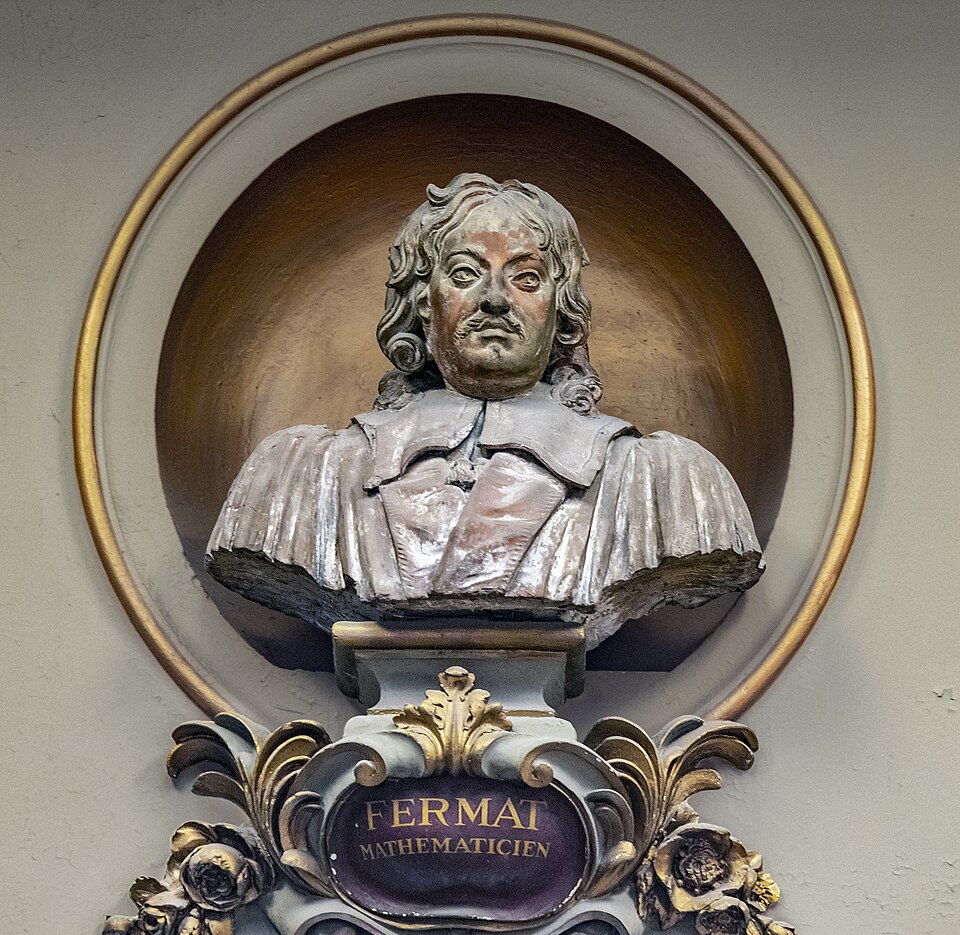
Yes, a trick I liked very much! I had invented a method to find the greatest or smallest of something: the maximum and minimum. Imagine a hill: I looked for the exact top point, where it no longer rises and does not yet descend. For that, I calculated the slope, the tangent, that line that grazes the curve at one point. Much later, two scholars named Newton and Leibniz admitted they were inspired by me to build a great mathematical tool. I had sown a small seed.
Finding the top of a hill: where it no longer rises.
—And what did you eat, you, an important gentleman like that?
Ah, we ate well in a counselor's home, my child! My table was plentiful, a sign of my rank. There was good wheat bread, white and soft, roasted meats like poultry or mutton, vegetables from my garden, and cheeses from Languedoc. And wine from the Toulouse region, of course! But the Church imposed fast days: on those days, no meat, we made do with fish, often dried or salted. I lived in a fine townhouse, a large multi-story house, with a study full of books.
White bread and Toulouse wine: a happy magistrate's table.
—If someone told you that today everyone knows your name, what would you say?
That would overwhelm me, my child. I who fled honors, I who hid my proofs in margins and letters... to know that young students like you still speak my name! My Last Theorem, scribbled one evening near Diophantus, kept the greatest minds busy for three and a half centuries. I did not foresee that. I would say this: never despise what you do for pleasure, in the evening, for yourself. My simple pastime has crossed the centuries. Your small passions today may be worth more than you think.
Never despise what you do for simple pleasure.
Read further
This imaginary interview was generated by artificial intelligence from sources documented in Pierre de Fermat's profile. It dramatises what the figure might have said based on what we know about them, but does not constitute attested historical testimony. For primary sources and factual documentation, refer to the full profile.