Imaginary interview with Rama
by Charactorium · Rama · Mythology · 5 min read
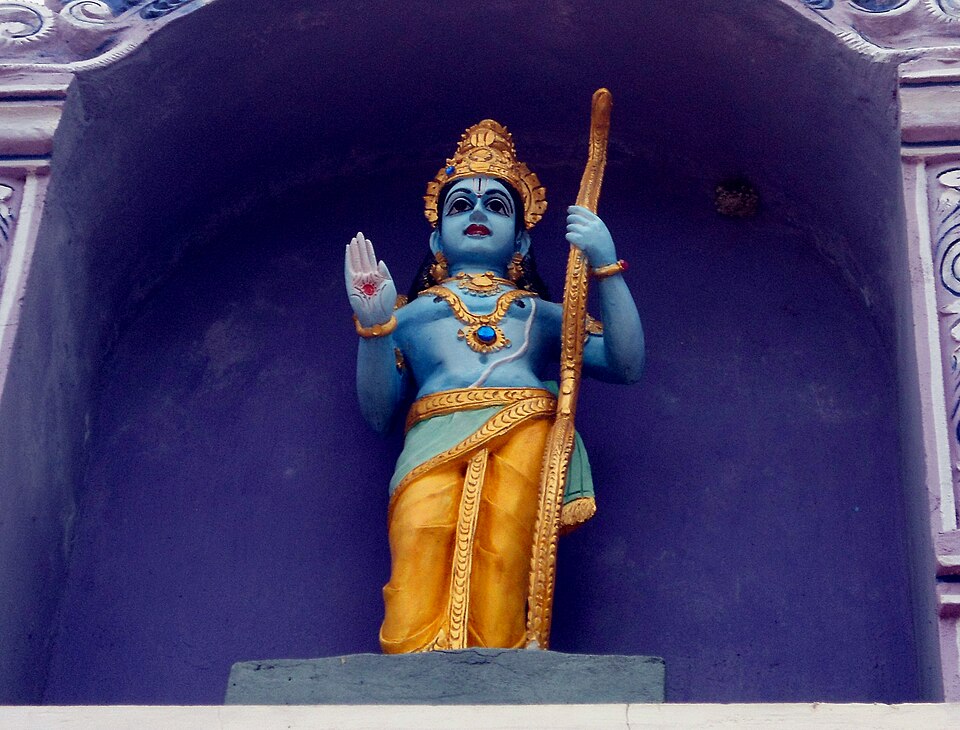
On the banks of the Sarayu, in the shadow of the terraces of Ayodhyā, he whom tradition calls the seventh avatar of Vishnu consents to speak. The sun declines over the kingdom he calls his own; the divine bow rests against a pillar. He has the calm voice of those who have obeyed, and walked, and conquered.
—How did you receive the news of your exile, you who were destined for the throne?
That very morning, they adorned me for the coronation. Then came the word of my father Dasharatha, bound by an ancient promise, and everything changed: not the scepter, but fourteen years in the forest. Understand me: a king who breaks his word breaks the order of the world. Dharma is not a chain worn with regret; it is the path on which one stands upright. I removed the silk, took the bark, and set out for the forest of Dandaka as one enters a temple. My father died of grief; I, in turn, gained the ability to look at myself. A son who saves his father's promise gives him back more than the throne.
A king who breaks his word breaks the order of the world.
—What did the forest teach you during those fourteen years?
The forest strips you bare. At Chitrakut, on the sacred mountain, I was no longer the prince of Ayodhyā but a man with his wife Sītā and his brother Lakshman as his only kingdom. People think asceticism is deprivation; it is rather a lightening. Where the palace surrounded me with ministers and counsels, exile returned me to hermits, to sages reciting the Vedas under the trees. There I learned that dharma is measured not by the grandeur of the setting but by the firmness of the heart when no one is watching. Rice shared on a leaf is worth a court banquet, if the hand that gives it is just. Those years were my true coronation.
People think asceticism is deprivation; it is rather a lightening.
—Do you remember the day the ocean stood before you, separating your army from Lankā?
The water stretched endlessly, and on the other side Sītā was captive in the kingdom of Rāvana. No ship, no ford. Then came Hanumān and his monkey people — those allies that men despise. Stone by stone, they built a bridge over the waves, which tradition calls the Rāma Setu. See the lesson: it was neither kings nor royal armies that opened the way for me, but creatures that pride would have cast aside. Good does not triumph alone; it relies on those unexpected ones. I crossed that bridge knowing that my victory would be theirs as well.
Good does not triumph alone; it relies on those unexpected ones.
—What did the battle against Rāvana represent to you, beyond the rescue of your wife?
People think I marched on Lankā out of love alone. Love was the spark, but the stakes went beyond a man and his wife. Rāvana had made might into right, abduction into custom; he had overturned order. To reclaim Sītā was to straighten a tilted world. On my war chariot, the Sharanga bow in hand, I was not shooting at a demon but at the reign of tyranny. The battle was long, the island trembled. When he fell, it was not my glory that arose, but dharma set right again. To free a captive or to free justice: for one who serves cosmic order, it is the same gesture.
To reclaim Sītā was to straighten a tilted world.
—The texts call you an incarnation of Vishnu. How does one live knowing they bear the divine?
One lives it without knowing it, most of the time. The sages say that Vishnu incarnated in me to defeat Rāvana and restore dharma; but at the moment, I was only a son who obeys, a husband who seeks, a king who doubts. Perhaps that is an avatar: not a god playing at being human, but a divinity who consents to human suffering to show the way from within. If I had gone through exile and war knowing myself invincible, what example would I have set? I wept for the loss of Sītā as any man weeps. Heaven, to teach mortals, had to bleed with them first.
Heaven, to teach mortals, had to bleed with them first.
—Why would a god choose to descend in a form as vulnerable as ours?
Because a command from on high does not touch the heart; a lived example does. The Purāna say that I came to destroy evil and show the path of virtue through my exile, my battle, my devotion as a son and husband. Yet one teaches courage only by facing what is fearful, nor fidelity by risking everything. If Vishnu had remained in his splendor, dharma would have remained a distant word. By taking flesh at Ayodhyā, he made it a path that human feet could follow. The divine makes itself small so that man, by imitating me, may become great.
The divine makes itself small so that man, by imitating me, may become great.
—Tell us about your bow, that weapon tradition calls divine.
The Sharanga is not a weapon for hunting or boasting. As a child, in the afternoon, when the sun weighed upon Ayodhyā, I practiced with the bow, the sword, the quiver — for a kshatriya prince who cannot protect does not deserve to rule. But this bow stretched more than a string: it stretched a responsibility. An arrow shot forgets nothing; it goes where justice sends it, or it stains the one who looses it. Versed in the Vedas as well as in arms, I learned that the hand that draws the bow must first have mastered its own heart. Strength without dharma is nothing but Rāvana's fury under another name.
An arrow shot forgets nothing; it goes where justice sends it.
—How do you reconcile the figure of the warrior and the sage that the texts praise in you?
They are thought opposites; they are the two hands of the same body. In the morning, I prayed at sunrise and sat in council; in the afternoon, I handled the bow and the war chariot. A kshatriya who studies only arms becomes a scourge; a sage who ignores defense leaves the weak to demons. Tradition calls me courageous, generous, just, and benevolent toward all beings — and I assure you that is harder on the battlefield than in the hermitage. To kill Rāvana without hatred, to conquer without pride: that is the test. The true warrior is not one who loves combat, but one who wages it reluctantly, to restore order, then lays down his arms.
The true warrior wages combat reluctantly, to restore order, then lays down his arms.
—Back in Ayodhyā crowned, what did you want to give your people?
Justice before splendor. Upon my return from exile, at last girded with the crown, I dreamed not of conquests but of a kingdom where the lowliest subject would sleep without fear. Tradition has named this reign the Rāma Rajya, the kingdom of Rāma, and I almost blush at it, for I only kept what a king must keep: grain in the granaries, the weak safe from the strong, the word above whim. The Mahābhārata calls me the best of kings; I would rather say the most diligent. To govern is not to rule over men, but to serve order before them. A throne is but a seat from which one watches over.
To govern is not to rule over men, but to serve order before them.
—What would you say to a king who, after you, wishes to deserve the name of just sovereign?
That he beware of his own comfort. At Ayodhyā, the palace offered me silk, ghee, evening banquets where ministers and visitors came — and that is precisely where the king loses himself, in the softness that lulls judgment. I knew bark before velvet; that kept me. Let a sovereign never forget that his word commits the world, as my father's word committed me for fourteen years. Let him prefer justice to the love of his people, for the people forgive the just and despise the complacent. And let him know to lay down the crown in his heart each evening: he who cannot imagine living without the throne is no longer worthy to sit upon it.
He who cannot imagine living without the throne is no longer worthy to sit upon it.
This imaginary interview was generated by artificial intelligence from sources documented in Rama's profile. It dramatises what the figure might have said based on what we know about them, but does not constitute attested historical testimony. For primary sources and factual documentation, refer to the full profile.