Imaginary dialogue between Hanumān and Rama
by Charactorium · Rama · Mythology · 5 min read
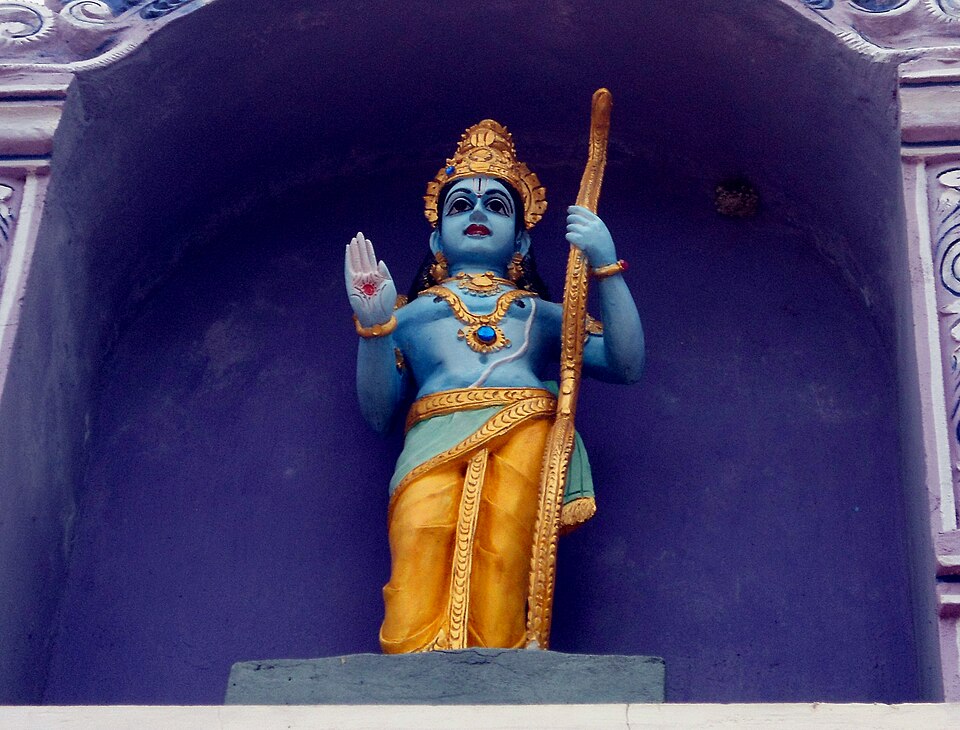
It is on the restored ramparts of Ayodhyā, at dusk, that Hanumān finds his lord Rāma some time after the coronation. The conch has sounded for evening devotions, and the scent of ghee from the lamps rises from the palace courtyards. The devoted monkey, who crossed the ocean and carried Rama on his shoulders in battle, comes to question him not as a subject but as a companion—one who has seen everything, from the forest to Lankā. He sits at his master's feet, his heart full, and listens.
—My lord, when King Dasharatha announced your fourteen-year exile, I was still far away. How could you leave the throne without a word of revolt?
Hanumān, my friend, there was nothing to conquer within me, for my father's word was already my own. An ancient promise bound him, and a son who loves his father does not let him become perjured for his own comfort. I took off my court garments, put on the bark of ascetics, and entered the forest of Dandaka as one enters a temple. Dharma is not a chain to be endured: it is the straight road one chooses when all others are smoother. The throne would wait for me or not; my duty, however, did not wait.
Dharma is not a chain to be endured: it is the straight road one chooses when all others are smoother.
—Fourteen years under the trees of Chitrakut and Dandaka—you, the prince of Ayodhyā. What did the forest teach you that the palace could not?
The forest stripped me of everything that was not essential. At the palace, I was surrounded by ministers, servants, the murmur of power; under the trees, only Sītā, my brother Lakṣmaṇa, and the sky remained. I shared the bread of hermits and the humble, I heard the sorrows of those the court never listens to. A king who has not known destitution rules over shadows. When I returned, I knew the price of a grain of rice and the weight of an injustice. Exile was not a punishment, Hanumān: it was my apprenticeship of the true kingdom.
A king who has not known destitution rules over shadows.
—You have often shown me the divine bow Sharanga. Was this weapon given to you for power, or for something else?
A weapon in an unjust hand is just one more misfortune, my faithful one. Sharanga was not given to me to subdue, but to protect those who cannot defend themselves. From childhood, as a kshatriya prince, I devoted my afternoons to the bow, the sword, the quiver—not out of love for war, but because a warrior who ignores his craft betrays those he claims to guard. The string I draw is never bent in anger. It aims at the demon, the oppressor, the disorder—never at the weak. Strength in the service of dharma, that is the only strength that counts.
A weapon in an unjust hand is just one more misfortune.
—My lord, the day Rāvana kidnapped Sītā, I was not yet by your side. When you discovered the empty hermitage, what did you feel?
Hanumān, it was as if the forest itself had fallen silent. I called her name among the trees, I questioned the deer and the rivers, and the world did not answer me. For a moment, I confess to you alone, the prince and the avatar faded away, and only a husband with a torn heart remained. But despair is a luxury that duty forbids. I dried my tears and sought allies—and that is how your path and mine crossed. Without you and the monkey people, I would never have found her trace beyond the seas.
Despair is a luxury that duty forbids.
—Do you remember, lord, when we built the bridge to Lankā—stone by stone across the ocean? Did you ever doubt that my monkey people could accomplish such a thing?
Doubt you, Hanumān? Never. The world believed that an army of monkeys and bears was worthless against Ravana's legions; I saw hearts harder than stone. Each rock you threw into the waves bore a name, a prayer, a devotion. That bridge, the Rāma Setu, was not the work of my will alone: it was built by the love of those who followed me expecting nothing in return. Men will remember the battle of Lankā as a triumph of arms. I know it was first a triumph of loyalty—yours above all.
That bridge was not the work of my will alone: it was built by the love of those who followed me expecting nothing in return.
—When you finally faced Rāvana himself on the field of Lankā, did you see him as an enemy to hate, or something else?
I never hated Ravana, my friend. He was learned, powerful, even devout in his own way—and that makes his fall more terrible. Evil is not always a crude monster: sometimes it wears a crown and recites the Vedas. Ravana had let his pride devour his wisdom, and no rank protects from that ruin. In fighting him, I was not destroying a being: I was restoring the order he had broken by abducting a virtuous wife. My arrow did not aim at the man, but at the disorder he had become. That is victory according to dharma.
Evil is not always a crude monster: sometimes it wears a crown and recites the Vedas.
—Lord, I who have served you body and soul, I humbly ask: do you know in yourself that you are Vishnu descended to earth, or do you live as a simple man?
You ask the question no one else would dare, Hanumān, and that is why I love you. The wise say I am the seventh avatar of Vishnu, come to restore dharma and strike down Ravana, and that the divine took flesh to walk among you. But if I had believed myself a god at every step, would I have wept for Sita? Would I have known the hunger of exile? Incarnation is not a comedy: to save humans, the divine accepts being fully human. I live my duty as son, husband, king—and it is by fulfilling it completely that the cosmic order is restored through me.
To save humans, the divine accepts being fully human.
—The ascetics repeat that your coming was to restore the cosmic order. Does this immense burden, lord, not weigh too heavily on a single life?
The burden only crushes those who carry it alone, Hanumān. Yet I was never alone: Lakṣmaṇa, Sītā, you, the forest people—each bore their part of the world's order. The balance of the cosmos does not rest on one divine arm; it rests on a thousand just deeds performed each day by humble hearts. My role was not to lift the sky, but to show the straight road and follow it without deviation, so that others might walk it after me. The divine does not impose order from without: it awakens it within each one. That is the true restoration.
The balance of the cosmos does not rest on one divine arm; it rests on a thousand just deeds performed each day.
—Now you are crowned, lord, and the people already speak of a Rāma Rajya, an ideal reign. What kingdom do you wish to build for Ayodhyā?
A kingdom where the humblest subject sleeps without fear—that is my whole desire. What use is a palace of stone and gold if a single unjust tear flows in its streets? I have known exile; I govern remembering the humble I met under the trees. Justice is not a favor from the king: it is a debt he owes to everyone. Let grain be abundant, let the judge be upright, let no one suffer from the whim of the powerful. If one day the Rāma Rajya is remembered, let it be not for my glory, but for the peace of the least of my people.
Justice is not a favor from the king: it is a debt he owes to everyone.
—One last question, my lord. Of all your trials—exile, war, the throne—which one most forged the king you are today?
Each was a teacher, Hanumān, but it was exile that made me a king before the crown. The throne gives power; the forest gave me the heart to use it justly. War showed me the price of disorder, and your loyalty taught me that no one rules alone. Today, when I dispense justice in this hall, I forget neither the cold of the nights in Dandaka, nor the tears shed for Sītā, nor the rocks you hurled into the ocean. A king who forgets his trials becomes a tyrant. I keep them alive, to remain worthy of those who followed me.
The throne gives power; the forest gave me the heart to use it justly.
This imaginary interview was generated by artificial intelligence from sources documented in Rama's profile. It dramatises what the figure might have said based on what we know about them, but does not constitute attested historical testimony. For primary sources and factual documentation, refer to the full profile.