Imaginary dialogue between Baldassare Castiglione and Raphael
by Charactorium · Raphael (1483 — 1520) · Visual Arts · 6 min read
It is in the patrician residence of the Borgo, a stone's throw from the Vatican, that Baldassare Castiglione meets his friend Raphael on an autumn afternoon in 1518. The smell of turpentine and fresh plaster still hangs in the studio, where half-rolled cartoons lean against the walls. The two men have known each other since the years in Urbino and the court of the Montefeltro, and Castiglione, his pen always busy with his Book of the Courtier, comes to capture, behind the prince of arts that Rome admires, the man who still paints faces himself. He settles near an easel where an unfinished Madonna is drying.
—My dear Raphael, you were only twenty-five when Julius II called you here. You who had never touched a fresco, what did you feel before those bare walls?
You who know my former shyness, Baldassare, you can guess my agitation. I arrived from Florence in 1508, still steeped in wooden panels and gentle Madonnas, and they entrusted me with the pope's very apartments. I had never covered an entire wall with fresh plaster. The Holy Father, seeing my first attempts in the Room of the Signature, ordered that what the other masters had painted be torn down to leave me the whole ensemble. Imagine my terror as much as my pride! I learned fresco on the scaffolding itself, correcting as I went, understanding that the wall forgives nothing: once dry, the plaster holds the mistake forever. It was there, in that urgency, that I found myself as a painter.
I learned fresco on the scaffolding itself: the wall forgives nothing.
—In that Room, you gathered all the sages of antiquity around Plato and Aristotle. Why this dream of philosophers rather than a sacred scene?
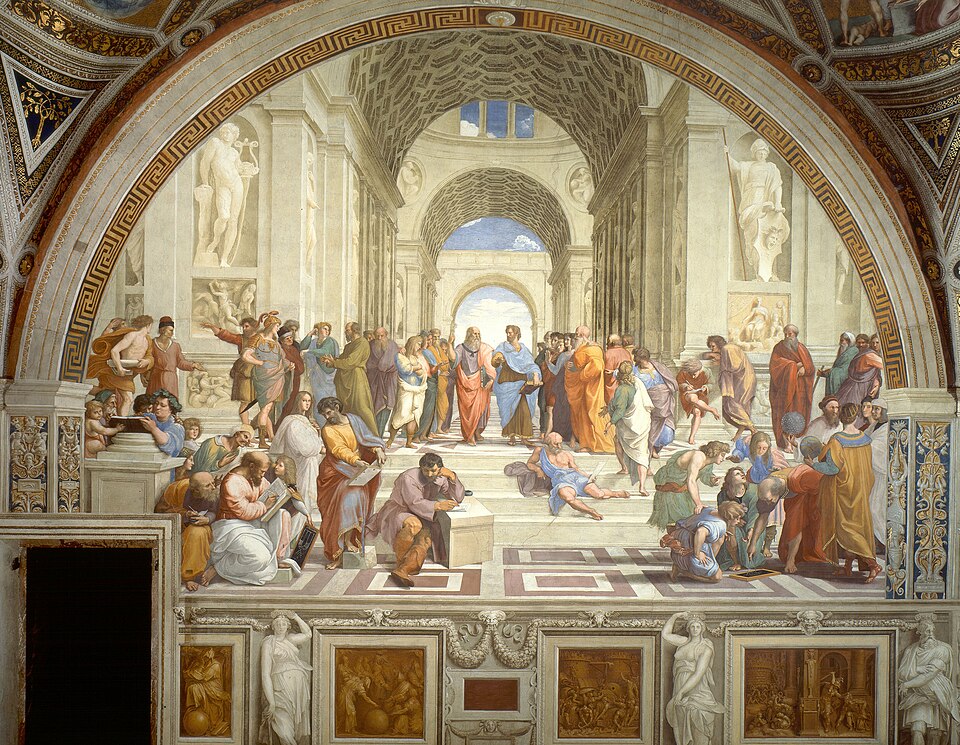
Because the place demanded it, my friend. The Room of the Signature was to show the harmony of human wisdom and faith, and they wanted, on that wall, the triumph of philosophy. I built a great portico in the manner of the Ancients, open to the sky, and I arranged the minds of Greece there as one arranges chords in harmony. Each has his gesture: one points to the earth, the other to the sky. I wanted the eye to move smoothly, from the center to the wings, as in a beautiful conversation where no one shouts. The School of Athens is not a learned lesson: it is the image of a world where reason and beauty hold together.
I arranged the minds of Greece there as one arranges chords in harmony.
—Before Rome, you had spent years in Florence. When you wrote to me then, you spoke constantly of Leonardo and Buonarroti. What do you owe them?
Everything that made me grow, Baldassare. When I arrived in Florence around 1504, I had just left the workshop of Perugino, sweet but frozen in his formulas. There, I discovered Leonardo's figures, those faces drowned in a vaporous shadow, that sfumato that softens contours to leave only grace. And Michelangelo taught me, without meaning to, the strength of the body in motion, the science of muscles and twists. I took from one his sweetness, from the other his power, and I tried to fuse them into a measure that was my own. My La Belle Jardinière, painted in 1507, was born from these lessons: a Virgin in a pyramid, calm, set in a clear landscape. I was not copying; I was seeking the balance between two geniuses too great to reconcile with each other.
I took from one his sweetness, from the other his power, and I tried to fuse them.
—You speak of balance as one speaks of virtue. That measure I admire in your Madonnas—do you seek it first in yourself or in your models?
In both, and that is the whole secret. You remember what I wrote to you about beauty: to paint a beautiful woman, one would need to see several, but beautiful women are rare and good judges even rarer. So I use a certain idea that comes to my mind, nourished by what my eyes have retained. I draw incessantly, in red chalk, in black stone, a thousand studies of hands, drapery, gazes. Then I choose, I discard, I compose. Nature gives the pieces; the mind gives the harmony. A Madonna is never a single woman: it is the grace I glimpsed in many, gathered into a single face so that it may never fade.
Nature gives the pieces; the mind gives the harmony.
—You are seen crossing Rome followed by a veritable court of pupils, like a lord. This large workshop—is it a burden or a strength, my friend?
A strength, but a strength that must be governed like a small court, you who know the art of leading men. My bottega counts dozens of hands: engravers, fresco painters, pigment grinders, young draftsmen from all over Italy. In the morning, I pass among them, I distribute tasks, I correct sketches, I redo a poorly draped fold. The Loggia of the Vatican, those fifty-two scenes from Scripture, I could not have done them alone: I give the design, the invention, the arrangement, and my disciples execute under my eye. But the faces, the hands, what carries the soul of a work, I keep for myself. Directing so many men means ensuring that my spirit remains in every stone, even those I have not touched.
I ensure that my spirit remains in every stone, even those I have not touched.
—This way of running such a large workshop—isn't it a form of that ease we often speak of, where effort hides under grace?
You catch me at my own game, Baldassare! It is indeed the sprezzatura you describe in your pages, that ease which conceals effort. The world believes my frescos are born without labor, as if by magic, because they appear effortless to the eye. But behind every figure lie a hundred drawings thrown down, reworked, torn up. The cartoon for The School of Athens cost me weeks before a single color touched the wall. If the effort showed, the work would be heavy; I want it to breathe, to seem to flow from a spring. Perhaps that is where we resemble each other, you with your pen and I with my brush: we hide the sweat to show only calm.
If the effort showed, the work would be heavy; I want it to breathe.
—Since Leo X made you prefect of antiquities, I see you walking the ruins more than the construction sites. Where does this passion for dead Rome come from?
From anger as much as from love, my friend. Walking through the city, I see every day temples, porticoes, arches reduced to stone quarries to build new walls. They burn ancient marbles to make lime! I wrote to the Holy Father to tell him my sorrow: how many pontiffs have let these testimonies of Rome's greatness perish. The pope entrusted me with drawing up the plan of the ancient city, street by street, monument by monument, as it once was. I rely on Vitruvius, I measure, I survey, I reconstruct. Saving these stones is saving the memory of a people who knew how to build better than we do. A painter is not only a creator: he can also be one who prevents destruction.
They burn ancient marbles to make lime!
—You call yourself painter, architect, and now you become a guardian of ruins. How do you bear, alone, so many trades that others share?
By believing they are one, Baldassare. Disegno, drawing, is the common root of all: painting, raising a building, surveying an ancient temple—everything starts from the same hand that conceives in the mind before tracing on paper. Since Bramante's death, I have directed the construction of St. Peter's, and I see no break with my painting: the same measure, the same concern for harmony governs a painted wall and a dome. The Ancients did not separate these arts. When I measure a ruined portico, I learn to build; when I build, I better understand the perspective of my frescos. Everything is connected. I do not feel torn: I serve a single beauty under different faces.
Disegno is the common root of all: everything starts from the same hand that conceives before tracing.
—Whispers in Rome speak of a young woman from Trastevere, a baker's daughter, whose face appears in your Madonnas. Will you tell me about her in confidence?
To you, who will not carry it to the square, I gladly confide. It is true that a woman holds a place in my life that the world guesses and I do not deny. Her face, yes, I have lent it to more than one Virgin, for I find in it that sweetness I seek everywhere without always meeting it. Patrons press me to take a wife, they even speak of an advantageous marriage, but my heart drags its feet. Painting a Madonna, you see, is also painting a tenderness one has known, transfiguring it, making it eternal and pure. I will not say her name here; but whoever looks closely at my angels and mothers may see a bit of her, and a bit of me.
Whoever looks closely at my Madonnas may see a bit of her, and a bit of me.
—You are now working on that great Transfiguration, divided between the glory above and the tumult below. What are you seeking in this new work, my friend?
To gather everything, perhaps, in a single painting. Above, Christ rises in light, calm, glorious; below, the apostles stir, helpless before the possessed child brought to them. I wanted to contrast the peaceful heaven with the turmoil of men, and to link these two worlds through gestures, upward gazes, arms stretched toward the top. It is a more vehement work than my Rooms, more ardent: I feel I must go beyond mere harmony, toward a force that seizes the soul. I do not know if I will have time to complete it as I dream it. But if I were to leave a final word as a painter, I would want it to be this: the passage from shadow to light.
I wanted to contrast the peaceful heaven with the turmoil of men.
This imaginary interview was generated by artificial intelligence from sources documented in Raphael's profile. It dramatises what the figure might have said based on what we know about them, but does not constitute attested historical testimony. For primary sources and factual documentation, refer to the full profile.