Imaginary interview with Raphael
by Charactorium · Raphael (1483 — 1520) · Visual Arts · 6 min read
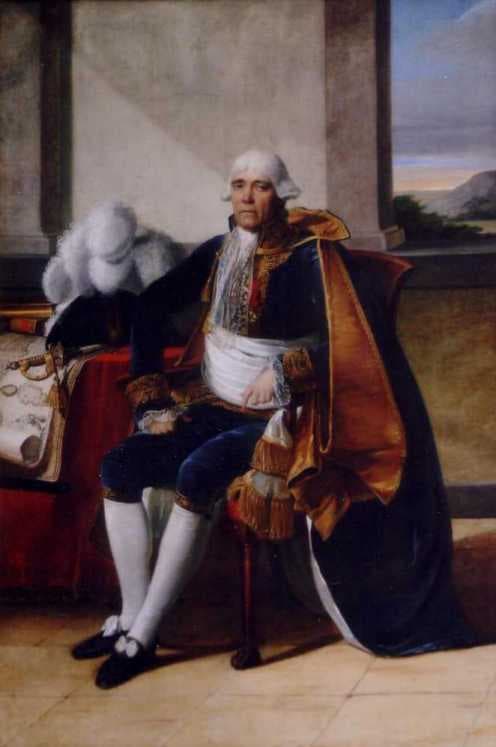
Rome, one morning in the year 1519. In a dwelling in the Borgo, a stone's throw from the Vatican, the air smells of fresh lime and varnish. Amidst scattered sketches and rolled-up cartoons leaning against the walls, a thirty-six-year-old man receives us with princely courtesy — Raphael of Urbino, painter to the pope, architect of St. Peter's and guardian of the ruins of Rome.
—How did a young man barely twenty-five find himself painting the pope's private apartments?
I was summoned from Urbino to Rome in 1508, and at that time I had never laid a hand on a large wall fresco. Imagine my astonishment: Julius II wanted me to decorate his own rooms, where other masters had already begun. I trembled, I admit. Then the pope, seeing what I had sketched, ordered the old decorations to be torn down to entrust the whole to me. I immediately wrote to my uncle Simone Ciarla that I was living here in great honor, in good health, and that Our Lord the pope was very pleased with me. Consider what that meant for the son of a modest court painter: they preferred me to older, more established men, and erased their work for mine.
The pope ordered the old decorations to be torn down to entrust the whole to me — I was twenty-five.
—Tell us about that fresco where you gathered all the sages of antiquity.
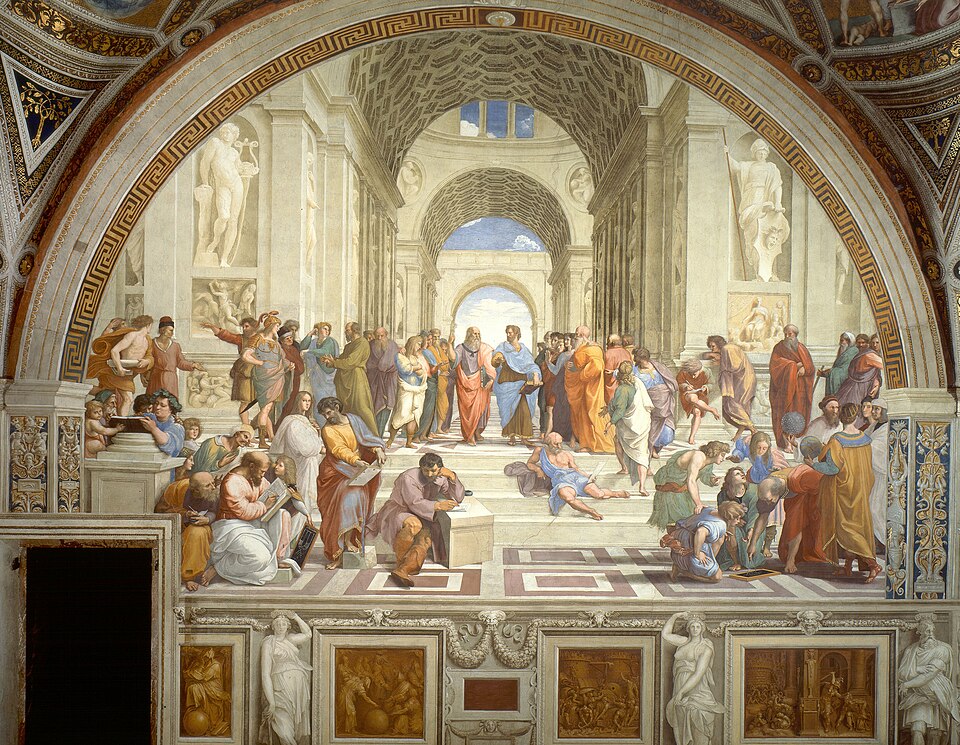
You are speaking of The School of Athens, which I painted between 1509 and 1511 in the Room of the Signature. I wanted to gather the great minds of the Ancients under a vast vault, Plato pointing upward to the sky, Aristotle with his hand extended toward the earth — one dreaming of ideas, the other weighing things. Before touching the wall, I drew a full-scale cartone, that large drawing on paper that you prick and dust to transfer the figures onto the fresh plaster. The fresco forgives nothing: you must paint quickly, while the lime is still wet, for once dry it holds the pigment for eternity. Every line converges to a single point, as if reason itself ordered the space.
The fresco forgives nothing: you must paint while the lime is still wet.
—What does this preparatory work mean to you, these drawings that the public never sees?
The public admires the finished wall, but the work is born long before, on paper. I cover entire sheets in sanguine and black stone, studying a drapery, a hand, the tilt of a neck, until the form seems true to me. The cartone of The School of Athens — now preserved in Milan — bears the traces of these gropings. For me, disegno is not just the line: it is the thought of the work, its inner skeleton before color. A painter who neglects his drawings builds on sand. I learned this long ago in Florence, watching Leonardo blur his contours and Michelangelo sculpt his bodies: everything starts from an idea that the hand pursues before the brush fixes it.
Disegno is not the line: it is the thought of the work before color.
—They say you walk through Rome followed by a veritable court. What is the truth of it?
They exaggerate, yet they are not entirely wrong. My bottega is one of the largest in Rome: dozens of hands work under my direction, and when I go out, many accompany me — pupils, assistants, friends come to see the progress of the works. Good Vasari will later say that I moved like a prince surrounded by his retinue — he is not wrong about the number. But understand: without this workshop, I would never have managed simultaneously the Rooms, the Vatican Loggia, the Farnesina and St. Peter's. A master alone cannot cover so many walls. I distribute the sketches in the morning, I reserve for my own hand the faces and draperies, and I correct in the evening. It is not a court: it is a great body that paints with many arms.
It is not a court: it is a great body that paints with many arms.
—What does an ordinary day in your Borgo workshop look like?
I rise early, sometimes I hear mass in one of the neighboring churches, then I go to my bottega here in the Borgo, in the shadow of the Vatican. The morning belongs to others: I examine what my assistants have advanced, I distribute tasks, I correct a sketch that is too loose. The afternoon is mine — I paint what no one must touch: the faces, the hands, the fall of a fabric. I also climb the scaffolding to supervise the laying of the frescoes and converse with the humanists who pass by. In the evening, I often dine with my friend the banker Agostino Chigi at the Farnesina, among poets and cardinals. They say I am a good talker; I think above all that I love men as much as painting.
The morning belongs to others; the afternoon is mine.
—The pope entrusted you with the guardianship of Rome's antiquities. What did this charge awaken in you?
Leo X appointed me guardian of antiquities around 1515, and this charge moved me more than I expected. Walking through Rome, I saw temples, arches, porticoes torn down stone by stone to build new walls — ancient grandeur reduced to rubble and lime. I wrote to the pope to beg him to put an end to it. I reminded him how many pontiffs before him had allowed these works, these temples, these porticoes to be ruined, and that these beautiful things deserved to be preserved as testimonies to the greatness of Rome. A painter is not just a maker of images: he has eyes to see what others trample. Saving an ancient column is saving a lesson in beauty for those who will come.
Ancient grandeur reduced to rubble: a painter has eyes to see what others trample.
—You are working on a plan of ancient Rome. How does one resurrect a vanished city?
That is the work that occupies me now, at the request of Leo X: to draw up the topographical plan of ancient Rome, street by street, monument by monument, and accompany it with a letter explaining my method. I rely on old Vitruvius, that De architectura which is our breviary, and on the surveying of the ruins still standing. With compass and square, I measure what remains, I guess what is missing, I restore lost proportions. Consider: no one had yet attempted to draw the city of the Caesars as a coherent whole. This is no longer just painting: it is giving life back to stones, reading in a fragment of cornice the entire building. If God grants me life, I want Rome to be seen as it once was.
With the compass, I measure what remains and I guess what is missing.
—You painted the portrait of your friend Castiglione. What did you seek to capture in him?
Baldassare Castiglione is one of those friends with whom one thinks aloud. In painting him, around 1514, I wanted neither brilliance nor pomp: grays, muted blacks, deep velvet, and above all the gaze — all the dignity of a man lies in his eyes when you know how to paint them. He preaches this sprezzatura, the art of appearing effortless while hiding the effort, of seeming that everything comes to you without trouble. That is also my wish in painting: that difficulty never be seen. We exchanged ideas on beauty, and I once confided to him that, lacking enough beautiful women to contemplate and good judges to guide me, I use a certain idea that comes to my mind. The portrait was born from those conversations.
All the dignity of a man lies in his eyes, when you know how to paint them.
—They say the same woman's face appears in several of your Madonnas. Who is she?
People gossip a lot in Rome, and they are not always wrong. There is a woman, Margherita Luti, daughter of a baker from Trastevere, nicknamed la Fornarina. Her face, I admit, slips into more than one of my Virgins, and into a portrait that bears that nickname. But do not think I copy a single flesh: when I seek beauty, no living model suffices. That is why I trust that certain idea I spoke of — I take a forehead here, a gaze there, a sweetness elsewhere, and from several women I compose one that exists nowhere. Margherita lends her features, but the Madonna is born from the mind as much as from the eyes. Love and painting, in me, feed on the same fire.
Margherita lends her features, but the Madonna is born from the mind as much as from the eyes.
—After so many frescoes, the pope also appointed you architect of St. Peter's. How do you bear so many responsibilities at once?
Upon the death of Bramante in 1514, I was given charge of the St. Peter's basilica — me, at thirty-one. I confess that at night, sometimes, the weight crushes me: painting the Rooms, directing the Loggia, surveying ancient Rome, and building the greatest temple of Christendom. But I believe the arts are but one language. The compass that traces a church plan is the same that orders the perspective of a fresco; disegno governs both. There is endless debate over which prevails — painting, sculpture, or architecture — this paragone that scholars love. As for me, I try to hold them all with one hand, not out of pride, but because they seem inseparable to me.
The arts are but one language: the compass that traces a church also orders the fresco.
This imaginary interview was generated by artificial intelligence from sources documented in Raphael's profile. It dramatises what the figure might have said based on what we know about them, but does not constitute attested historical testimony. For primary sources and factual documentation, refer to the full profile.