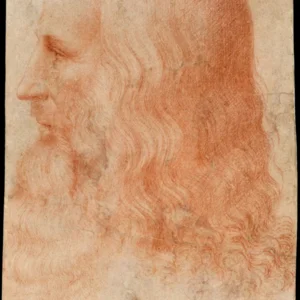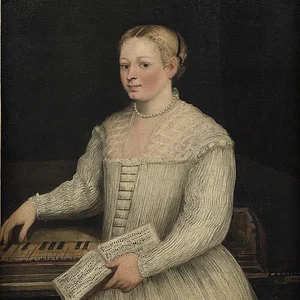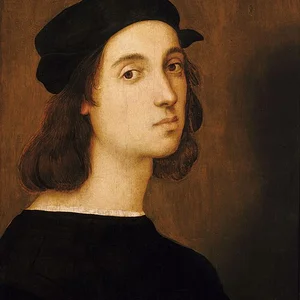

Italian painter and architect of the Renaissance (1483–1520), Raphael is one of the great masters of the Italian Renaissance. He is celebrated for his harmonious compositions, his Madonnas, and his monumental frescoes, most notably The School of Athens in the Vatican.
Raphael(1483 — 1520)
Raphael
Saint-Empire romain germanique
8 min read
Frequently asked questions
Key Facts
- 1483–1504: Training in Urbino under his father Giovanni Santi, then apprenticeship with Perugino
- 1509–1511: Creation of The School of Athens, a landmark fresco in the Apostolic Palace at the Vatican
- 1514: Appointed chief architect of St. Peter's Basilica in Rome
- 1515–1520: Direction of his Roman workshop, fulfilling numerous papal and aristocratic commissions
- 1520: Untimely death in Rome at age 37; buried in the Pantheon
Works & Achievements
A monumental fresco in the Stanza della Segnatura in the Vatican, depicting the great philosophers of Antiquity gathered around Plato and Aristotle. An absolute masterpiece of classical composition and perspective, it embodies the humanist ideals of the Renaissance.
A large painting commissioned for the church of San Sisto in Piacenza, depicting the Virgin Mary holding the Christ Child, flanked by Saint Sixtus and Saint Barbara. It is famous for the two pensive angels at the bottom of the canvas, which have become one of the most reproduced images in the history of art.
A painting on wood depicting the Virgin and Child with the young Saint John the Baptist in an open landscape. It showcases Raphael's masterful command of pyramidal compositions and the gentle Florentine style he developed during his time in Florence.
A portrait of the author of The Book of the Courtier, a close friend of Raphael. Regarded as one of the greatest portraits of the Renaissance, it combines chromatic restraint, psychological depth, and aristocratic dignity.
Raphael's final major work, left unfinished at his death. Divided into two dynamic registers — the glory of the transfigured Christ above and the turmoil of the apostles below — it foreshadows the Baroque style through its dramatic intensity.
A Vatican gallery decorated by Raphael and his workshop with grotesque ornaments and fifty-two biblical scenes, known as 'Raphael's Bible.' This vast decorative program reflects his management of a large workshop and his role as artistic director.
A cartographic project commissioned by Pope Leo X to produce a topographic map of ancient Rome, accompanied by a theoretical letter to the pope. This pioneering work makes Raphael a forerunner of modern archaeology and heritage preservation.
Anecdotes
Raphael died on April 6, 1520 — his 37th birthday and Good Friday. His sudden death, following a brief fever, plunged Rome into dismay: Pope Leo X wept upon hearing the news, and Raphael's body was laid out in his studio, surrounded by his last unfinished works.
Raphael was renowned for his extraordinary charm and sociability. The historian Giorgio Vasari records that he would walk through the streets of Rome accompanied by a retinue of some fifty assistants, apprentices, and admirers — a true prince of the arts.
In 1515, Pope Leo X appointed Raphael 'Prefect of Antiquities' for Rome. He wrote a passionate letter to the pope denouncing the destruction of ancient monuments being plundered for their building stone, making him one of the earliest advocates for the preservation of cultural heritage.
Raphael reportedly had a lasting relationship with Margherita Luti, the daughter of a baker from Trastevere, nicknamed 'La Fornarina.' Her face appears in many of his Madonnas and in a celebrated portrait that bears her nickname, now held in the Borghese Gallery in Rome.
At just 25 years old, having never before painted a monumental fresco, Raphael was summoned to Rome by Pope Julius II to decorate his private apartments in the Vatican. He carried out the work with such mastery that Julius II ordered the existing decorations destroyed so that Raphael could take charge of all the Rooms.
Primary Sources
How many popes, Holy Father, who have occupied the same seat as yourself, have allowed the ancient works to be ruined — the temples, the porticoes… These beautiful things deserve to be preserved as testimony to the greatness of Rome.
Nature, conquered by art in Buonarroti, was almost conquered by art and grace together in Raphael of Urbino; for this artist possessed all the rare qualities that are ordinarily divided among several men.
To paint a beautiful woman, I would need to see several beautiful women, but since there are few beautiful women and few good judges, I make use of a certain idea that comes to my mind.
I live here in great honour and enjoy good health. I have begun working in the Rooms of the Pope, which are the finest works in Rome, and Our Lord the Pope is very pleased with me.
Key Places
Raphael's birthplace, an exceptional artistic hub under the court of the Dukes of Montefeltro. It was in this humanist and refined atmosphere that he received his earliest artistic influences.
The city where Raphael trained in Perugino's workshop from around 1499 to 1504. There he learned the fundamentals of harmonious composition and the gentle expressiveness that would come to define his style.
Raphael lived here from 1504 to 1508, studying the works of Leonardo da Vinci and Michelangelo. This period profoundly transformed his mastery of anatomy, movement, and sfumato.
The centerpiece of Raphael's Roman career, where he painted his most celebrated frescoes for the papal apartments of Julius II. The School of Athens stands as the pinnacle of his monumental art.
The villa of banker Agostino Chigi, for which Raphael and his workshop painted magnificent mythological frescoes, including The Triumph of Galatea. This commission showcases his talents as a decorator for a secular clientele.
Typical Objects
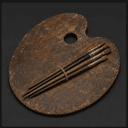
Raphael's everyday tools, made from sable or badger hair. He wielded them with a precision and fluidity that amazed his contemporaries.
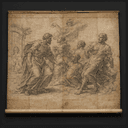
A large full-scale preparatory drawing on paper, used to transfer compositions onto the fresh plaster of a wall. The cartoon for The School of Athens is preserved at the Biblioteca Ambrosiana in Milan.
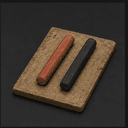
Raphael's favorite drawing techniques for his studies of figures and drapery. He left behind hundreds of preparatory drawings of extraordinary quality.
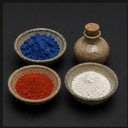
The raw materials of Renaissance painting, some extremely costly — such as lapis lazuli from Afghanistan, which yielded ultramarine blue. Raphael used them with an unrivaled mastery of mixing and glazing techniques.
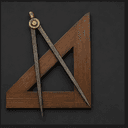
Essential instruments for Raphael in his role as chief architect of St. Peter's Basilica. He also used them to construct the mathematical perspective underlying his large painted compositions.
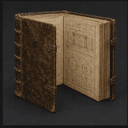
The De architectura by the Roman engineer Vitruvius was the theoretical reference for Renaissance architects. Raphael drew directly from it for his architectural projects and for his reconstruction of ancient Rome.
School Curriculum
Vocabulary & Tags
Key Vocabulary
Tags
Époque
Mouvement
Daily Life
Morning
Raphael began his day early, sometimes attending Mass in one of Rome's many churches. He would then make his way to his bottega in the Borgo, near the Vatican, where he reviewed the progress of his numerous assistants and pupils, assigned tasks, and corrected preparatory sketches.
Afternoon
Afternoons were devoted to the most delicate parts of his paintings, which Raphael executed himself — faces, hands, and drapery above all. He regularly visited the Vatican worksites to oversee the laying of frescoes and to meet with his papal patrons or the humanist scholars who came to visit his studio.
Evening
In the evenings, Raphael moved in Rome's intellectual circles, taking part in conversations among scholars, poets, and learned cardinals. He often dined with patrons such as the banker Agostino Chigi, and was renowned for his gift for conversation, his courtesy, and his natural charm.
Food
The Roman table of the Renaissance offered white bread, vegetables, roasted meats, and fish on the lean days prescribed by the Church. As a man of means, Raphael had access to more refined fare at his patrons' banquets: game, pastries, Mediterranean fruits, and wines from the Latium region.
Clothing
Raphael dressed with the elegance of a courtly gentleman, wearing doublets of velvet and silk, fitted hose, and a fur-lined cloak on cold days. His exceptional social standing led him to take great care with his appearance, so as to seem worthy of his illustrious papal and aristocratic patrons.
Housing
Raphael owned a patrician residence in Rome's Borgo district, near the Vatican, which he had himself designed or arranged to suit his architect's taste. This refinedly decorated house also served as a reception space for his many visitors: popes, cardinals, ambassadors, and fellow artists.
Historical Timeline
Period Vocabulary
Visual Style
Le style de Raphaël se caractérise par des compositions harmonieuses baignées de lumière dorée, des couleurs profondes (bleu lapis, rouge vermillon, ocre) et une sérénité idéale qui incarne l'esthétique de la Haute Renaissance italienne.
Sound Ambience
L'univers sonore de Raphaël mêle les bruits discrets de l'atelier de peinture — enduit, pigments, dessins — aux cloches du Vatican et aux conversations érudites des humanistes romains qui fréquentent son atelier.
Liens externes & ressources
Références
Œuvres
Portrait de Baldassare Castiglione
vers 1514-1515
La Transfiguration
1516-1520
Les Loges du Vatican
1517-1519
Plan de reconstitution de la Rome antique
vers 1519