Kids interview Raphael
by Charactorium · Raphael (1483 — 1520) · Visual Arts · 5 min read
Two young visitors, twelve years old, push open the door of a Roman workshop cluttered with cartoons and pots of paint. An elegant painter greets them with a smile, a brush still in his hand. His name is Raphael, and he has agreed to answer all their questions.
—How old were you when the pope entrusted you with the Vatican walls?
I was barely 25 years old, my child. Imagine: I had never painted a large fresco on a wall in my life. A fresco is a painting applied to wet plaster, and you have to work fast before it dries. Pope Julius II summoned me to Rome in 1508 to decorate his private apartments. I was terrified and happy at the same time. It was like being asked to cook for a king on the day of your first meal. But I dared, and he liked it.
At 25, I had never touched a wall, and they gave me the pope's palace.
—Is it true that the pope erased other paintings just for you?
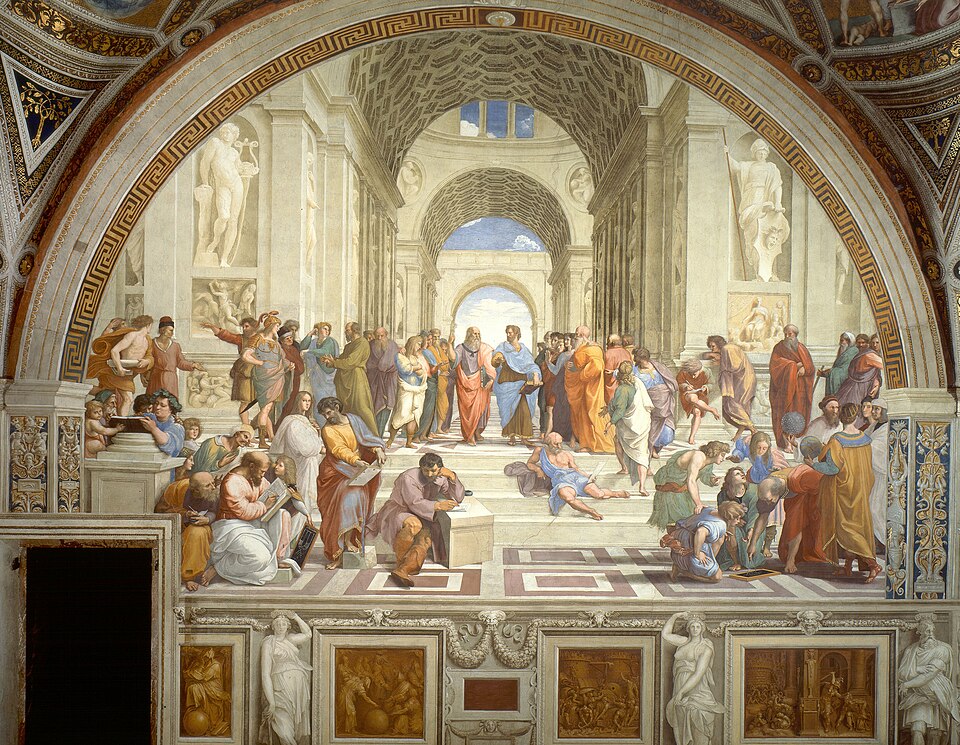
Yes, and it still takes my breath away when I think about it. In those rooms called the Stanze, other painters had already begun. When Julius II saw my first fresco, The School of Athens, he gave a crazy order: erase everything, and entrust all the walls to me alone. Imagine erasing the work of respected masters to give it to a beginner. I was proud, but also a bit embarrassed for them. That day I understood that my life had changed forever.
He had the work of others erased to give me all the walls.
—In The School of Athens, who are all those people in the middle?
They are the great thinkers of antiquity, those who lived a thousand years before me. In the center, two masters walk side by side: Plato points his finger to the sky, and Aristotle extends his hand toward the earth. It's my way of saying that one dreamed of ideas, the other observed the real world. To hold it all together, I used perspective: lines that recede into the distance and give the illusion of a vast palace. Imagine a great stone corridor where every sage finds his place, like a beautiful family of thought.
Plato points to the sky, Aristotle points to the earth: that is all wisdom.
—They say you walked through Rome with lots of people around you?
It's quite true, and it amuses me that you know that. A writer of my time, Giorgio Vasari, recounted that I crossed Rome surrounded by about fifty people: my pupils, my assistants, admirers. Imagine a street with no engines, just the sound of horse hooves, and in the middle, a small cheerful crowd accompanying me to work. They said I walked like a prince. But you know, it wasn't pride. I simply needed all those hands to carry out so many commissions at once.
I walked through Rome like a prince, followed by fifty friends and pupils.
—How did you manage to paint so many things alone?
But I wasn't alone, exactly! I ran a bottega, the Italian word for a large workshop where the master and his assistants work together. Imagine a beehive where each person has a task. In the morning, in my house in the Borgo district, near the Vatican, I checked everyone's progress and corrected the drawings. For the Vatican Logge, my pupils painted fifty-two scenes from the Bible based on my designs. I kept the faces and hands, the most delicate parts. It was like an orchestra, and I was the conductor.
My workshop was a beehive, and I was its conductor.
—What did your house smell like, and what did you eat in the evening?
What a lovely question, my child! At home, it smelled of linseed oil, black stone dust, and pigments. The most precious came from far away: lapis lazuli, a blue stone from Afghanistan, more expensive than gold, which gave a magnificent blue. In the evening, I was often invited to the home of the banker Agostino Chigi. They served game, pastries, fruits from the South, and wine from Latium. But the Church imposed days without meat: on those days, it was fish. I especially loved the conversation, even more than the dishes.
At home, it smelled of oil, stone, and that blue from Afghanistan.
—Were you in love with someone in real life?
It has been much told, so I'll tell you without blushing. I was said to have a great attachment to a young woman named Margherita Luti, nicknamed la Fornarina, which means "the baker's daughter." Her father ran a bakery in the Trastevere district, across the river. They say her gentle face appears in several of my Virgins, those Madonnas I loved to paint. Imagine always recognizing the same smile from one painting to another. Keeping a beloved face in one's painting is perhaps my way of never forgetting her.
Keeping a beloved face in one's painting is never forgetting her.
—Why were you appointed to take care of Rome's old ruins?
Because those ruins broke my heart, simply put. In 1515, Pope Leo X appointed me "prefect of antiquities." At the time, people were demolishing ancient Roman temples to salvage their fine stones and build new houses. Imagine demolishing a beautiful castle just for its bricks. I wrote a letter to the pope begging him to stop this waste. I even began drawing a map of ancient Rome, street by street. I wanted these treasures preserved as witnesses to past greatness, not crushed.
They were demolishing thousand-year-old temples for their stones: it broke my heart.
—How did you know what Rome looked like so long ago?
I walked a lot among the ruins, measuring them with my compass, the architect's instrument. I observed every fallen column like a letter from an old alphabet. I also used a very ancient book, the treatise of Vitruvius, a Roman engineer who explained how they built in his time. Imagine traveling back in time thanks to a manual fifteen hundred years old. Patiently, I reconstructed vanished temples on paper. It was detective work as much as artistry, and I was one of the very first to attempt it.
I read the ruins like the letters of a very old alphabet.
—What was it like to be friends with popes and such powerful people?
It was exhilarating, but it required a lot of attention. I dined with cardinals, poets, scholars. One of my friends, Baldassare Castiglione, wrote a book on the art of being at ease everywhere without ever seeming forced. They called it sprezzatura. Imagine someone who succeeds at everything with a smile, as if nothing cost them effort. I tried to be that way: courteous, calm, never arrogant. But behind that calm, I worked tirelessly. With the powerful, one word too many can ruin everything. Kindness, you see, was my finest armor.
Kindness was my armor among the powerful.
—Is it true you died on your birthday?
Yes, my child, and it is a strange story. I died on April 6, 1520, on the very day of my 37th birthday, after a short fever. It was also Good Friday, a solemn day for Christians. They say Pope Leo X wept when he learned of it. My body was laid out in my studio, and nearby stood my last painting, The Transfiguration, which I had not had time to finish. Imagine an unfinished work watching over its painter. Don't be too sad: a short life can be very full.
A short life can be very full.
—What would you like to be remembered for today?
I would like harmony to be remembered, that simple word. When you look at The School of Athens or one of my Madonnas, I hope you feel a calm, like gentle music for the eyes. I sought all my life the beautiful balance, what my friends called grace. But also remember my struggle to save the old stones of Rome, and the joy of a workshop full of pupils. Imagine my paintings as windows left open after my death. If, five centuries later, two children come to talk to me, then I am not truly gone.
My paintings are windows left open after my death.
This imaginary interview was generated by artificial intelligence from sources documented in Raphael's profile. It dramatises what the figure might have said based on what we know about them, but does not constitute attested historical testimony. For primary sources and factual documentation, refer to the full profile.