Imaginary interview with Robert Desnos
by Charactorium · Robert Desnos (1900 — 1945) · Literature · 6 min read
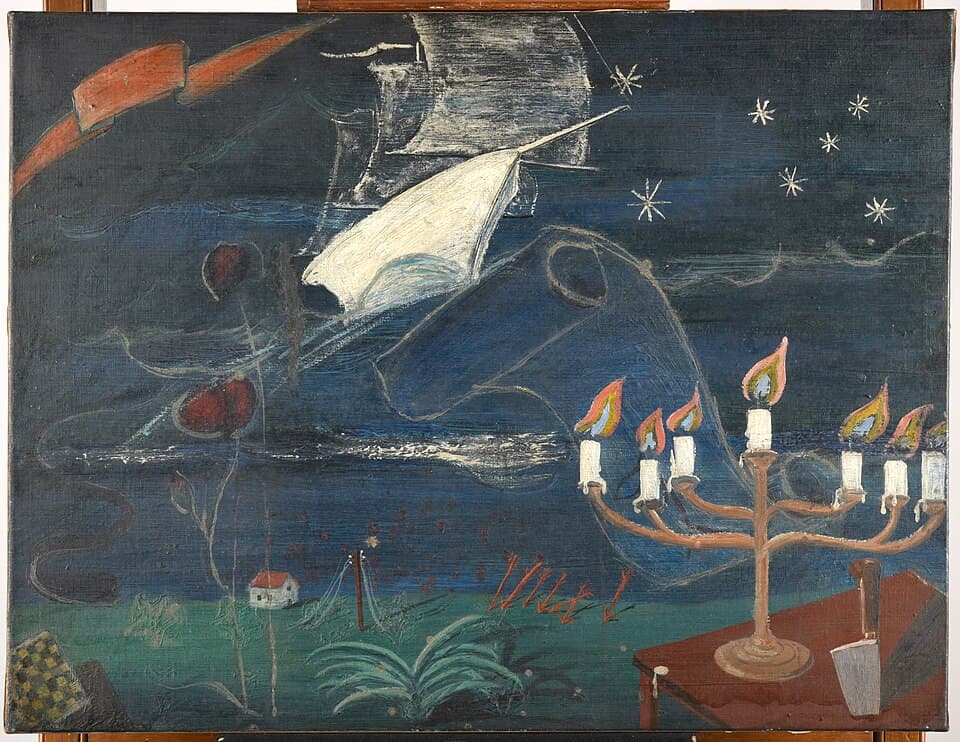
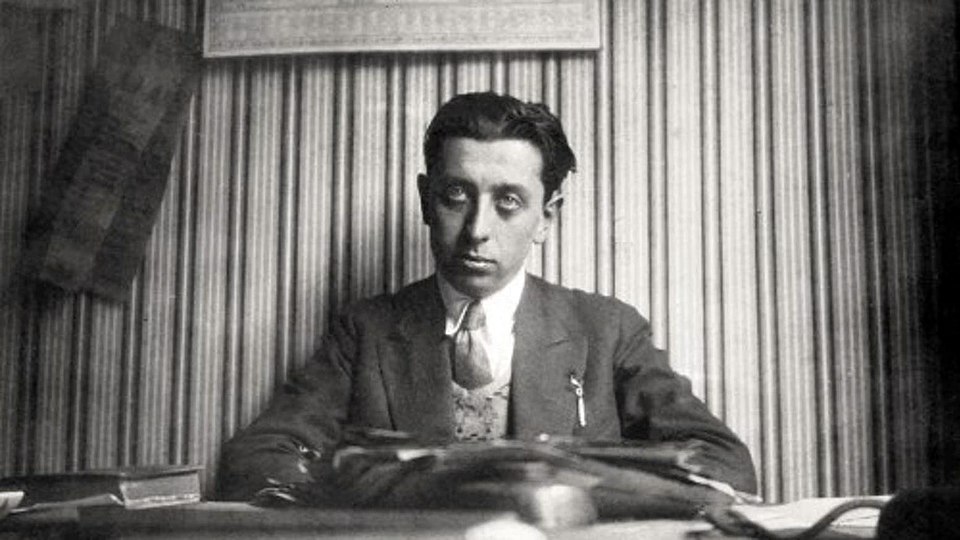
Place Blanche, late afternoon. At the back of the Café Cyrano, where the surrealists remade the world between glasses of bistro wine, a man with a restless gaze fiddles with a matchbox while rolling words around in his mouth like marbles. Robert Desnos has agreed to talk — about sleep, giant ants, the microphone, and the camps. He orders a strong black coffee and smiles: 'Go ahead, I'm already dreaming out loud.'
—How do you explain that ability that so fascinated your comrades: falling asleep at will to dictate poems?
It was right here, or nearly, around 1922, when Breton was organizing his sleep sessions. We'd dim the lamps, I'd put my head down, and something would open — a trapdoor under the skull. I didn't decide anything: language would take off without me, faster than my hand could follow. Breton said I traced signs I no longer controlled, and it was true. They nicknamed me Rrose Sélavy, a name I shared with Duchamp like sharing a coat. The others looked at me like a curious beast, a countertop medium. I think I was just less afraid than they were to let myself fall into the well. Automatic writing wasn't a parlor trick: it was going down to fetch the sentence before it knew it was a sentence.
Language would take off without me, faster than my hand could follow.
—What do you say to those who saw these sessions as mere playacting, a medium's act to impress the crowd?
Let them come sit in my place, here, under the mirrors of the Café Cyrano, and try. You can't fake that vertigo for months. Of course, there was theater — we were young, we liked to scare the bourgeoisie. But underneath the theater there was a real hunger: to prove that poetry isn't a matter of applied talent, that it lies in everyone, just beneath the surface of daytime. When Breton wrote his first Manifesto in 1924, he cited me as living proof that it existed. That flattered me and scared me a little: you don't become the mascot of a revolution without paying the price. The sleep wasn't a lie. It was the part of me that refused to lie.
—You turned puns and homophones into a genuine method. Why give such seriousness to what seems like mere amusement?
Because nothing is more serious than a successful pun. 'Rrose Sélavy and I dodge the echoes' — hear how the sounds volley back and forth, bump into each other, answer in the dark. People think I'm just having fun; in truth, I'm disarming. A pun takes language by surprise, trips it up, and in that fall a truth appears that the well-groomed sentence was hiding from you. Words have an underground life, shameful cousins, resemblances they dare not admit. My work is to force them to recognize each other. When I write in Corps et Biens, it's not to make it pretty: it's to remind that whoever masters sounds holds a lever on reality. The pun is my way of being free on my feet.
A pun takes language by surprise, and in that fall a truth appears.
—In Corps et Biens, one line became famous. Do you remember the state of mind in which you wrote it?
'I have dreamed of you so much that you lose your reality.' That's what happens when you've spent years confusing waking and sleeping: by dint of dreaming a woman, you dissolve her. 1930, Corps et Biens — they said it was my masterpiece, I'd say it's the moment my puns learned to cry. Oneirism isn't just a cabinet of curiosities; it's also a very precise pain, that of loving an image more real than the person. All the surrealist machinery I had honed at the Café Cyrano was now put to the service of one thing: saying that desire invents what it pursues, and that by pursuing it too much you risk kissing nothing but air on an absent mouth.
It's the moment my puns learned to cry.
—You're known as a surrealist, but forgotten as a radio man. What were you looking for behind the microphone?
An audience. Plain and simple. From 1933, I wrote for French radio: shows, sung commercials, poems made for the ear, not the eye. The microphone became a full-fledged instrument, as serious as my portable typewriter. You see, surrealism risked ending up among initiates, in small magazines passed around three hundred people. Radio, on the other hand, entered kitchens, over housewives' shoulders. I realized that poetry could travel by voice, slip into a jingle, contaminate the unwary without them noticing. People frowned: a poet selling toothpaste in verse! But I always thought the word should go down into the street, not wait for people to come up and get it.
I always thought the word should go down into the street.
—How did the radio voice transform your very way of writing?
It taught me rhythm again. When you write for the eye, you cheat: the page forgives, you reread. But a sentence spoken into the microphone doesn't come back — it passes once, and if it limps, it's dead. I had to tend to breathing, accents, the return of sounds, like in a refrain. My afternoons, once devoted to poems for magazines, filled up with scripts timed to the second. This clockmaker's work of the voice, I think it prepared everything: without it, I would never have known, later, how to write those children's rhymes that were meant to be sung. Radio took me from murmured writing to the word that rings out. It made me, without my knowing it, a poet for ears before being a poet for eyes.
—Tell us about the Chantefables. What drove the surrealist you were toward children's rhymes?
'An ant eighteen meters long with a hat on its head, that doesn't exist, that doesn't exist.' Well, there you have it: a child immediately accepts the giant ant, where an adult resists. Little ones are born surrealists; they haven't yet learned to say that it doesn't exist. My Chantefables, in 1944, was about rediscovering that belief, intact. And then, I admit, there was the time: while night was falling over Paris, writing an ant dragging a chariot of penguins was a way to keep fear at bay. I wanted poems made for the mouth, to be sung, chewed, spit out laughing in a schoolyard. The impossible ant defuses terror. A child's laugh is, in its own way, an act of resistance.
Little ones are born surrealists; they haven't yet learned to say that it doesn't exist.
—Imagine you're still being read a century from now. What do you think you'll be remembered for?
If I'm to be honest, and if I dare dream that far, I think it won't be my hypnotic nights or my manifestos that survive me — it will be the ants. History's joke: you build a learned body of work, Corps et Biens, Contrée, its chiseled sonnets, and it's a nursery rhyme about a hippopotamus that ensures your immortality in school playgrounds. But what finer legacy? To be recited by six-year-old mouths that won't even know my name, generation after generation. The serious poet in me should be annoyed; the child I never stopped being is secretly delighted. Let them forget me in anthologies, fine — as long as an eighteen-meter ant keeps walking around with its hat in schoolchildren's heads.
To be recited by six-year-old mouths that won't even know my name.
—You could have kept quiet and kept writing. Why did you go underground at the risk of everything?
Because you can't spend your life celebrating freedom of imagination and then stay silent when bodies are being chained. The same portable typewriter that typed my poems was used to strike leaflets under false names. In occupied Paris, my afternoons of clandestine meetings replaced the old wanderings. My heart, that heart that hated war, began to beat for the fight — I wrote it in Fortunes, and I meant it. Surrealism had taught me to refuse imposed reality; the Occupation was the most imposed reality of all. Resisting was the logical follow-up to hypnotic sleep: saying no to what they tried to make me accept as the only possible world. I didn't have the temperament of a hero. I had that of a man who can't stand having his dreams dictated to him.
I had the temperament of a man who can't stand having his dreams dictated to him.
—At the bottom of the camps, stripped of everything, what do you think you still had left?
The name. When I was arrested on February 22, 1944, then dragged from camp to camp — Auschwitz, Buchenwald, and those places whose very syllables hurt — they took my clothes, my hair, my body almost. But I kept reciting poems in a low voice, in the evening, for those who were fading beside me. That was all I had left to give. To Youki, from Flöha, I wrote that I was still standing, that my love was my only strength — and it wasn't just a phrase. Reciting was staying human. When a comrade recognized me, exhausted, I still found the strength to say who I was: I am Robert Desnos, poet. Not a number. A poet. As long as a word stayed in my mouth, they hadn't taken everything.
As long as a word stayed in my mouth, they hadn't taken everything.
This imaginary interview was generated by artificial intelligence from sources documented in Robert Desnos's profile. It dramatises what the figure might have said based on what we know about them, but does not constitute attested historical testimony. For primary sources and factual documentation, refer to the full profile.