Imaginary interview with Rosa Parks
by Charactorium · Rosa Parks (1913 — 2005) · Politics · 5 min read
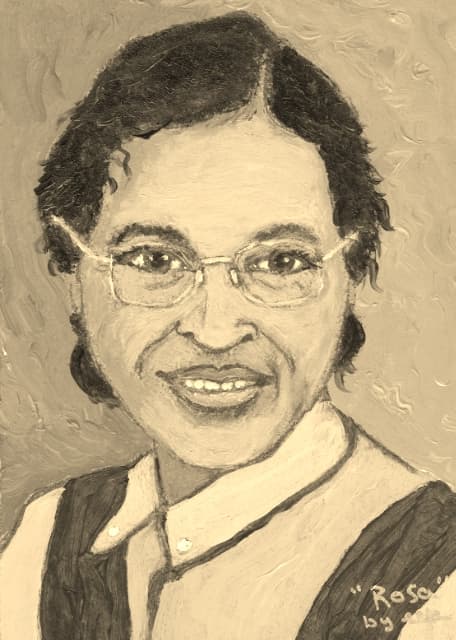
Detroit, a winter afternoon in the 1990s. In a small living room where light falls on a sewing machine tucked away in a corner, an elderly woman with a soft voice and a steady gaze agrees to look back on her life. Rosa Parks speaks slowly, as if stitching a hem: without haste, but without leaving a single stitch crooked.
—What really happened on that bus, on December 1, 1955?
It was the end of the day, December 1, 1955, in Montgomery. I had been doing alterations all afternoon, and my shoulders reminded me of it. The driver asked me to give up my seat to a white passenger because the white section was overflowing. People later said I was physically tired. That's not quite right. The only tiredness I felt was the tiredness of giving in, always giving in. I said no, simply. I was arrested, fined, and the next day the boycott began. I didn't feel I was breaking the law: it was the law itself, those Jim Crow laws, that seemed unjust to me.
The only tiredness I felt was the tiredness of giving in, always giving in.
—Did you know, that evening, that your act would spark a 381-day movement?
No one wakes up in the morning thinking they will make history by evening. When they took me to the station, I mostly thought about my husband Raymond, the fine, the shame they wanted to heap on me. But the Black community of Montgomery rose as one. For 381 days, thousands of people walked, shared cars, wore out their shoes rather than board those buses. Meetings were held at Holt Street Church, where a young minister named Martin Luther King found the words we all carried in silence. My refusal was just a spark; the fire was lit by the people.
My refusal was just a spark; the fire was lit by the people.
—You are often portrayed as just a passenger. Yet your activism went back much further. Can you tell us about it?
I always smile a little when I'm described as an ordinary woman who acted on impulse. I had been secretary of the NAACP since 1943, the National Association for the Advancement of Colored People. For over ten years, I took notes at meetings, collected testimonies from Black families who were victims of violence, assaults, and injustices the courts refused to hear. I had learned patience and precision in the struggle long before that bus. A gesture that seems spontaneous is often the fruit of long years of quiet preparation. That December 1, I knew exactly what I was doing.
A gesture that seems spontaneous is often the fruit of long years of quiet preparation.
—What did you learn during those years of activism in the NAACP?
I learned to listen. At the NAACP, my work often involved recording the stories of others—young men accused without proof, women no one believed. You quickly discover that segregation is not just about buses or separate water fountains; it's a whole system that tells a Black child he is worth less. I also understood that nonviolent civil disobedience was not weakness. Refusing to answer hate with hate is to keep the dignity they try to strip from you. That discipline I learned in back rooms, long before the spotlight was on me.
Refusing to answer hate with hate is to keep the dignity they try to strip from you.
—You were a seamstress. How did that craft shape your view of the world?
My days were spent bent over fabrics, in a large department store in Montgomery, doing alterations for ladies who would never have let me sit beside them. A seamstress learns patience with detail: one misplaced stitch and the whole garment falls crooked. The society I lived in was like a cloth sewn crooked, and everyone pretended not to see the seams that hurt. I wore simple, well-pressed dresses, a neat hat—not out of coquetry, but because my dignity was the only thing the Jim Crow laws could not confiscate.
My dignity was the only thing the Jim Crow laws could not confiscate.
—How did you experience daily life under this system of segregation?
Imagine having to think, every moment, which fountain to drink from, which door to enter, which seat you are 'entitled' to. The Whites Only and Colored signs were everywhere, like invisible walls in the air. I got up early, around five, coffee and bread, then sewing work, and in the evening community meetings at church. Segregation steals something more precious than comfort: it steals your peace of mind, constantly occupied with calculating where your body has the right to exist. That invisible tiredness is what my refusal on the bus aimed to break.
Invisible walls in the air.
—After Montgomery, you left Alabama for Detroit. What were you looking for there?
The boycott triumphed in 1956; the Supreme Court declared bus segregation unconstitutional. But victory came at a cost: Raymond and I lost our jobs and received threats. We left for Detroit, Michigan, where my brother lived. People sometimes think the North was a promised land; it had its own injustices, more insidious. I worked there for many years as an assistant to Representative John Conyers, receiving people who came seeking help. My fight did not end on that bus: it only changed city and face.
My fight did not end on that bus: it only changed city and face.
—In 1987, you founded an institute focused on youth. Why that choice?
Because freedom is not inherited like a piece of furniture; each generation must stitch it themselves. In 1987, with Raymond's memory, I founded the Rosa and Raymond Parks Institute for youth in underserved neighborhoods of Detroit. I wanted to give them what had been denied me at their age: the conviction that they matter, that they have the right to take their place in the world. Social justice is not just abolishing a bad law; it is nourishing the spirit of those who come after. I told them they needed determination and courage, because the struggle for justice is never easy, but it is always worth it.
Freedom is not inherited like a piece of furniture; each generation must stitch it themselves.
—You shared your memories in an autobiography. What did you want to convey?
In 1992, I published Rosa Parks: My Story. I wrote it because so many people were telling my life for me, reducing it to a tired woman on a bus. I wanted my own voice to be heard, to make people understand the long road that leads to a single moment of refusal. I wrote what is dearest to my heart: 'I would like to be remembered as a person who wanted to be free so that other people would be also free.' To be free so that others might be free too—that is my whole life in a sentence.
To be free so that others might be free too—that is my whole life in a sentence.
—How would you like to be remembered?
Not as a statue, nor as a saint sitting primly on a bus. When I was interviewed, I said a simple thing: 'I did not want to be chosen. I wanted to choose.' They tried to turn me into a patient, almost passive symbol. But that day in 1955, I chose. I was not fleeing the law on a whim; I refused what I believed was deeply unjust. If people remember anything about me, let it be this: an ordinary woman who, one winter evening in Montgomery, decided her dignity was no longer negotiable. The rest—the medals, the museums—belongs to those who walked with me.
I did not want to be chosen. I wanted to choose.
This imaginary interview was generated by artificial intelligence from sources documented in Rosa Parks's profile. It dramatises what the figure might have said based on what we know about them, but does not constitute attested historical testimony. For primary sources and factual documentation, refer to the full profile.