Kids interview Rosa Parks
by Charactorium · Rosa Parks (1913 — 2005) · Politics · 5 min read
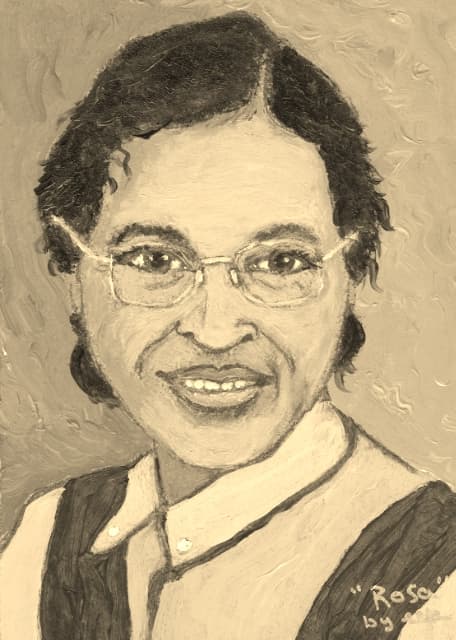
That morning, two middle school students visit a small civil rights museum. At the back of a room, an elderly woman with a gentle voice invites them to sit beside her. It is Rosa Parks, and she has agreed to answer all their questions.
—What was your city like when you were young?
You know, my child, I lived in Montgomery, Alabama, in a neighborhood reserved for Black families. Everywhere, there were signs. On some, it said Whites Only. On others, Colored. Imagine not being able to drink from the same fountain as your neighbor, just because of the color of your skin. That was the Jim Crow laws: rules that separated people everywhere. At school, on buses, even in restrooms. I grew up seeing those signs every day. And every day, deep inside me, something said no.
Imagine not being able to drink from the same fountain as your neighbor, just because of your skin.
—What job did you do every day?
I was a seamstress. I spent my days bent over fabrics at a big department store in Montgomery, mending and altering dresses. I did this work for white ladies who would never have let me sit next to them. One misplaced stitch, and the whole garment goes crooked—so I had learned the patience of detail. In the evening, I went home to a small modest house I shared with my husband Raymond. I always wore simple, neatly pressed clothes, a tidy hat. Not out of vanity, my child. It was my way of saying: you will not make me bow my head.
My neatly pressed clothes said one thing: you will not make me bow my head.
—What exactly happened on that bus?
It was December 1, 1955, in the evening, after my day of sewing. I was sitting on the bus, tired but calm. The driver ordered me to get up to give my seat to a white passenger. City law required it. And then, I said no. A small word, very simple. People later thought I was just exhausted from work. That's not true. The only thing that tired me was always giving in. The police report said I had refused in violation of the segregation ordinance. That no changed everything.
The only thing that tired me was always giving in.
—Were you afraid when the police arrested you?
Of course I was a little afraid, my child. They took me to the station, fingerprinted me, fined me. I thought of my husband Raymond, who was worried at home. But you know, there are two kinds of fear. The kind that makes you silent, and the kind that makes you stronger. I didn't feel I was breaking the law; I felt the law itself was unjust. When you are sure you are right deep in your heart, fear becomes very small. That evening, I didn't regret my no for a single second.
When you are sure you are right deep in your heart, fear becomes very small.
—Were you just a lady passing by?
Ah, that's a story often told, and it's false! I wasn't a random passerby. Since 1943, I had been secretary of the NAACP, a large organization defending the rights of Black people. For over ten years, I had recorded testimonies from mistreated families, gathered stories of injustice that no one wanted to hear. I had already taken part in actions against segregation. So when I said no on that bus, I knew exactly what I was doing. A gesture that seems sudden, my child, is often the fruit of long years of quiet preparation.
A gesture that seems sudden is often the fruit of years of preparation.
—Why didn't you shout or fight back?
Because I had learned something else, and it's important. It's called civil disobedience: refusing an unjust rule, but without violence, without raising a hand against anyone. Imagine a very high wall. You can hit it with your fists and hurt yourself. Or you can stand before it, calm, and refuse to move forward. The second is stronger. Later, before the U.S. Congress, I said I had hurt no one, I simply refused to do what I found unjust. Responding to hatred with hatred is losing the dignity they are trying to take from you.
Responding to hatred with hatred is losing the dignity they are trying to take from you.
—And after your arrest, what did people do?
That's when it became wonderful, my child. The entire Black community of Montgomery rose up together. People decided not to ride the buses as long as the injustice lasted. That is called a boycott. And it lasted 381 days! Imagine: for over a year, thousands of people walked, shared cars, wore out their shoes, rather than sit in the back as ordered. My refusal was just a small spark. The great fire was lit by an entire people, day after day, with tired feet and solid hearts.
My refusal was just a spark. The fire was lit by an entire people.
—How did you organize yourselves all together?
We met in the evenings at Holt Street Church in Montgomery. It was our headquarters, if you like. There we prayed, sang, and decided what to do the next day. A young pastor came to speak to us: his name was Martin Luther King, and he found the words we all carried in silence. We distributed posters and small papers throughout the neighborhood to remind everyone not to take the bus. You see, my child, we had neither money nor power. But when thousands of people stand together and hold firm, it becomes a force that nothing can stop.
We had neither money nor power, but together we were a force that nothing could stop.
—What became of you after all that?
After the victory of the boycott in 1956, life became difficult for me in Montgomery. So I moved to Detroit, Michigan, up north. But I never stopped fighting, you know! I worked for years as an assistant to a politician, John Conyers, who defended people's rights. The fight doesn't end with one day or one bus. Once you have tasted justice, you cannot leave injustice alone. I continued until the end, because it had become the meaning of my life.
Once you have tasted justice, you cannot leave injustice alone.
—If people remember you one day, what would you like them to say?
What a beautiful question, my child. In Detroit, with my husband Raymond, I founded an institute to help young people like you learn and grow in dignity. It was my way of passing things on. In my book of memories, I wrote these words in English: « I did not want to be chosen. I wanted to choose » — 'I did not want to be chosen, I wanted to choose.' Do you understand? I did not want to become a symbol. I simply wanted to be free, so that others could be too. If you remember one thing about me, remember that.
I did not want to be chosen, I wanted to choose.
This imaginary interview was generated by artificial intelligence from sources documented in Rosa Parks's profile. It dramatises what the figure might have said based on what we know about them, but does not constitute attested historical testimony. For primary sources and factual documentation, refer to the full profile.