Imaginary dialogue between Studs Terkel and Rosa Parks
by Charactorium · Rosa Parks (1913 — 2005) · Politics · 5 min read
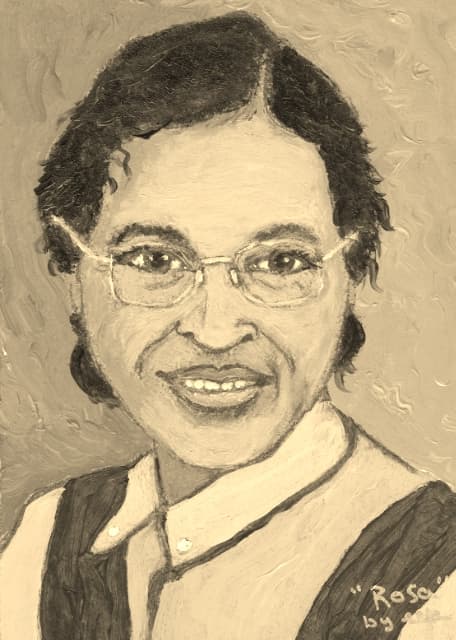
It is in the modest living room of a house in Detroit, in January 1988, that Studs Terkel places his tape recorder on the coffee table, near a still-steaming cup of coffee. Outside, the gray Michigan light falls on the snow. The man who has spent his life collecting the words of ordinary people has known Rosa Parks by reputation for a long time; this time he comes to listen to her for his oral history work, convinced that behind the legend of the bus hides a woman far more complex than the official image.
—Rosa, you opened your door to me here in Detroit for this memory work. Let's go back to the beginning: that bus in Montgomery, December 1, 1955, what happened?
It was the end of the day, I was coming home from my seamstress job, tired as one is on a Thursday evening. The driver demanded that I give my seat to a white man, because his row was full. I said no. It wasn't a big decision prepared in advance, you see, it was above all a refusal: I had given all my life, and now I would not give that seat. I've often been told about the tiredness in my legs. The only tiredness I remember is that of having given in for too long. The driver called the police, and the rest now belongs to many people, not just me.
The only tiredness I remember is that of having given in for too long.
—People readily tell the story of an exhausted seamstress who acted on a whim. Does that image really resemble you, Rosa?
No, and that's something I want to correct in front of you. I had been secretary of the NAACP since 1943, twelve years before that bus. I had recorded files of lynched men, assaulted women, I had prepared cases, knocked on doors. I knew the segregation law better than those who enforced it. So when they paint me as a poor weary woman who couldn't take it anymore, they erase all that patient work, all those evening meetings, all that organized anger. I was not a victim of chance. I was an activist waiting for her moment, and that evening, the moment found me sitting.
I was not a victim of chance. I was an activist waiting for her moment.
—The police report describes you as a 'colored woman' violating the city ordinance. How did you experience that arrest, those hours at the station?
They took me away, they took my fingerprints, they photographed me with a number, like a criminal. I had hit no one, I had stolen nothing; I had refused to get up. That official, cold paper that says I violated the segregation ordinance also unwittingly reveals the whole absurdity of the system: it took an entire law to force a woman to change seats. I was afraid, I won't lie to you, we heard so many stories that ended badly for our people. But deep inside me reigned a strange calm. I had finally made my actions coincide with what I had always believed was right.
It took an entire law to force a woman to change seats.
—After your arrest, your community stopped riding the bus for 381 days. Did you expect such an eruption, Rosa?
Not a single one of us imagined it would last more than a year. At Holt Street Church, people gathered by the hundreds, and we decided to walk rather than get on those buses. Maids walked miles, in all weather, rather than pay to be humiliated. We organized: cars took turns, everything was coordinated in the back rooms of churches. It was no longer my affair alone, it was ours. And when the Supreme Court finally declared segregation in transportation unconstitutional, in 1956, it was those worn feet and that collective patience that had won, far more than my gesture of one evening.
Women walked miles rather than pay to be humiliated.
—You know I spend my life listening to people talk about their work. Yours was sewing. What did that work of needles teach you?
Sewing taught me patience and precision, Mr. Terkel. You don't cheat with a hem: it's straight or it's not. At the department store in Montgomery, I did alterations for white ladies who barely spoke to me, and yet I saw everything, I heard everything. The needle gives you time to think. And then this trade taught me a dignity through small things: a well-pressed garment, clean gloves, a neat appearance. In a world that wanted to belittle us, taking care of one's appearance was a silent way of saying: I am worth as much as you. My hands worked the fabric, but my mind was sewing something else.
Taking care of one's appearance was a silent way of saying: I am worth as much as you.
—Let's go back even further. You grew up in Pine Level, raised by your mother and grandmother. What memory do you keep of that childhood in the South?
My childhood was poor, but never without pride. My grandmother and mother raised me with the idea that I was equal to anyone, even when the whole world repeated the opposite. At night, we sometimes heard the Klan prowling, and my grandfather kept watch, his gun within reach. I learned very early that you could be terrified and standing at the same time. At school, our books were the rejects from white schools, but they taught me to read and to believe in my own worth. Everything I did on that bus, it was that childhood that made it possible. You don't stand up one day by chance; you stand up because women taught you, from the cradle, not to bend your back.
I learned very early that you could be terrified and standing at the same time.
—When we started this interview, you told me you didn't feel you were breaking the law. Can you explain what you meant by that?
I didn't feel I was breaking the law. Think about it: the laws we were violating themselves seemed unjust to me. How can you respect a rule that declares me inferior, that decides where I must sit based on the color of my skin? Such a law does not have the dignity of a law; it is only force disguised as right. My duty, as I felt it, was not to obey but to disobey. That is why I never felt shame, not for a second. When the established order is itself a moral disorder, it is respecting it that becomes the fault.
Such a law does not have the dignity of a law; it is only force disguised as right.
—You left Alabama to settle here, in Detroit. Why that move, and what did you find in this Northern city?
After the boycott, Montgomery had become unlivable for my husband Raymond and me: no work, threats, the phone ringing at night. We moved North, like so many other black families of our generation. Detroit wasn't the paradise we imagined, believe me; segregation wore different clothes there, more discreet, but very real. I ended up working as an assistant to Representative John Conyers, taking care of people in the neighborhood, their housing, their paperwork. My fight did not stop at the edge of a sidewalk in Alabama. It simply changed address. Justice, you see, has no border between the South and the North.
My fight did not stop at the edge of a sidewalk in Alabama. It simply changed address.
—Last year, you founded an institute in the name of Raymond and yourself. What do you expect from the young people you intend it for?
I wanted this institute for children, because the future belongs to them. Too many young people in poor neighborhoods grow up without being told they matter, without being taught their own history. I want to teach them where they come from, what their elders endured and conquered, so they never believe that everything is owed to them nor that nothing is allowed to them. Freedom is not a gift you receive once and for all; each generation must defend it in its turn. My husband Raymond fought by my side all his life, in the shadows. Giving his name to this work was a way of saying that the struggle is passed on, like a trade, from hand to hand.
Freedom is not a gift you receive once and for all; each generation must defend it in its turn.
—One last question, Rosa. When you look back at all that path, from that bus to this living room in Detroit, what would you like people to remember about you?
I would like them to remember an ordinary person who simply wanted to be free, so that others could be too. I did not choose to be a symbol; you don't wake up one morning deciding to enter history. I only chose not to get up that evening, and everything else was the work of a multitude: pastors, seamstresses, children, anonymous men who walked. If something must be remembered, let it be this: courage is not reserved for the great. It lives in the simplest people, those you spend your life listening to, Mr. Terkel. It is their voice, and not mine alone, that changed this country.
Courage is not reserved for the great. It lives in the simplest people.

This imaginary interview was generated by artificial intelligence from sources documented in Rosa Parks's profile. It dramatises what the figure might have said based on what we know about them, but does not constitute attested historical testimony. For primary sources and factual documentation, refer to the full profile.