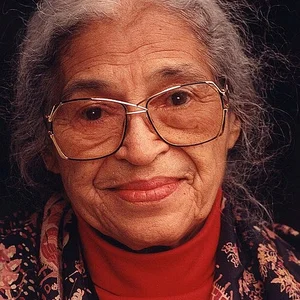

Rosa Parks was an African American civil rights activist, born in 1913 in Alabama. She became famous in 1955 for refusing to give up her seat to a white passenger on a bus in Montgomery — an act of civil disobedience that sparked the Montgomery Bus Boycott and helped accelerate the end of racial segregation in the United States.
Rosa Parks(1913 — 2005)
Rosa Parks
États-Unis
8 min read
Frequently asked questions
Famous Quotes
« I would like to be remembered as a person who wanted to be free so other people would be also free.»
« I have learned over the years that when one's mind is made up, this diminishes fear; knowing what must be done does away with fear.»
Key Facts
- December 1, 1955: Rosa Parks refuses to give up her seat to a white passenger on a bus in Montgomery, Alabama, leading to her arrest
- 1955–1956: The Montgomery Bus Boycott lasts 381 days and becomes a landmark event in the civil rights movement
- 1956: The U.S. Supreme Court rules that racial segregation on public transportation is unconstitutional (Browder v. Gayle)
- 1957: Rosa Parks moves to Detroit and continues her commitment to civil rights
- 2000: Rosa Parks receives the Congressional Gold Medal for her contributions to civil rights
Works & Achievements
On December 1, 1955, Rosa Parks refused to give up her seat to a white passenger on a bus in Montgomery, Alabama. This act of nonviolent civil disobedience became a major symbol of the struggle against racial segregation.
Her arrest sparked a 381-day boycott of Montgomery's public transit system, mobilizing the African American community. The campaign led to the overturning of segregation laws on public transportation.
Rosa Parks served as secretary and then as an active organizer for the NAACP (National Association for the Advancement of Colored People), working to advance civil rights both before and after 1955.
Rosa Parks published her autobiography, recounting her life, her commitment to civil rights, and the circumstances surrounding her historic act of civil disobedience.
She established the Rosa Parks Foundation to support young people, civic education, and the promotion of social justice in underserved communities.
Rosa Parks received the Congressional Gold Medal in 1999 and was honored with numerous distinctions recognizing her foundational role in the civil rights movement.
Anecdotes
On December 1, 1955, in Montgomery, Alabama, Rosa Parks refused to give up her seat to a white passenger on a city bus, as local law required. Arrested and fined, her act became the spark that ignited the Montgomery Bus Boycott, which lasted 381 days and mobilized the entire Black community. This peaceful act of civil disobedience changed the course of civil rights history in the United States.
Before December 1, 1955, Rosa Parks was far from an unknown figure: she had been secretary of the NAACP (National Association for the Advancement of Colored People) since 1943 and had already taken part in several actions against segregation. Her long history of quiet commitment shows that she was a seasoned activist — not a tired woman who acted on impulse, as some accounts have suggested.
Rosa Parks continued her fight after 1955, working alongside Martin Luther King Jr. and taking part in other civil rights movements, including campaigns against poverty and for economic equality. She received numerous honors during her lifetime, including the Presidential Medal of Freedom in 1996, in recognition of her pivotal role in bringing an end to legal segregation in the United States.
Rosa Parks worked as a seamstress for much of her life, a profession that gave her a firsthand view of the injustices built into the segregationist system. She grew up in Pine Level, Alabama, raised by her mother and grandmother in an atmosphere of dignity in the face of systemic racism — an upbringing that shaped her character and her determination to fight injustice.
Following the success of the Montgomery Boycott in 1956, Rosa Parks moved to Detroit, Michigan, where she continued her activism. She worked as an aide to Representative John Conyers and co-founded the Rosa and Raymond Parks Institute for Self Development, an organization supporting disadvantaged youth — a reminder that her commitment to social justice extended far beyond the fight against segregation.
Primary Sources
I would like to be remembered as a person who wanted to be free so that other people would be also free. I did not want to be chosen. I wanted to choose.
Rosa Parks, a colored woman, refused to give up her seat to a white passenger in violation of the city ordinance regarding segregation on public transportation.
I was arrested not because I fought with police officers or because I harmed anyone, but simply because I refused to do what I believed to be unjust.
You must show determination and courage. The struggle for justice is never easy, but it is always worth it.
I did not feel that I was breaking the law. Think about it. The laws we were violating themselves seemed unjust to me.
Key Places
Rosa Parks' birthplace in 1913. This small Alabama town shaped her early years and family environment in the segregated South.
The city where Rosa Parks refused to give up her seat on December 1, 1955 — a defining moment for the civil rights movement. This act of civil disobedience sparked the Montgomery Bus Boycott.
The city where Rosa Parks settled after her stand in Montgomery, and where she continued her civil rights activism until her death in 2005.
The gathering place where meetings of the Montgomery Bus Boycott were held. This is where the movement was coordinated and organized, with figures such as Martin Luther King Jr. at its heart.
A museum and library dedicated to the life and legacy of Rosa Parks, opened in 2000. This memorial site preserves the history of her activism and the broader struggle for civil rights.
Typical Objects

The Montgomery bus seat that Rosa Parks refused to give up on December 1, 1955. This act of civil disobedience sparked the Montgomery Bus Boycott and became a symbol of the struggle against racial segregation.

The "Whites Only" and "Colored" signs that marked public spaces across the United States. They represent the Jim Crow laws that Rosa Parks helped abolish through her action.

Rosa Parks was a seamstress by profession. Her work uniform symbolizes her daily occupation and the modest social status of African American women of her era.

Newspapers reporting on the Montgomery Boycott of 1955–1956. They spread news of her act to national and international public opinion, transforming this act of resistance into a mass movement.

Symbolic of captivity and oppression, they represent the struggle against slavery and segregation. Broken chains are an enduring symbol of the civil rights movement.

The posters and leaflets calling for the Montgomery Bus Boycott. These documents illustrate the collective organization and community mobilization against racial discrimination.

A simple everyday personal belonging that recalls the ordinary humanity of Rosa Parks — a courageous woman whose seemingly unremarkable act changed the history of civil rights.

A symbolic representation of the amendments (14th and 15th) abolishing segregation and guaranteeing equal rights. Rosa Parks's fight contributed to the real-world enforcement of these constitutional principles.
School Curriculum
Vocabulary & Tags
Key Vocabulary
Tags
Daily Life
Morning
Rosa Parks rose early, around 5 or 6 in the morning, to prepare a modest breakfast that usually consisted of coffee and bread. Before heading to work as a seamstress in Montgomery, she took great care with her appearance — a reflection of her personal dignity and her commitment to social propriety, even in the face of segregation.
Afternoon
In the afternoons, Rosa Parks worked as a seamstress at a department store in Montgomery, performing alterations and tailoring for customers. After work, she often attended meetings of the NAACP (National Association for the Advancement of Colored People) or took part in community activities through her church and the broader African American community.
Evening
In the evenings, Rosa Parks spent time with her husband Raymond and participated in the social life of her community, including meetings of civil rights organizations. She devoted time to reading, prayer, and reflection on the social and political issues that weighed on Black communities across the South.
Food
Rosa Parks followed a simple diet typical of working-class African Americans in the South, centered on local vegetables, rice, pork, chicken, and dairy. Meals were generally prepared at home and reflected African American culinary traditions, with limited access to a wider variety of foods due to economic hardship and the restrictions of segregation.
Clothing
Rosa Parks dressed modestly but neatly — typically a simple dress, a coat, and a hat — reflecting her respectability and her status as a skilled worker. She paid careful attention to her appearance, and her understated elegance carried an implicit refusal to conform to the racist stereotypes imposed by a segregated society.
Housing
Rosa Parks lived in an African American neighborhood in Montgomery, in a small but well-kept house she shared with her husband Raymond. Their home was a simple yet warm living space, the heart of her family and community life, located in a residential area strictly segregated under Jim Crow laws.
Historical Timeline
Period Vocabulary
Visual Style
Un style mêlant la photographie documentaire des années 1950, le réalisme social américain et l'art graphique des mouvements de protestation. L'ambiance conjugue la dignité, la résilience et l'espoir par des teintes sépia chaudes, une lumière dramatique et douce, et des références aux affiches de contestation de l'époque.
Sound Ambience
Une ambiance sonore immersive restituant l'atmosphère tendue d'une gare routière de Montgomery en 1955, mêlant les bruits caractéristiques des transports publics de l'époque à la musique de fond typique des années 1950, créant un environnement qui évoque le contexte historique et la gravité du moment.
Liens externes & ressources
Références
Œuvres
Refus de céder son siège dans le bus de Montgomery
1955
Boycott des bus de Montgomery
1955-1956
Activisme dans la NAACP
1943-1957
Mémoires : 'Rosa Parks: My Story'
1992
Fondation Rosa Parks
1987
Reconnaissance législative et honneurs
1999-2005