Imaginary interview with Rosalind Franklin
by Charactorium · Rosalind Franklin (1920 — 1958) · Sciences · 6 min read
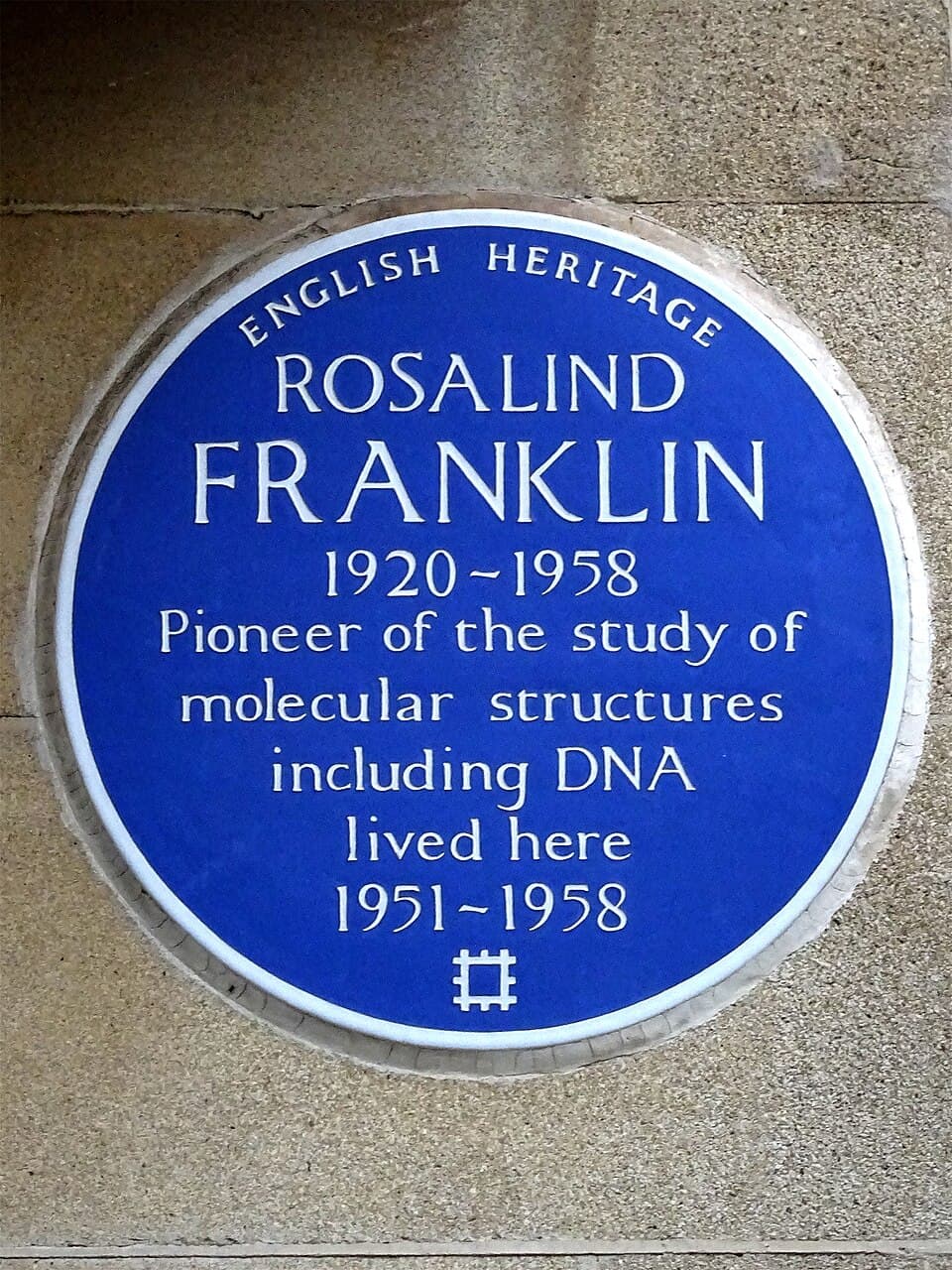
Winter 1957. At Birkbeck College, in a laboratory still cluttered with film reels and sealed tubes, a researcher puts away her plates with methodical slowness. Rosalind Franklin agrees to speak, on condition that she be listened to as one reads a diffractogram: without prejudging the answer before measuring every angle.
—Where did you learn this craft of observing the invisible with X-rays?
In Paris, in 1947, at the Central Laboratory of Physical Chemistry. I came with my French — which I spoke without self-consciousness — and a desire to handle X-rays differently, not just as a recipe. There, matter was discussed not by hurried chemists, but by patient people who would rotate a sample a thousand times to understand how it diffracts. That's where I learned that a good image is never a stroke of luck: it's the reward of a clean setup, controlled humidity, a fiber oriented to the precise degree. I also learned to distrust premature enthusiasm. A diffraction pattern says nothing; it allows deduction, provided you respect the geometry. Those Parisian years gave me a grammar, and I have never stopped speaking it softly before every image.
A good image is never a stroke of luck: it's the reward of a clean setup.
—Before DNA, your first work was on something else entirely. What were you doing?
Coal. That always surprises people, but before living molecules, I measured the porosity of coals, their ability to retain or release gases — work useful to the British war effort, which fed my thesis. Nothing glorious on the surface, yet everything was already there: crystallography, stubborn measurement, the refusal of easy conclusions. My life then was not only scientific. I left France in 1940, like so many others, before the occupation; I switched from one language to another almost without thinking — French, German, a little Hebrew. I was often judged harshly; I think mainly I had learned early that a poorly established fact costs dearly. Coal taught me that before DNA confirmed it.
—Do you remember the moment when Photograph 51 gave up its secret?
1952, at King's College London. I had adjusted the fiber's humidity with almost manic care, oriented the sample, exposed it for hours. When the plate came out, the cross of spots spread with a clarity I had never achieved before. A cross, in crystallography, is not a pretty shape: it is the signature of a helix. The spacing of the spots gave the pitch, their absence at certain points betrayed two offset strands. I did not shout discovery. I noted, measured, repeated, because a figure so beautiful is precisely the one that can deceive you if you love it too much. Photograph 51 did not show the molecule; it imposed constraints so strict that only one geometry could survive. That image did not speak loudly — it spoke truly, and that is rarer.
That image did not speak loudly — it spoke truly, and that is rarer.
—How does one work when the instrument demands such patience?
The X-ray diffractometer does not reward impatience. You prepare your DNA crystals with almost liturgical gestures, maintain them at the desired humidity, let the photographic plate collect, hour after hour, the rays that the fiber scatters. Diffraction is that: waves that deviate when meeting the order of atoms and, crossing, leave an imprint. My laboratory notebook bears the trace of every adjustment, because the slightest change in angle alters the reading. I distrust ball-and-stick models until the measurement has decided — the eye always wants to see the shape it hopes for. My job is to interpose, between my desire and my conclusion, a long chain of verifications. It is austere, I admit. But it is the only way I know not to lie to the facts.
—What place was left for a woman in these prestigious laboratories?
At King's College, the air was sometimes unbreathable, and it wasn't a matter of sealed tubes. I was treated as a technician when I brought data; my results were discussed without always deeming it necessary to include me in the discussion. I learned to retreat behind rigor, because it was the only ground where I could not be challenged: my images were better, my measurements tighter, and no prejudice could erase that. I was called difficult. I think mainly I refused to trade precision for affability. A woman who demands proof quickly becomes seen as intractable, where a man would be seen as demanding. I did not seek to please; I sought to be right, and to demonstrate it so well that it became indisputable.
I did not seek to please; I sought to be right.
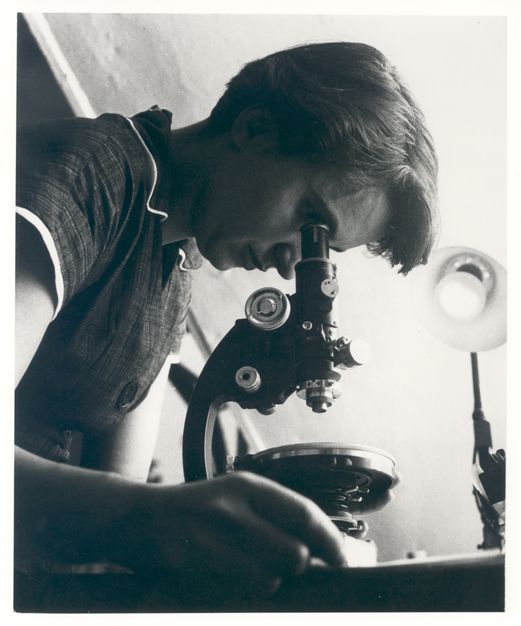
—Why did you leave King's College in 1953?
Because I was suffocating, and a laboratory where one breathes poorly ends up stifling thought as well. At Birkbeck College, where I arrived in 1953, I found something I had almost forgotten: the freedom to choose my questions. No one looking over my shoulder to claim my data. I could build my team, direct my research toward viruses, begin to love the work for itself again. People imagine science as a matter of pure ideas; it is also, very much, a matter of places where you are allowed, or not, to deploy your method. Here, the humidity of the human atmosphere finally suited my fibers. I never produced as much as at Birkbeck, and that is no coincidence: you work better where you no longer have to defend your right to be in the laboratory.
—What is this new research that occupies you now?
The tobacco mosaic virus. Since 1955, I have been questioning it with X-rays as I questioned DNA, and it has given me an answer I find magnificently sober: its structure is helical. The subunits coil in a spiral around an axis, with a regularity that reads directly in the diffraction pattern. It is a biological paracrystal, neither quite crystal nor quite disorder, and it is precisely that boundary that fascinates me. Understanding how living matter organizes itself without any architect having drawn it — that is what drives me. After DNA, I needed a new object to verify that my method held beyond a single triumph. The virus confirmed it: the helix is not a quirk of DNA; it is a solution that nature readily repeats.
—Imagine you are read in a century: what would you like to be remembered about your role?
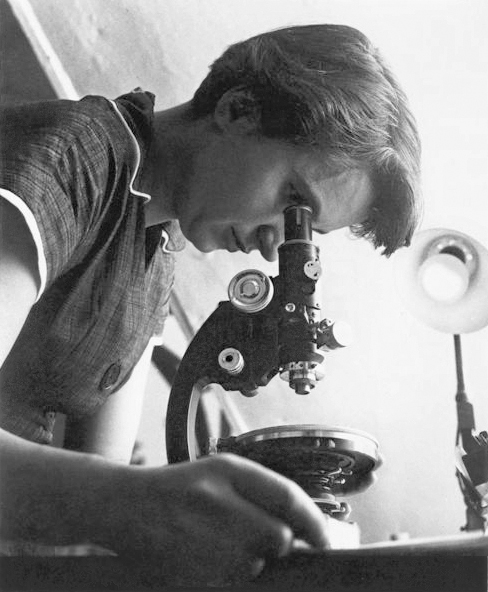
If I were to imagine being read in a hundred years — a presumptuous exercise for someone so attached to verifiable facts — I would hope for neither statue nor legend. I would want people to look at my images and my calculations, and to understand that a discovery does not fall from the sky from a single mind. My data fed a model from which others reaped the glory; that cost me, I don't hide it. But I would a thousand times rather be judged on the quality of a Photograph 51 than pitied for what was not granted me. Let them simply say: here was someone who measured accurately, and whose numbers held. The posterity I respect is not that of stories; it is that of results that can be replicated. If my plates withstand a century's scrutiny, I will be amply repaid.
I would rather be judged on the quality of an image than pitied for what was not granted me.
—Your health has been troubling you lately. Do you speak about it willingly?
I was diagnosed with cancer in 1956, and I would be dishonest not to think of it in light of my work. For years, I leaned over photographic plates as close as possible to the source, without always measuring what prolonged exposure to X-rays took from the body that handled them. We knew these rays were dangerous; we believed them controlled. I do not make this illness a tragic fate, nor an accusation — simply a fact, like any other, that must be faced squarely. The same power that allowed me to read the structure of DNA also traversed my own tissues. There is an irony there that I have no taste to dramatize, but which I cannot ignore either. Nature makes no distinction between a DNA fiber and the hand that holds it.
Nature makes no distinction between a DNA fiber and the hand that holds it.
—How do you continue working under these conditions?
By continuing, quite simply. As long as I can adjust a sample and read a diffraction pattern, I go to the laboratory. The disease has no opinion on the structure of viruses; my measurements, however, await completion, and I prefer to devote what energy I have to them rather than to waiting rooms. My laboratory notebook still fills, perhaps a little more slowly, but with the same rigor. I have always thought that work was not an escape from life, but its clearest, most honest part. At Birkbeck, my team continues what I began, and that is a very concrete consolation: a well-conducted research does not die with the one who started it. I do not know how many more plates I will expose. I only know that I want to expose them well.
This imaginary interview was generated by artificial intelligence from sources documented in Rosalind Franklin's profile. It dramatises what the figure might have said based on what we know about them, but does not constitute attested historical testimony. For primary sources and factual documentation, refer to the full profile.