Imaginary interview with Simone de Beauvoir
by Charactorium · Simone de Beauvoir (1908 — 1986) · Literature · Philosophy · 6 min read
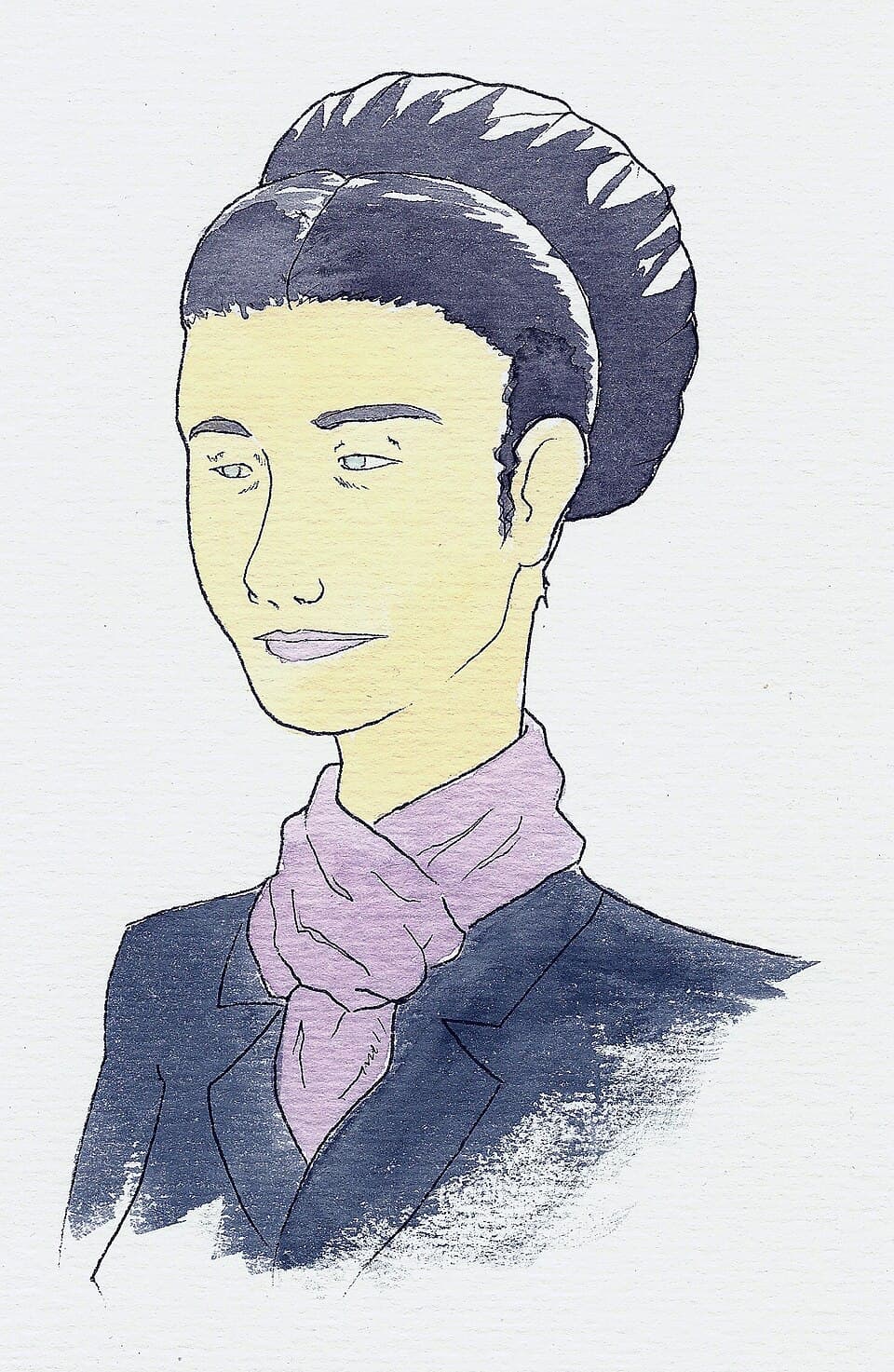
Saint-Germain-des-Prés, a gray morning in 1965. Upstairs at the Café de Flore, at the corner table that was long her office, Simone de Beauvoir stubs out a half-smoked cigarette and closes a notebook filled with tight handwriting. She agrees to talk, on condition that she not be asked to be a monument.
—Do you remember the day of the philosophy agrégation, in 1929?
I can still see the room, the smell of chalk, and that unkempt boy asking impossible questions. Sartre came first, I second, and the jury, it seems, hesitated for a long time: some whispered that the real philosopher was me. I took no vanity from it. At twenty-one, I had already decided the essential — as I wrote in Memoirs of a Dutiful Daughter, "I decided never to marry and to be a writer". Fate had planned a dutiful daughter for me; I preferred to side with my freedom. That meeting was not a romantic coup de foudre but a pact: two consciousnesses that refused to lie to each other. It lasted until his last hour.
Fate had planned a dutiful daughter for me; I preferred to side with my freedom.
—How was the idea of The Second Sex born?
From a very simple vertigo. I wanted to talk about myself, and I first wanted to ask the question: what does it mean, for me, to be a woman? I then understood that I had always defined myself in relation to men, as the other, never as the subject. This discovery seized me. I accumulated readings — biology, history, psychoanalysis, myths — while the ashes piled up in the ashtray on this very table. The sentence that sums it all up, you know it: "one is not born a woman: one becomes one". No biological destiny fixes what a woman will be; it is society that sculpts that figure. When the book appeared in 1949, the Vatican immediately placed it on the Index. Curious honor: one only censors what one fears.
One only censors what one fears.
—You say you wrote this book even before considering yourself a feminist. What do you mean?
I had no banner, I had a discomfort. I led the life of a free intellectual, I taught philosophy, I published — I had the illusion of escaping the condition of women. In writing, I saw that this freedom was an exception wrested away, not a shared right. Feminism was not for me a received doctrine but a slowly deduced consequence. Existentialism had taught me that existence precedes essence; it was enough to follow that thread to women for the whole edifice of the "feminine nature" to collapse. I was accused of sullying motherhood, of despising my sex. I despised nothing: I refused to call nature what was only training. Understanding one's own alienation is already beginning to free oneself from it.
I refused to call nature what was only training.
—What would you say to those who reduce your work to your life with Sartre?
Let them reread the jury's judgment of 1929! One never sets out to reduce a philosopher to his wife; the reverse, however, seems obvious. Our bond was intense, lasting, and it is no sentimental mystery: we had agreed to tell each other everything and to possess nothing of each other. But She Came to Stay, The Mandarins, The Second Sex are not footnotes to his pages. I pursued my own thought, he his, and our disagreements were fruitful. The reflex to define me in relation to a man, you see, is exactly the one I spent my life dismantling. In doing so, without meaning to, you offer me the best proof that my book was not wrong.
One never sets out to reduce a philosopher to his wife; the reverse seems obvious.
—Why did you so long refuse to have an apartment of your own?
Because a home is already an assignment. I lived for years in hotel rooms, a suitcase for my only kingdom, and I valued that nakedness. To own furniture is to begin to let oneself be furnished. Every morning, I came down here, to the Flore, or to the Deux Magots nearby; I had a coffee, a cigarette, and I worked for hours, the stove roaring in winter for the chilled regulars. This table was better than a bourgeois desk: it did not belong to me, so it did not hold me back. Material freedom is not a detail of comfort; it is a condition of thought. One writes poorly when one has too much to lose.
To own furniture is to begin to let oneself be furnished.

—How did a writing day unfold, concretely?
Without ceremony. I got up early, coffee first, then the cigarette, then the page. The morning belonged to writing, without exception; nothing else had the right to encroach on it. In the afternoon, I met Sartre and our circle; we discussed, we read each other's work, we corrected each other without complacency — intellectual friendship is pitiless or it is nothing. In the evening, debates resumed elsewhere, in a room, over a glass of wine, until unreasonable hours. I dressed simply, without coquetry, a skirt, a sweater, hair tied back; I had no time to waste composing a face. Writing demands an almost monastic regularity. One thinks inspiration is capricious; in truth, it comes to those who sit down every day at the same hour.
Inspiration comes to those who sit down every day at the same hour.
—You refused official honors. Why this distrust?
Because a distinction is always a way of pigeonholing you. When Sartre refused the Nobel in 1964, people cried posturing; there was no coquetry in it, but a logic. A writer who lets himself be decorated also lets himself be co-opted; he becomes another piece of furniture in the salon of official culture. I received the Goncourt for The Mandarins, I admit it — but a novel prize is not a state anointing. What I refuse is for an institution to embrace me in order to tame me. The committed intellectual is valuable only as long as he disturbs; the day power applauds him, let him ask himself what he has stopped saying. Bourgeois co-optation is a caress that smothers.
Bourgeois co-optation is a caress that smothers.
—What does commitment mean to you, beyond words?
A debt paid with one's person, not just with one's pen. I wrote in The Ethics of Ambiguity that "freedom exists only within a situation, and it cannot brutally deny that situation without denying itself" — but that it can seek itself by working to transform that situation. That is my whole creed. One does not free oneself by dreaming; one frees oneself by acting on reality. World War II cured me of individualism: I had believed one could think alone, apart from History; the camps taught me that no consciousness is innocent of its time. Since then, I hold that writing and acting are the same gesture, or they are only an alibi. Thought that changes nothing merely adorns its own powerlessness.
One does not free oneself by dreaming; one frees oneself by acting on reality.

—You commit your name to risky struggles. How far must an intellectual go?
As far as risking something, otherwise it is just a podium speech. Signing a salon petition costs nothing; publicly declaring that one has broken a law that throws women into the back room of back-alley abortionists, that commits the body as much as the signature. When one puts one's name at the bottom of such a manifesto, one exposes oneself to threats, anonymous letters, the contempt of the right-minded — and one accepts it, because silence, for its part, kills more surely. A woman who dies from a clandestine abortion does not receive hate mail: she receives death. Between two risks, I quickly chose mine. Emancipation is not an idea one caresses; it is a battle one fights, with one's name uncovered.
Silence, for its part, kills more surely.
—Do you believe that laws will eventually follow your ideas?
Laws always follow, with a shameful delay. An idea makes its way into consciences long before entering the Code; the legislator is the last to know. I cannot predict what text will be born from our battles today — I am no soothsayer — but I know that one never quite puts back into the bottle what one has released from it. When women dare to say aloud what they were forced to hide, the ground gives way under the old order. The Second Sex was symbolically burned, placed on the Index, and yet thousands read it, sometimes in secret. That is how things change: not by decree, but by contagion. The scandal of one generation becomes the evidence of the next.
The scandal of one generation becomes the evidence of the next.
—If you imagined that you would still be read in a century, what would you want to be remembered?
What a perilous question for someone who distrusts statues! If by some impossibility I were still read, I would not want to be recited, but used as a tool, then set aside. A living thought is not an inheritance to be kept under glass; it is a situation to be transformed further. I would hope that a young girl — not necessarily dutiful — opens The Second Sex and finds there not ready-made answers, but the courage to ask her own questions. Freedom is not transmitted like property: each person must conquer it in their own life, their own century. If one becomes a woman, one can therefore become free. May my future readers become free differently than I did: that would be my finest posterity.
A living thought is not an inheritance to be kept under glass.

This imaginary interview was generated by artificial intelligence from sources documented in Simone de Beauvoir's profile. It dramatises what the figure might have said based on what we know about them, but does not constitute attested historical testimony. For primary sources and factual documentation, refer to the full profile.