Imaginary dialogue between Charles de Gaulle and Simone Weil
by Charactorium · Simone Weil (1909 — 1943) · Philosophy · 6 min read

It is in the offices of Free France at Carlton Gardens, in London, in the spring of 1943, that General de Gaulle receives the frail philosopher he has employed for a few months. The room smells of cold tobacco and administrative paperwork; outside, the city still hums with the sirens of the previous night. He has summoned her for her reports on the reconstruction of France, but the man who carries the destiny of the nation wonders about this woman who refuses to eat more than the ration of the occupied. Between the efficiency-minded leader and the uncompromising mystic, the interview promises the friction of two irreconcilable demands.
—Mademoiselle Weil, I am told that in 1934 you left your teaching post to become a worker at Renault. Why this renunciation?
My general, I could no longer teach about the human condition without having touched it with my own hands. So I hired out my arms at the Billancourt factory, at the press and the milling machine, among women who knew nothing about me. There I learned what no book had told me: that mechanical fatigue, repeated to the point of stupefaction, extinguishes thought and turns a human being into a thing. You enter in the morning with your soul, you leave in the evening emptied, unable even to remember that you have suffered. From this ordeal were born my notebooks, which one day may be read under the title La Condition ouvrière. I kept the workman's overalls as one keeps a wound: to never forget on which side justice stands.
You enter in the morning with your soul, you leave in the evening emptied, unable to remember that you have suffered.
—You could have, like so many other intellectuals, pleaded the workers' cause from your desk. What did you find at the workbench that theories had hidden from you?
I found that true misfortune is not only poverty or hardship: it is the humiliation that gnaws from within. At the factory, you are not asked to think, you are asked to obey the rhythm of a machine. Attention, which is in my view the highest faculty of humans, has no use there. Yet work that forbids attention is a crime against human nature. The theorists talk about wages and property; I understood that the root of the evil lies elsewhere, in that servitude which separates the worker from his own thought. That is why I do not believe it is enough to change the masters. Work must be given back its spiritual dignity, otherwise we will have only moved the chain.
Work that forbids attention is a crime against human nature.
—Before the war, in 1936, you went to Spain to join a column of militiamen. What were you seeking in that conflict that was not ours?
I went because when the oppressed rise up, one cannot stay home and bless them from afar. I joined a column of anarchists, on the side of the Republicans, determined to share their fate. The war did not give me the chance to fight: an accident, boiling oil, burned me and I had to be repatriated. But what I saw there cured me of an illusion. I understood that force, even in the service of a just cause, transforms the one who wields it as much as the one who suffers it. You set out to defend men, and you find yourself killing lightly. This discovery marked me more than any wound. Since then, I have distrusted any violence that believes itself pure.
Force, even in the service of a just cause, transforms the one who wields it as much as the one who suffers it.
—I am told that you read Homer in the original Greek. That a mind like yours is passionate about these old poems surprises me, I admit.
I learned Greek out of love, my general, to hear the ancients without the veil of translation. And in The Iliad, I found not a poem of military glory, but the truest portrayal ever painted of force. Force is what turns a human into a thing: the corpse dragged in the dust, the drunken victor who will be defeated tomorrow. Homer takes no one's side; he shows that force blindly crushes those who think they possess it. This lesson is as valid for our time as for Troy. When I meditate on the balance between force and justice, it is to these verses that I return. The Greeks understood what we forget: that nothing human escapes the weight of misfortune.
Force is what turns a human into a thing.
—Your notes constantly mix politics and God. You were born Jewish, yet you speak to me of Christ. How do you explain that, Simone?
I explain nothing, my general; I report what happened to me. Around 1938, while reciting a poem, I was seized by a presence I had neither sought nor expected. I who had never prayed, I found myself before something more real than anything else. I did not change sides nor receive baptism; I remained on the threshold, out of fidelity to all those who stay outside. From this experience was born my reflection on gravity and grace. Gravity is the forces that pull us downward, envy, fear, oppression; grace is what descends and lightens us without our having deserved it. All my thought lies in that balancing.
Gravity pulls us downward; grace descends and lightens us without our having deserved it.
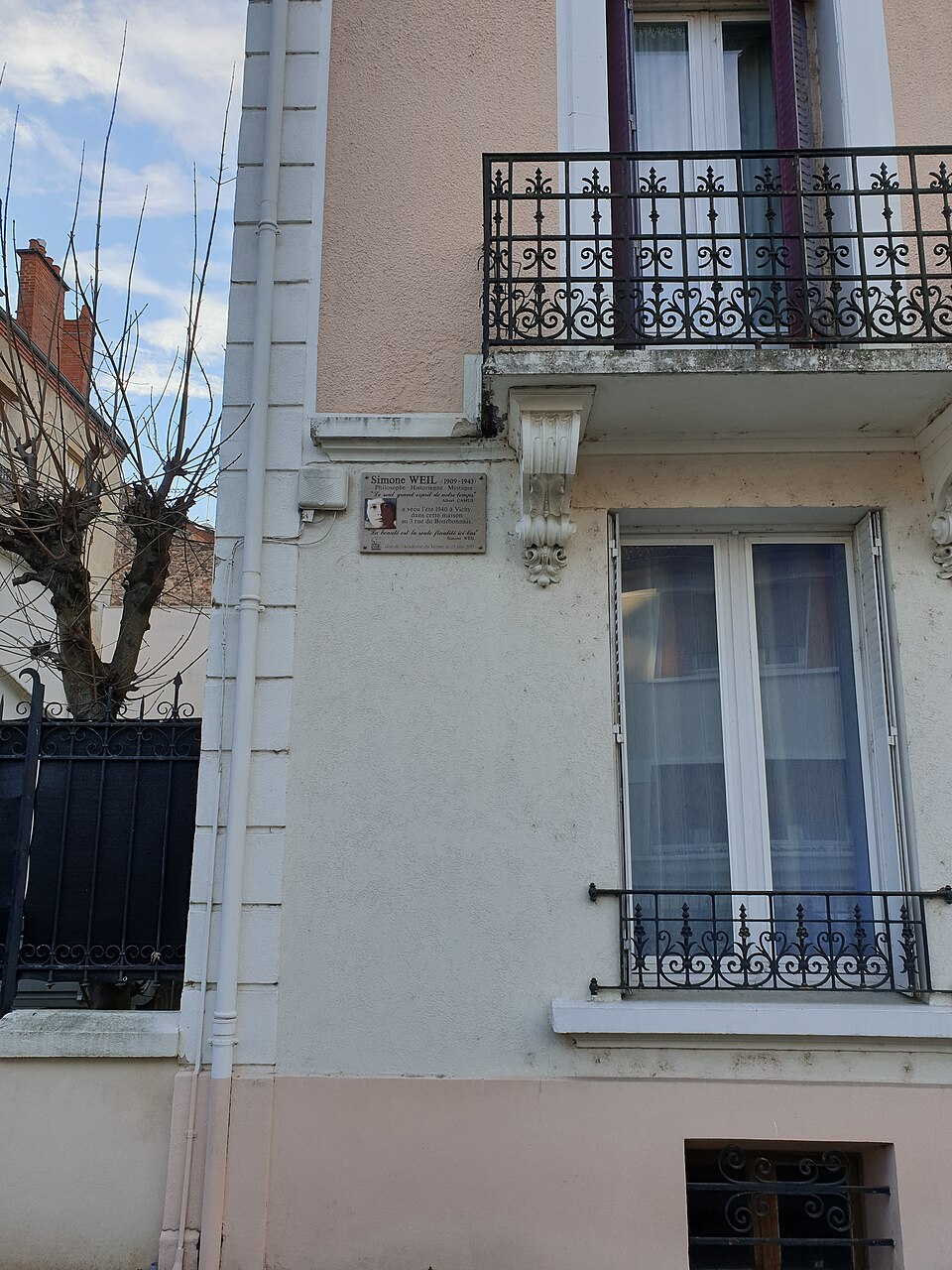
—A spirituality without a Church, you say. But a nation, I fear, is not governed with souls. What do you concretely propose for France?
You are right to press me, my general. In the notes I gave you, I tried to say what a people needs to live, not merely to survive. A human hungers for bread, but also for order, freedom, truth, and above all for rootedness. A uprooted nation feeds on lies and ends up uprooting others: look at Germany. The reconstruction you are preparing will not hold if it gives the French only institutions and machines. They must be given back a spiritual soil, living traditions, work that has meaning. That is the object of what I call enracinement. I know this seems far from the urgencies of war. But a victory that forgets the soul of the country would be only a reprieve.
A uprooted nation feeds on lies and ends up uprooting others.
—You submitted to me a project for training nurses sent to the front line, as close to the fire as possible. I confess I saw it as nothing but a dangerous chimera.
I maintain it nonetheless, my general, and I ask you to hear me one last time. You oppose Hitler with soldiers, tanks, courage; but he has invented a mystique of death that galvanizes his followers. To this black mystique, we must oppose a mystique of sacrifice that is, on the contrary, on the side of life. Unarmed women, going under the bullets to tend the wounded and die with them, would show the world that our cause is worth giving everything without taking anything. This is not strategy, I know; it is a sign. War is also won by the symbols we offer to peoples. You see a chimera; I see the only response worthy of the evil we fight. Allow me not to give up.
To the black mystique of death, we must oppose a mystique of sacrifice that is on the side of life.
—Let us speak frankly. Those who work with you here are alarmed: you refuse to eat more than the ration of the occupied French. Is that reasonable, in London, in the midst of war?
Reasonable, perhaps not; just, I believe. How could I swallow a full plate knowing that over there, under the occupier, my compatriots count their grams of bread? I do not grant myself the right to what they do not have. It is neither pride nor disgust with life, whatever people whisper in the corridors. It is the only way I have found to remain faithful to those I cannot otherwise help. All my life I have wanted my thought and my body to say the same thing; I will not betray that now that suffering is everywhere. I know my health suffers, and I am reproached for it. But a solidarity that costs nothing is just fine words.
I do not grant myself the right to what my occupied compatriots do not have.
—This austerity, these migraines I hear about, this body you exhaust: is it not, Simone, a way of punishing yourself for still being alive?
I do not punish myself, my general; I try to look misfortune in the face without turning away. I have had migraines since adolescence, pains that sometimes confine me for whole days, and I long believed they had no meaning. Then I understood that accepted misfortune can become a path of knowledge, that it strips us of everything nonessential. I do not seek it, hear me well; I only refuse to protect myself from it through comfort, lies, or forgetfulness. You carry on your shoulders the fate of the nation; I have only my life to offer, so I keep it open. If it must be short, let it at least not have lied. That is all I ask.
Accepted misfortune can become a path of knowledge; it strips us of everything nonessential.
—When this war is over, and we will win it, what will remain, in your view, of a France that has suffered so much and so nearly failed?
There will remain what we have managed to preserve of the eternal under the provisional, my general. I was born in the only country where Greek, Hebrew, and Christian traditions met, and losing this heritage would be unbearable to me. The France of tomorrow must not only heal its ruins: it must rediscover why it is worth being French. This is not decreed from above; it is cultivated like soil, through justice rendered to work, truth spoken to the humble, respect for what transcends the State. You will build institutions, and that is necessary. But ensure they serve the soul of the people and not the reverse. A nation is great only by what it protects of its most fragile.
A nation is great only by what it protects of its most fragile.

This imaginary interview was generated by artificial intelligence from sources documented in Simone Weil's profile. It dramatises what the figure might have said based on what we know about them, but does not constitute attested historical testimony. For primary sources and factual documentation, refer to the full profile.