Imaginary dialogue between Périclès and Sophocles
by Charactorium · Sophocles (495 av. J.-C. — 405 av. J.-C.) · Literature · 6 min read
It is on the slopes of the Theater of Dionysus, beneath the Acropolis still bathed by the declining sun of a spring evening, around 440 BCE, that Pericles meets his friend Sophocles. The tiers are empty, the ground strewn with faded crowns after the Dionysia. The two men have sat together on the board of strategoi; one governs the city, the other makes it weep and tremble. Pericles comes this evening not as a statesman, but as a friend curious to understand how, in this poet's head, something is born that stirs an entire people.
—Sophocles, your Antigone has shaken the assembly. You who sit with me in the city, how dare you vindicate the one who defies the king's edict?
You touch there, Pericles, on what keeps me awake at night. I did not mean to vindicate Antigone against Creon, nor Creon against her — I meant to show that both have a share of truth, and that it is precisely for this reason that they break. Antigone invokes the unwritten and unchanging laws of the gods, those laws that no mortal decree can abolish. Creon, for his part, defends the city, as you defend it every day. But he pushes too far, he becomes rigid, and his pride, his hubris, leads him to lose his son and his wife. I do not write to decide: I write so that the Athenian, on leaving, feels the weight of both duties.
I do not write to decide: I write so that the Athenian feels the weight of both duties.
—But are you not afraid, my friend, that a people seeing Creon ridiculed will learn to despise the authority of those who govern them?
On the contrary, Pericles. A people who have never seen a leader make a mistake on stage is a people defenseless before a leader who makes mistakes in the city. Tragedy is a school of prudence. When Creon understands his error too late, each spectator thinks to himself: this is what stubbornness produces. I do not ridicule authority; I show it fallible, hence human. You who govern know better than anyone how tempting it is to confuse one's will with that of the gods. My theater reminds the powerful that they remain mortal — and that, believe me, serves the city more than flattery.
A people who have never seen a leader make a mistake on stage is defenseless before a leader who makes mistakes in the city.
—They say you introduced a third actor on stage. Explain to me, you the showmaker: why break thus with Aeschylus' custom?
With only two actors, Pericles, one can only show a confrontation: one against one. But life is not a duel; it is a knot. By adding a third masked face on stage, I was able to bring in doubt, the witness, the one who hesitates between two sides. Suddenly Creon, Antigone, and Ismene exist together, and the spectator no longer knows where to give his heart. The linen mask fixes an emotion, but with three, these emotions clash and create truth. The chorus, for its part, remains that voice of the people that comments and judges. All my life I have sought to bring theater closer to the complexity of men — and three voices are better than two for that.
Life is not a duel; it is a knot.
—In this amphitheater where we sit, thousands of citizens watch you. What do you feel on the day your play faces the judgment of the crowd?
A sacred terror, I confess. When the day dawns on the Dionysia and the tiers fill, I know that everything rests on the silence or the murmur of that crowd. I have won many crowns here, yes — but no victory erases the anxiety of the next. This theater is not a court entertainment: it is the entire city gathered, rich and poor mixed together, coming to see itself. When the tragic mask appears and a shiver runs through the thousands of spectators like wind through wheat, I feel that we have touched something greater than ourselves. It is for that moment that I write, and it costs me my serenity each time.
No victory erases the anxiety of the next.
—Do you remember, Sophocles, when you were elected strategos at my side in 468? A poet commanding armies: did you not tremble to take on that burden?
How could I forget, Pericles? The day the city entrusted me with command, I understood that my fellow citizens did not separate the man who writes from the man who serves. That honored me as much as it frightened me. I am not a great soldier, you know, and I often followed men more seasoned than myself. But our democracy demands that the citizen be whole: that he deliberate in the assembly, bear arms, and also mount the stage. Serving at your side taught me one thing that my tragedies repeat: governing means deciding without ever being sure, and then bearing the weight of one's choices. The strategos and the poet ask the same question — what to do when every duty contradicts another?
Governing means deciding without ever being sure, and then bearing the weight of one's choices.
—Do you really believe that this city, where every citizen votes and deliberates, needs your tragedies? Are our laws and assemblies not enough?
Laws say what must be done, Pericles; tragedy says what it costs. Your assembly decides, votes, acts — and that is good. But on the morning when men are sent to die, who reminds the city of the price of tears? That is where I intervene. The most beautiful democracy remains blind if it does not learn to mourn what it sacrifices. My heroes fall so that the living may reflect. When I see, from these tiers, thousands of moist eyes after Antigone, I know that the city did not merely govern itself that day: it looked at itself. You and I serve the same people, but you decide, and I make them doubt.
Laws say what must be done; tragedy says what it costs.
—Tell me about Oedipus. This man gradually discovers that he has unknowingly killed his father. Why do you hound a poor innocent at heart so?
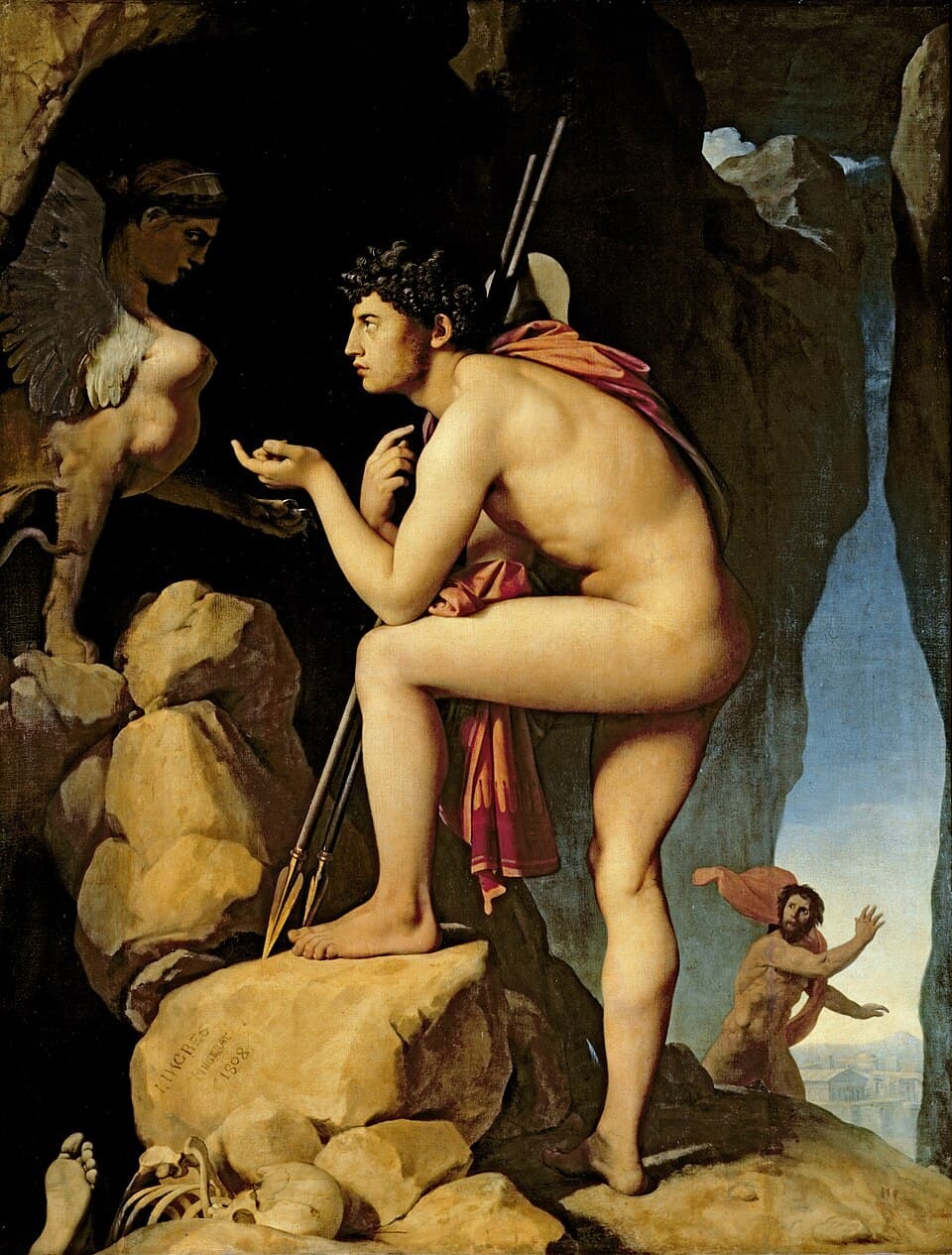
Because there is nothing more human, Pericles, than that moment when one finally recognizes oneself. Oedipus seeks the culprit of a crime, and the more he seeks, the closer he comes to himself. That is what I call anagnorisis, recognition: the terrible moment when the hero sees what he has always been. I also love peripeteia, that reversal where the investigator becomes the criminal, where the one who wanted to save Thebes discovers himself as its stain. Oedipus is not punished for a voluntary fault — he is crushed by his Moira, his fate, which he fled precisely by thinking he fled it. I do not hound him: I show that no one truly knows who he is, and that truth, when it comes, can blind you.
The more Oedipus seeks the culprit, the closer he comes to himself.
—This idea of a fate that man cannot escape, even by knowing it — does it not despair the free citizen we wish to form?
I understand your fear, you who want men masters of their decisions. But look closely: Oedipus is not great because he escapes his fate — he is great because he refuses to lie to himself. When everything is revealed, he does not flee, he does not deny: he accepts, even to the point of punishing himself with his own hands. There is his freedom. Fate traces the road, but the way we travel it belongs to us. My heroes are not puppets of the gods; they are men who, cornered, choose their dignity. That is what I want to give the citizen: not the illusion that he commands everything, but the courage to face what he does not command. Therein lies true greatness.
Fate traces the road, but the way we travel it belongs to us.
—We are at the age of great memories, my friend. You were almost a child at Salamis. What remains in you of that day when Greece nearly perished?
Everything, Pericles, everything remains. I was a teenager when our ships broke the Persian fleet in the strait, and they say I danced, naked and lyre in hand, among the choruses celebrating the victory. I still see the smoke on the sea and the intoxication of the saved city. It was the morning of the world we live in today. I then saw Athens rise, the Parthenon ascend stone by stone under your impulse, democracy shine. I have lived through nearly this entire century as one lives through a whole life of glory. And it is perhaps for this reason that my tragedies speak so much of fate: I saw a city go from supreme peril to splendor, and I know how much men's fortune hangs by a thread.
I saw a city go from supreme peril to splendor — I know how much men's fortune hangs by a thread.
—Clouds are gathering between Athens and Sparta. You who have known so many happy years, how do you look upon the shadow coming over our city?
With the lucidity that age and the stage have given me, Pericles. I have sung victories, but I never believed that fortune always smiles. My plays say it enough: no mortal should count himself happy before his last day. Athens is at its peak, and it is precisely from the peak that one fears the fall. I am not a seer, but I have observed men enough to know that the pride of a prosperous city can be its hubris, like Creon's. I do not say this to sadden you, you who bear the burden of our choices. I only say that I will continue to write, as long as the gods grant me life, so that my people never forget that they are mortal. That is my way of watching over Athens.
No mortal should count himself happy before his last day.
This imaginary interview was generated by artificial intelligence from sources documented in Sophocles's profile. It dramatises what the figure might have said based on what we know about them, but does not constitute attested historical testimony. For primary sources and factual documentation, refer to the full profile.