Imaginary dialogue between Mikhaïl Gorbatchev and Vigdís Finnbogadóttir
by Charactorium · Vigdís Finnbogadóttir (1930 — ?) · Politics · 5 min read
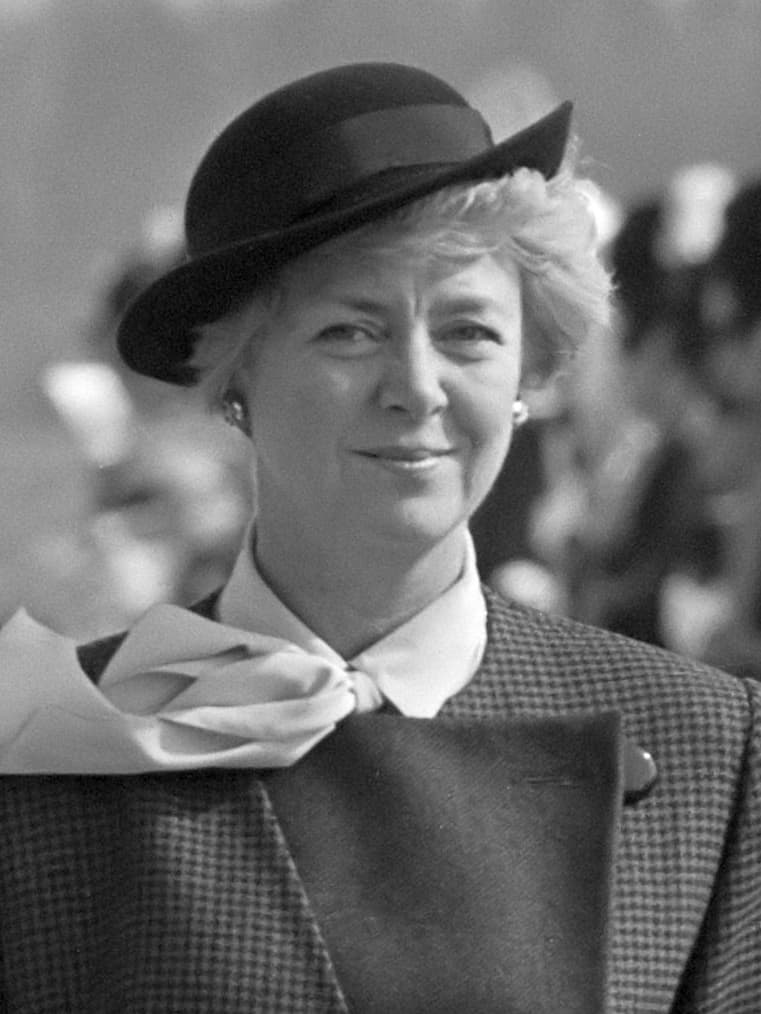
It is under the pale light of an Icelandic summer, in Reykjavík, that Mikhail Gorbachev meets Vigdís Finnbogadóttir at the threshold of the new century, a few years after she left Bessastaðir. The Atlantic wind flaps the blue, white, and red flag above the residence. The two leaders have known each other since the 1986 summit where she had hosted him and Reagan on the soil of her small republic. Today he returns no longer as a head of state, but as a man curious to understand how a theater director became the first woman elected to lead a nation.
—Vigdís, in 1980, you won with 33.6% against three men. I was told you didn't even want to run?
That's correct, Mikhail, and I don't hide it. I never knocked on the door of power: it was women, ordinary citizens, who came knocking on mine. They convinced me that a woman's voice was missing at the top of our republic. I hesitated for a long time — I was a theater director, not a politician. Against three male candidates, I won by only a few votes, and that narrow margin marked me forever. You, who had to conquer your power within an apparatus, can measure how strange it is to be carried by others. I accepted because I felt it was not my ambition, but a collective expectation.
I never knocked on the door of power: it was citizens who came knocking on mine.
—You remain the only theater director to have governed a country. What did the stage teach you, and that France where you studied?
The theater taught me everything about the job of president, believe me. In Paris, where I studied drama, I understood that speech is an act, that a right word can lift a room like a people. By directing the Reykjavík City Theatre, I learned to listen before speaking, to give a reply without crushing the other. The French language, which I deeply love, opened me to the idea that a small culture can dialogue as equals with the largest. A presidency, at bottom, is also a stage: you embody something larger than yourself. But unlike theater, you never lower the curtain.
A presidency is also a stage: you embody something larger than yourself.
—Before being elected, you had adopted a little girl alone, in 1972. Were you not afraid that would close doors?
I was warned, yes. An unmarried woman adopting a child alone, in the Iceland of those years, was bold, almost scandalous to some. Yet I made that choice without calculation, out of love, long before thinking of any office. And the Icelandic people, far from reproaching me, saw a woman of her time, free and responsible. I believe my daughter made me a more credible candidate, not the opposite: she proved I lived what I defended. You know, Mikhail, a leader who has risked nothing in private life finds it hard to ask courage of others.
A leader who has risked nothing in private life finds it hard to ask courage of others.
—They say that one Christmas night in 1985, you refused to sign a law. What really happened?
The Icelandic presidency is often presented as purely symbolic. That night, I wanted to show that the symbol could have teeth. I was pressured to sign a text that would have restricted women's right to self-determination. I refused to affix my signature, in the middle of Christmas Eve, and the debate swept the whole country. It was one of the loneliest moments of my sixteen years. But what is the use of an office if one never dares to fully inhabit it? I had promised, on my inauguration day, to represent all Icelandic women; that night, I kept my word. A presidency without conscience is just a gilded piece of furniture.
A presidency without conscience is just a gilded piece of furniture.
—In Nairobi, in 1985, you spoke about women's education before the whole world. Why that theme rather than another?
Because everything starts there, Mikhail. In Nairobi, before the world conference, I expressed my deepest conviction: without gender equality, no nation truly progresses. Iceland, a small fishing country, had understood that long before its neighbors. An educated woman uplifts an entire society, transmits, challenges, invents. I spoke not as a theorist but as a former teacher: I have seen students' eyes light up when they are believed capable. The sustainable development everyone talked about then remained for me inseparable from girls' education. A presidency offered me a platform; I was not going to waste it on conventional speeches.
—You were re-elected four times, until 1996. Does power, in the end, not trap those who wield it?
The danger is real, and I watched for it in myself like a sentinel. Sixteen years is a long time; you get used to honors, to deference, and you forget where you come from. I made sure to keep one foot in ordinary life: reading, theater, simple conversations with the people of Reykjavík. The narrow margin of my first election served as a safeguard — I knew I owed my mandate only to trust, never to a party or a machine. When I felt I had given what I could, I knew it was time to leave. Serving is not possessing; a president is only a temporary tenant of an office that belongs to the people.
Serving is not possessing; a president is only a temporary tenant of an office that belongs to the people.
—Do you remember 1986, when you hosted us in Reykjavík? What does it mean for a small nation to welcome the greats of this world?
How could I forget? You were there, with President Reagan, and the whole world suddenly looked at my wind-beaten island. Hosting two superpowers on our soil was an immense pride and a responsibility for Iceland. We had neither army nor power, only a neutral, calm place where one could talk. I understood that day that the diplomacy of a small country is not the weakness some think: we offered a place where walls could fall. You yourself were then seeking to reform a vast system; I was watching over a few hundred thousand souls. And yet, that evening, we spoke the same language, that of possible peace.
—Since leaving Bessastaðir, you have defended Icelandic with UNESCO. Why such passion for the language of such a small people?
Because a language is never small, Mikhail. Icelandic is spoken by a few hundred thousand souls, yet it carries sagas eight centuries old, a memory that no other language can express in our place. As a UNESCO Goodwill Ambassador for Languages since 1998, I fight for endangered idioms to be respected as much as major world languages. Losing a language is extinguishing a unique way of seeing the world. You, who have seen so many peoples coexist in the same empire, know what a language means for an identity. Defending Icelandic is not nationalism: it is defending the very diversity of humanity.
Losing a language is extinguishing a unique way of seeing the world.
—You constantly link language and independence. Did Iceland of 1944 shape you in that regard?
Deeply. I was a child when Iceland won its independence, and I grew up with the idea that our freedom depended on our language as much as on our laws. A people that stops naming the world in its own words eventually stops belonging to itself. That is why I have always linked the struggle for sovereignty to that for culture. During my presidency, I never stopped reminding young people that speaking Icelandic correctly was a civic act, almost an act of gentle resistance. A small nation does not survive by its strength; it survives by what it refuses to forget. Language is our true territory, the one no map shows.
A small nation survives by what it refuses to forget.
—As I leave you, Vigdís, tell me: what do you wish to be remembered about the woman behind the president?
That I was first a mother, a teacher, a woman of the theater — and that none of that disappeared under the presidential sash. I wanted to prove that a woman alone, without dynasty or fortune, could carry a nation and make it proud. If anything is remembered, I would like it to be this simple idea: one can serve without betraying oneself, exercise power without ceasing to be oneself. I raised my daughter, defended my language, refused to sign what wounded my conscience. The rest belongs to the Icelanders. You and I, Mikhail, have learned a rare thing: that a leader's courage is measured less by what he builds than by what he dares not to betray.
This imaginary interview was generated by artificial intelligence from sources documented in Vigdís Finnbogadóttir's profile. It dramatises what the figure might have said based on what we know about them, but does not constitute attested historical testimony. For primary sources and factual documentation, refer to the full profile.