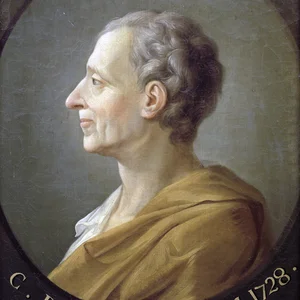

An 18th-century French philosopher and writer, Montesquieu is the author of the landmark work 'The Spirit of the Laws' (1748). He theorized the separation of powers, a foundational concept of modern political thought, and contributed to the emergence of Enlightenment philosophy.
Montesquieu(1689 — 1755)
Montesquieu
royaume de France
7 min read
Frequently asked questions
Famous Quotes
« There is no liberty if the judiciary power be not separated from the legislative and executive.»
« It is an eternal experience that every man who has power is impelled to abuse it.»
« Laws are the necessary relations that derive from the nature of things.»
Key Facts
- 1689: Born at La Brède near Bordeaux
- 1721: Publication of 'Persian Letters', a literary success and work of social criticism
- 1748: Publication of 'The Spirit of the Laws', his major work theorizing the separation of the three powers (legislative, executive, judicial)
- 1750: Defense of his work against criticism from the Church
- 1755: Death in Paris
Works & Achievements
A fictional epistolary novel in which two Persians visit France and observe European society with irony. Montesquieu's first major work, it inaugurates the social and political criticism of the Enlightenment.
A historical and political essay analyzing the reasons for the rise and fall of Rome. Montesquieu develops a causal method of analyzing political phenomena that foreshadows The Spirit of the Laws.
A masterwork in 31 books that analyzes laws, political regimes, and liberty through history and geography. Montesquieu sets out his theory of the separation of powers, the foundation of modern constitutions.
Montesquieu's response to the theological and political attacks against his major work. He defends the comparative method and the secular nature of his approach to laws.
A collection of personal notes, reflections, and aphorisms kept throughout his life. These notebooks reveal the depth and freedom of thought of Montesquieu beyond his published works.
Anecdotes
Montesquieu was elected to the Académie française in 1728, but his opponents contested his election on the grounds that he did not reside in Paris. He ultimately had to prove that he had a fixed address there in order to keep his seat. This dispute reveals the jealousies already stirred by his growing reputation.
The Persian Letters, published anonymously in 1721, were an instant success: the work was reprinted several times within a few months. Through the fictional perspective of two Persians visiting Paris, Montesquieu criticized French society — a device that allowed him to denounce its abuses without being directly implicated.
During his grand tour of Europe (1728–1731), Montesquieu spent nearly two years in England. There he closely studied the British parliamentary system, met philosophers and statesmen, and was elected a Fellow of the Royal Society of London — a rare honor for a foreigner.
The writing of The Spirit of the Laws occupied Montesquieu for nearly twenty years. Afflicted by a serious eye condition that nearly left him blind, he continued to dictate his work to secretaries. He is said to have confided: "This work nearly killed me, and now I rest."
Montesquieu was also a passionate vineyard owner: his château de La Brède, in the Gironde, produced wine that he personally exported to England and Ireland. He managed his vines with great care and regarded this activity as essential to both his financial and intellectual independence.
Primary Sources
"How can anyone be Persian?" This question, asked by Parisians to Rica, illustrates the European ethnocentrism that Montesquieu seeks to denounce through the outsider perspective of his fictional characters.
"So that no one can abuse power, it is necessary that, by the arrangement of things, power should check power."
"It is not fortune that rules the world... There are general causes, whether moral or physical, which operate in every monarchy, raise it, maintain it, or overthrow it."
"I have always seen that, to succeed in the world, one had to appear foolish and be wise."
Montesquieu expresses his admiration for the English constitution and his conviction that political liberty rests on the separation between legislative power and executive power.
Key Places
Montesquieu's birthplace and main residence, this medieval moated castle lies at the heart of his wine estate. It was here that he wrote the bulk of The Spirit of the Laws.
The judicial institution where Montesquieu served as président à mortier from 1716 to 1726. This hands-on experience with law and justice directly informed his political thought.
Montesquieu was a regular at Parisian literary salons, notably that of Madame de Lambert, where philosophers, writers, and aristocrats debated new ideas. It was in this milieu that he built his reputation as a man of letters.
Montesquieu spent nearly two years in England (1729–1731), observing the workings of the British Parliament. This firsthand experience formed the basis of his theory of the separation of powers, inspired by the English model.
It was in Geneva that The Spirit of the Laws was published in 1748, beyond the reach of French royal censorship. The city was then a refuge for bold philosophical publications.
Typical Objects

Montesquieu's daily instrument, with which he wrote and dictated his legal and political analyses over decades. Despite near-blindness, he continued to work with the help of devoted secretaries.

As président à mortier at the Parlement de Bordeaux, Montesquieu wore the scarlet robe of senior magistrates. This position gave him concrete knowledge of judicial institutions, which he would later theorize.

Montesquieu travelled throughout Europe and drew on maps to develop his climate theory, according to which geography and the physical environment shape the laws and customs of peoples.

As owner of the vineyards at the Château de La Brède, Montesquieu personally exported his wine to England. Viticulture was for him both a source of income and a tangible connection to the Gascon land.

The work, published in Geneva to escape French censorship, circulated in various editions. Tan leather-bound copies were typical of major philosophical works of the 18th century.

Afflicted with a serious eye condition (likely cataracts), Montesquieu used glasses and frequently had to dictate his texts. His fragile eyesight is mentioned in his correspondence as a constant source of suffering.
School Curriculum
Vocabulary & Tags
Key Vocabulary
Tags
Époque
Concept
Mouvement
Daily Life
Morning
Montesquieu rose early at La Brède and devoted the first hours of the morning to reading and dictating his work. He would then walk his vineyards with his stewards to monitor the state of the crops and preparations for the harvest.
Afternoon
The afternoon was reserved for writing, correspondence with philosophers, jurists and European politicians, as well as revising his manuscripts. In the city, he frequented academies and salons to debate philosophy and politics.
Evening
Evenings in Paris were social affairs: Montesquieu attended dinners in literary salons, where he shone with his wit and irony. At La Brède, he preferred quiet reading by the fireside or family conversations in the great hall of the château.
Food
Montesquieu followed a diet typical of the Bordeaux provincial nobility: roasted meats, poultry, pastries and above all wine from his own vineyards. Sober in his habits despite the abundance of his table, he advocated moderation as a virtue of good health.
Clothing
As a presiding magistrate, he wore the red ceremonial robe in the exercise of his judicial duties. In daily life, he wore the noble dress of his era: a justaucorps in velvet or fine cloth, a lace jabot shirt, powdered wig and silk stockings.
Housing
The Château de La Brède, built in the 14th and 15th centuries, was a medieval fortress surrounded by moats that Montesquieu had partially modernised. It housed a vast library of several thousand volumes — the heart of his intellectual life — and comfortable apartments blending antique furniture with the refinements of the 18th century.
Historical Timeline
Period Vocabulary
Visual Style
Le style visuel de l'univers de Montesquieu allie l'élégance rococo des salons français, la lumière dorée des vignobles bordelais et la solennité studieuse des grandes bibliothèques du XVIIIe siècle.
Sound Ambience
L'univers sonore de Montesquieu mêle le calme studieux de son château girondin, le bruissement des salons parisiens et l'effervescence intellectuelle du XVIIIe siècle naissant.
Liens externes & ressources
Références
Œuvres
Les Lettres persanes
1721
Considérations sur les causes de la grandeur des Romains et de leur décadence
1734
De l'esprit des lois
1748
Défense de l'Esprit des lois
1750
Mes Pensées
posthume (1899)