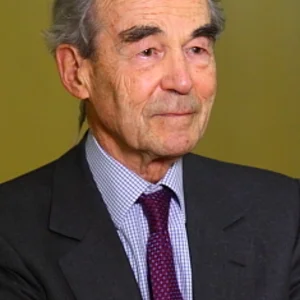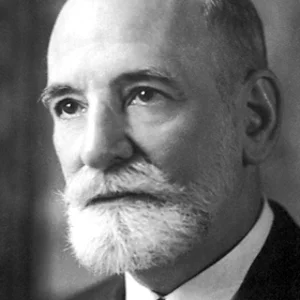

French jurist and statesman, René Cassin was one of the principal drafters of the Universal Declaration of Human Rights (1948). A resistance fighter from the very first days alongside General de Gaulle, he was awarded the Nobel Peace Prize in 1968.
René Cassin(1887 — 1976)
René Cassin
France
8 min read
Frequently asked questions
Famous Quotes
« The dignity of the human being is the foundation of freedom, justice and peace in the world.»
« Human rights are not a luxury reserved for wealthy peoples.»
Key Facts
- 1887: Born in Bayonne
- 1940: Joins de Gaulle in London and takes part in the Free French Forces
- 1948: Principal co-drafter of the Universal Declaration of Human Rights adopted by the UN
- 1968: Nobel Peace Prize
- 1976: Dies in Paris
Works & Achievements
The foundational text of international human rights law, of which Cassin was the principal drafter. Adopted in Paris by the United Nations, it proclaims thirty fundamental rights and remains the most translated document in history.
An international treaty to which Cassin actively contributed, establishing for the first time a binding judicial mechanism — the European Court — to protect fundamental rights across Europe.
An institution created by Cassin to train jurists from around the world in human rights. It bears his name today and has an international reach, organizing an annual teaching session for hundreds of participants each year.
Cassin played an active role in this first major world conference on human rights, which took stock of twenty years of implementation of the Universal Declaration and called for strengthening the mechanisms of protection.
For more than thirty years, Cassin presided over this international Jewish organization dedicated to education and the defense of the rights of Jewish communities worldwide — a commitment he pursued in parallel with his work at the United Nations.
Anecdotes
On June 28, 1940, barely two days after the armistice signed by Pétain, René Cassin boarded a plane in Bordeaux and joined de Gaulle in London. He was one of the very first senior French civil servants to rally to Free France, abandoning his post, his family, and his belongings to continue the fight. De Gaulle immediately appointed him legal adviser to the French National Committee.
Seriously wounded in the leg during the Battle of the Marne in September 1914, Cassin bore the physical after-effects of the First World War for the rest of his life. This traumatic experience forged his deep conviction that only a robust system of international law could prevent wars and protect individuals from the barbarity of states.
In 1945, Cassin learned that his sister Ida and his brother-in-law had been deported and murdered in the Nazi camps. This personal tragedy further strengthened his commitment to drafting the Universal Declaration of Human Rights: behind every article, he carried the memory of the millions of victims of Nazism.
During the 1947–1948 negotiations at the United Nations, Cassin drafted in a single night the second version of the Declaration, which became the working basis for the entire Commission. He labored at a frantic pace, searching for wording capable of winning agreement from delegates as different as the Americans, the Soviets, and representatives of Arab countries.
In 1968, at the age of 81, Cassin received the Nobel Peace Prize in Oslo. He donated a large share of the prize money to the International Institute of Human Rights he had just founded in Strasbourg, refusing to treat the award as a personal trophy and turning it instead into a tool in service of the cause he had championed his entire life.
Primary Sources
All human beings are born free and equal in dignity and rights. They are endowed with reason and conscience and should act towards one another in a spirit of brotherhood.
Twenty years after the proclamation of the Universal Declaration, millions of human beings still see their fundamental rights violated. That is why we must tirelessly strengthen the international mechanisms capable of defending those rights in concrete terms.
The legitimacy of Fighting France does not rest on the formal observance of an armistice signed under duress, but on fidelity to the founding principles of the Republic and to the international commitments freely entered into by France.
It is not enough to proclaim rights: they must be guaranteed by binding international mechanisms, failing which the Declaration will be nothing more than a pious wish with no real effect for individuals.
Key Places
René Cassin's birthplace, in the Pyrénées-Atlantiques. His attachment to his region and to French culture nourished his lifelong love of freedom and the Republic.
The city where Cassin joined de Gaulle and Free France in June 1940. He worked there as legal adviser to the government-in-exile, contributing to the institutional reconstruction of Resistance France.
The venue where the UN General Assembly adopted the Universal Declaration of Human Rights on 10 December 1948. Cassin presented the text on behalf of the French delegation during a historic session.
The seat of the Council of State, where Cassin served for more than forty years, rising to Vice-President. From there he coordinated much of his legal and international work.
An institution of which Cassin was one of the founding fathers and which he presided over from 1965 to 1968. In Strasbourg he also founded the International Institute of Human Rights in 1969, which now bears his name.
The republican monument where René Cassin's ashes were transferred on 5 October 1987, the centenary of his birth. He rests there among the great servants of the Republic, in recognition of his exceptional commitment to human rights.
Typical Objects

The tool of the jurist and diplomat, the quill served Cassin in drafting and annotating the countless versions of the Universal Declaration during sessions of the UN Commission. His manuscripts, annotated in red ink, are preserved in the UN archives.

The official black robe with gold braid, worn at solemn sittings of the Conseil d'État. Cassin served in this institution for more than forty years, rising to become its vice-president, embodying the highest traditions of French law.

Awarded in Oslo on 10 December 1968, this gold medal crowned a lifetime of service to human rights. Cassin was the first French jurist to receive the honour, and he donated a large share of the prize money to his foundations.

Symbol of the international organisation founded in 1945, within which Cassin worked for years to build a universal legal framework for human rights. The UN blue and the world map represent the universalist vision he championed throughout his career.

The many typewritten drafts corrected by hand, preserved in the UN archives, bear witness to Cassin's relentless effort to find wording acceptable to every nation. These pages covered in crossings-out are the true working drafts of one of the most important texts in human history.
School Curriculum
Vocabulary & Tags
Key Vocabulary
Daily Life
Morning
Cassin rises early, around six o'clock. He begins his day by reading diplomatic dispatches and the international press — essential for a man at the heart of global negotiations. He then dictates his correspondence before heading to the Council of State or the French delegation at the UN.
Afternoon
His afternoons are devoted to lengthy negotiating sessions at the Commission on Human Rights or to hearings at the Council of State. He prepares his interventions meticulously, annotating draft texts in red ink, searching for the precise wording that can win the approval of delegates from very different legal traditions.
Evening
In the evenings, he continues to work — rereading draft conventions, preparing lectures, writing legal articles. An avid reader of philosophy and law, he readily immerses himself in Montesquieu, Rousseau, or Kant, whose ideas shaped his universalist vision of human rights.
Food
A man of the South-West, Cassin retains a strong attachment to the flavors of his native Basque Country. In Paris and New York, he eats simply; his intense intellectual work takes precedence over the pleasures of the table. During the war years in London, he shares, like all members of the Resistance, the British rations.
Clothing
As a Councillor of State, he dons the official black robe with gold braid for solemn hearings. In his daily life as a diplomat, he wears a dark three-piece suit, a restrained tie, and a felt hat — the standard attire of senior French civil servants in the 1940s–1960s.
Housing
Cassin lives in Paris in an apartment in the 9th arrondissement. During the war, he stays in various London lodgings made available to members of Free France. During UN sessions in New York or Geneva, he stays in hotels near the United Nations headquarters.
Historical Timeline
Period Vocabulary
Liens externes & ressources
Références
Œuvres
Déclaration universelle des droits de l'homme
10 décembre 1948
Convention européenne des droits de l'homme
4 novembre 1950
Fondation de l'Institut International des Droits de l'Homme, Strasbourg
1969
Conférence internationale de Téhéran sur les droits de l'homme
1968
Présidence de l'Alliance Israélite Universelle
1943—1976