 flip
flipCollard Greens Braised in Pot Likker
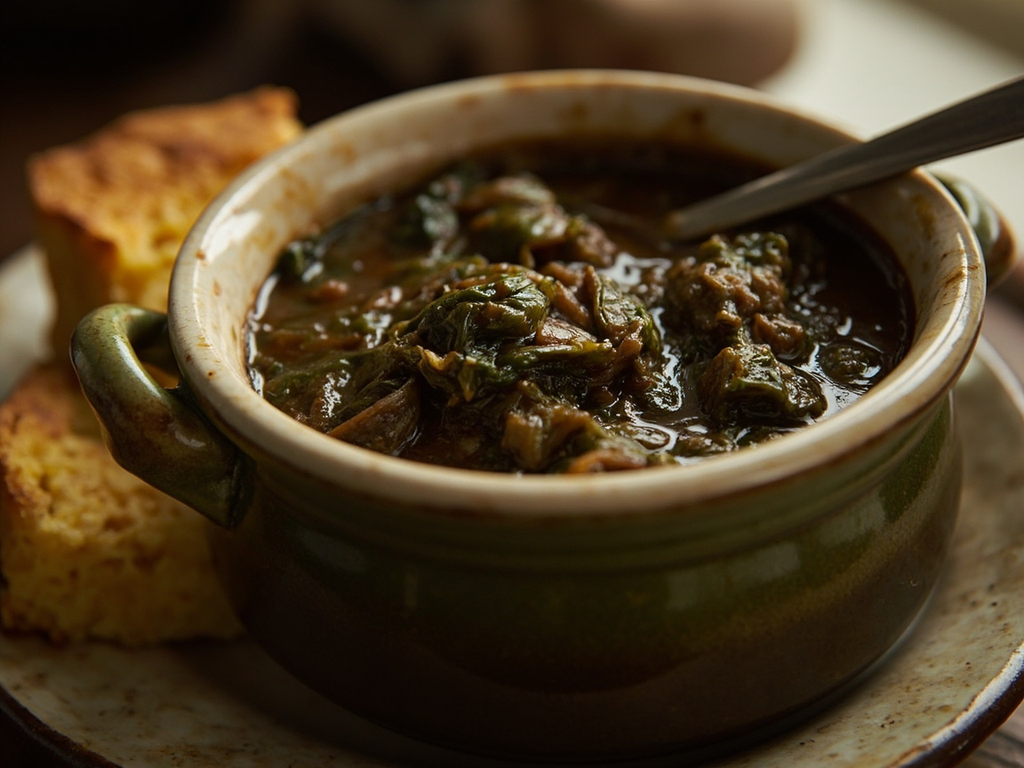
Collard Greens Braised in Pot Likker
Why this dish? Collard greens kept well all winter and were cooked long with a piece of smoked pork. They are the archetypal vegetable of Black Southern kitchens that traveled up the Migration to Harlem: robust, cheap, nourishing. On the table of a modest-income artist like Douglas, this dish provided greens and strength.
Thick leaves slowly cooked until meltingly tender, in a lightly vinegary smoked broth. The cooking liquid, the famous 'pot likker', is never discarded; it is drunk or sopped up with cornbread.
Never think we threw away the greens' water — that would be throwing away the best. That dark juice, the pot likker, is where all the nourishment lives; my grandmother said it cured the winter. We washed the leaves three times, because the earth hides there, then we let them soften for hours with a piece of smoked skin. A splash of vinegar at the end wakes everything up. It's a cuisine of patience, my friend, like we needed to get through those years.
- •Collard greens — one large bunch (leafy green)
- •Smoked pork skin or hock — one piece (umami)
- •Onion — one (aromatic)
- •Apple cider vinegar — a splash (acidity)
- •Salt, pepper — to taste (seasoning)
Collard Greens Braised in Pot Likker
Thick leaves slowly cooked until meltingly tender, in a lightly vinegary smoked broth. The cooking liquid, the famous 'pot likker', is never discarded; it is drunk or sopped up with cornbread.
Why this dish? Collard greens kept well all winter and were cooked long with a piece of smoked pork. They are the archetypal vegetable of Black Southern kitchens that traveled up the Migration to Harlem: robust, cheap, nourishing. On the table of a modest-income artist like Douglas, this dish provided greens and strength.
Never think we threw away the greens' water — that would be throwing away the best. That dark juice, the pot likker, is where all the nourishment lives; my grandmother said it cured the winter. We washed the leaves three times, because the earth hides there, then we let them soften for hours with a piece of smoked skin. A splash of vinegar at the end wakes everything up. It's a cuisine of patience, my friend, like we needed to get through those years.
Ingredients (period version)
- Collard greens — one large bunch (leafy green)
- Smoked pork skin or hock — one piece (umami)
- Onion — one (aromatic)
- Apple cider vinegar — a splash (acidity)
- Salt, pepper — to taste (seasoning)
Ingredients
- Collard greens or kale with thick ribs — 600 g (leafy green)
- Smoked pork belly or skin — 150 g (umami)
- Onion — 1, sliced (aromatic)
- Broth or water — 1 liter (cooking medium)
- Apple cider vinegar — 1 tbsp (acidity)
- Salt, pepper, pinch of sugar — to taste (seasoning)
Method
- Wash the leaves very thoroughly in plenty of water, several times, to remove sand.
- Remove the thick central ribs and cut the leaves into wide ribbons.
- In a pot, sweat the onion, add the smoked pork and broth, bring to a simmer.
- Add the greens, cover, and simmer on low heat for 45 minutes to 1 hour, until tender.
- Season with vinegar, salt, pepper, and a pinch of sugar to balance bitterness.
- Serve the greens with a ladle of their pot likker.
How it was made : Cooking for hours was the norm: the pot was set to simmer in the morning on the stove and forgotten until mealtime. The pot likker, rich in vitamins, was sometimes drunk alone as a tonic — a total economy of food, inherited from times when nothing could be wasted.
The contemporary twist : Reduce some pot likker to a glaze and brush it on the greens arranged in a fan, like the rhythmic bands of Douglas's compositions.
Sources : Adrian Miller, Soul Food: The Surprising Story of an American Cuisine (2013) · Jessica B. Harris, High on the Hog (2011)
Aaron Douglas · Charactorium