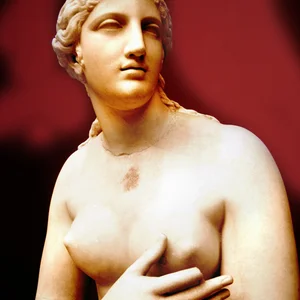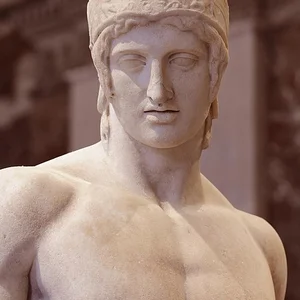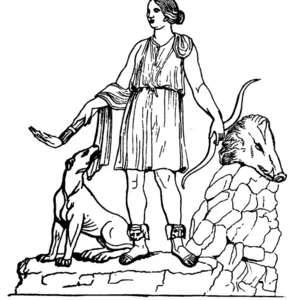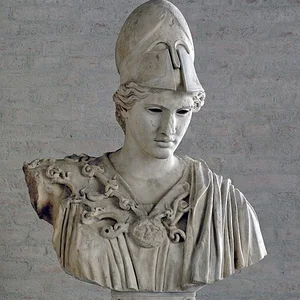

Athena is the Greek goddess of wisdom, military strategy, and the arts in ancient mythology. Patron of the city of Athens, she is depicted armed with an aegis and a spear, embodying intelligence and strategic thinking.
Athena
Athena
7 min read
Frequently asked questions
Key Facts
- Athena is the daughter of Zeus, born from the head of the king of the gods according to Greek mythology
- She is the protective patron of the city of Athens and the Parthenon, built in her honor in the 5th century BCE
- She embodies wisdom (sophia) and military strategy, in contrast to Ares, who represents brute violence
- She is associated with crafts, particularly weaving, and is the patron of artisans and artists
- She appears in many Greek myths, including the Trojan War, where she supports the Greeks
Works & Achievements
Athena becomes the patron goddess of the city of Athens after winning a contest against Poseidon. She offers the olive tree to the city, a symbol of wisdom and prosperity that marks her eternal bond with it.
Athena creates the aegis, a magical armor or protective amulet depicted as a goatskin or snakeskin. This divine weapon symbolizes her martial power and divine protection.
Athena is credited with inventing the loom and teaching the art of weaving to mortals. She embodies technical mastery and artistic excellence, representing practical and creative intelligence.
Athena embodies intelligent, calculated military strategy, in stark contrast to the brute violence of Ares. She counsels heroes such as Perseus and Achilles, symbolizing victory through wit rather than strength.
Athena is born fully armored from the forehead of Zeus, a foundational event that symbolizes her unique divine nature and her direct connection to the supreme power of the gods.
Athena's gift of the olive tree to Athens becomes a major economic and cultural resource for the ancient city, contributing to both its prosperity and its identity.
Anecdotes
According to Greek mythology, Athena was born from the head of Zeus after he swallowed her mother Metis. This founding myth, told by Hesiod in the Theogony, explains why Athena is associated with wisdom and strategic intelligence — qualities inherited from her mother. This miraculous birth is depicted in numerous ancient artworks, most notably on the pediment of the Parthenon.
Athena and Poseidon competed to become the patron deity of Athens. Each offered the city a gift: Poseidon struck the ground and produced a saltwater spring, while Athena planted an olive tree. The Athenians chose Athena, recognizing the greater usefulness of the olive. This myth, carved into the sculptures of the Parthenon, explains the sacred bond between the goddess and the city that bears her name.
The Parthenon, Athens' greatest temple built between 447 and 432 BCE, housed a colossal statue of Athena Parthenos (Athena the Virgin) made of gold and ivory, crafted by the sculptor Phidias. Standing roughly 12 meters tall, this statue — one of the wonders of the ancient world — symbolized the power and wisdom of the city's patron goddess.
Athena is the patron of several arts and crafts in Greek mythology, most notably weaving and pottery. She taught humans the art of weaving, and according to legend, she punished the mortal Arachne for claiming to rival her skill by transforming her into a spider. This story, told by the poet Ovid, illustrates the divine mastery Athena held over the crafts.
Primary Sources
Then grey-eyed Athena intervened, the goddess who delights in battle and in wisdom. She descended from Olympus to restrain Achilles, seizing him by his golden hair.
Athena, the grey-eyed goddess, protector of Odysseus, inspired him with courage and wisdom to face the trials of his long journey home.
Zeus gave birth to Athena fully armed in gold, clad in a fearsome aegis, and all the immortal gods looked on in awe at the sight of the goddess.
Athena, venerable goddess and protector of Athens, grants her favor to those who uphold justice and honor the laws of the city.
Athena, goddess of wisdom and the arts, competed with Arachne in weaving, thereby demonstrating her divine superiority in both intellect and skill.
Key Places
City patronized by Athena, who serves as its protective goddess. The city bears her name and is entirely dedicated to her in Greek mythology.
The great temple dedicated to Athena, built on the Acropolis of Athens in the 5th century BCE. It housed an imposing chryselephantine statue of the goddess.
The sacred citadel overlooking the city, the main site of Athena's worship and home to her most important temples. The religious and symbolic heart of the city.
The mythological home of the Greek gods, where Athena takes her place among the twelve Olympians — the divine origin of the goddess.
The city where Athena plays a major role in mythology, most notably as a key protagonist in the Trojan War, fighting on the side of the Greeks.
An ancient temple on the Acropolis dedicated to both Athena and Poseidon, housing cults and relics connected to the goddess and the protection of Athens.
Liens externes & ressources
Références
Œuvres
Patronage d'Athènes
période mythologique indéterminée
Invention de l'égide
période mythologique indéterminée
Invention du tissage et des arts
période mythologique indéterminée
Sagesse stratégique militaire
période mythologique indéterminée
Naissance miraculeuse
période mythologique indéterminée
Oliveraie d'Athènes
période mythologique indéterminée