 flip
flipBarley Maza with Olives and Sheep's Cheese
Barley Maza with Olives and Sheep's Cheese
Why this dish? The *maza*, an unleavened barley flatbread, was the ordinary bread of modest Athenians — more common than wheat bread, reserved for festive days. Agnodice, who shared the frugal diet of Athenians and ran across the Agora from one patient to another, ate this quick flatbread, held in one hand with a few olives and a piece of cheese.
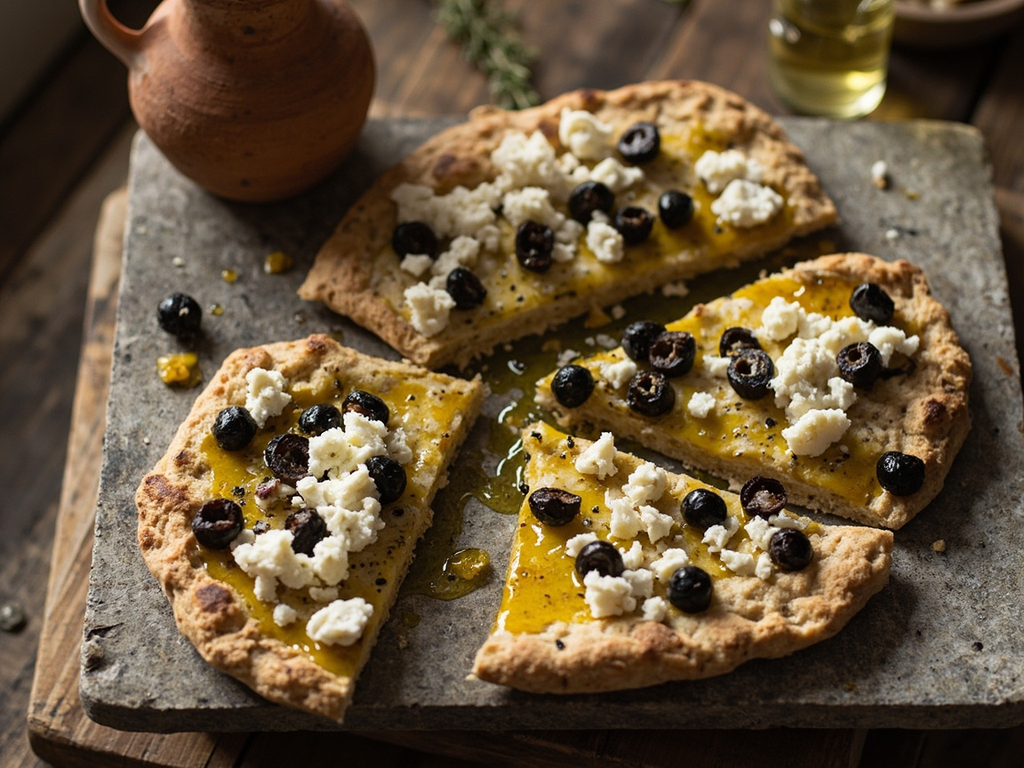
A dense, rustic barley flatbread, barely cooked, broken and topped with crushed black olives and fresh sheep's cheese. The meal of the Athenian people: nourishing, frugal, ready in an instant.
Listen to me, you who think a meal must be heavy to sustain the body. In the morning, when I had to run from house to house where women were waiting for me to give birth, I did not sit at a table: I kneaded barley flour with a little water and salt, flattened it on the hot stone, and carried it off with three olives and a piece of sheep's cheese. This is what keeps a physician on her feet from dawn to dusk — not the meat of the rich, but the honest barley of Attica.
- •Toasted barley flour (alphita) — two handfuls (cereal base)
- •Spring water — as needed (binder)
- •Sea salt — a pinch (seasoning)
- •Black olives — a small handful (opson (garnish))
- •Fresh sheep's cheese — a piece (opson (garnish))
- •Olive oil — a drizzle (binder and flavor)
Barley Maza with Olives and Sheep's Cheese
A dense, rustic barley flatbread, barely cooked, broken and topped with crushed black olives and fresh sheep's cheese. The meal of the Athenian people: nourishing, frugal, ready in an instant.
Why this dish? The *maza*, an unleavened barley flatbread, was the ordinary bread of modest Athenians — more common than wheat bread, reserved for festive days. Agnodice, who shared the frugal diet of Athenians and ran across the Agora from one patient to another, ate this quick flatbread, held in one hand with a few olives and a piece of cheese.
Listen to me, you who think a meal must be heavy to sustain the body. In the morning, when I had to run from house to house where women were waiting for me to give birth, I did not sit at a table: I kneaded barley flour with a little water and salt, flattened it on the hot stone, and carried it off with three olives and a piece of sheep's cheese. This is what keeps a physician on her feet from dawn to dusk — not the meat of the rich, but the honest barley of Attica.
Ingredients (period version)
- Toasted barley flour (alphita) — two handfuls (cereal base)
- Spring water — as needed (binder)
- Sea salt — a pinch (seasoning)
- Black olives — a small handful (opson (garnish))
- Fresh sheep's cheese — a piece (opson (garnish))
- Olive oil — a drizzle (binder and flavor)
Ingredients
- Barley flour — 150 g (cereal base)
- Warm water — 90 ml approx. (binder)
- Salt — 1/2 tsp (seasoning)
- Extra virgin olive oil — 2 tbsp (binder and flavor)
- Black olives (Kalamata type) — 60 g pitted (garnish)
- Feta or fresh sheep's cheese — 80 g (garnish)
- Dried thyme or oregano — 1 pinch (aroma)
Method
- Mix the barley flour with salt, then gradually add warm water and one spoonful of oil until you get a soft, non-sticky dough.
- Let it rest for 15 minutes, so the barley absorbs the water.
- Shape two flat cakes about 1 cm thick.
- Cook dry on a hot pan (or stone) for 4 to 5 minutes per side, until golden and firm.
- Roughly mash the olives with a fork, adding a drizzle of oil and the thyme.
- Break the warm flatbread, spread the olive paste on it, and crumble the cheese on top.
How it was made : The *maza* was almost never leavened or cooked for long: first the barley was roasted (producing *alphita*), then mixed with water, milk, oil, or honey depending on means. Raw or barely seared, it was the staple of the lower classes, soldiers, and athletes, as opposed to *artos*, the leavened wheat bread baked in an oven.
The contemporary twist : Serve the *maza* as a modern meze, cut into wedges like a "barley pita," with a drizzle of new olive oil and a twist of black pepper — a delicious return to roots.
Agnodice · Charactorium