 flip
flipShorwa-ye Gosht
Shorwa-ye Gosht
Why this dish? Ahmad Shah led incessant military campaigns — nine invasions of India, expeditions against the Persians and Uzbeks. Shorwa, a nourishing meat broth easy to prepare in the field with minimal equipment, was the staple meal of his armies marching through the Hindu Kush passes and the plains of Punjab.
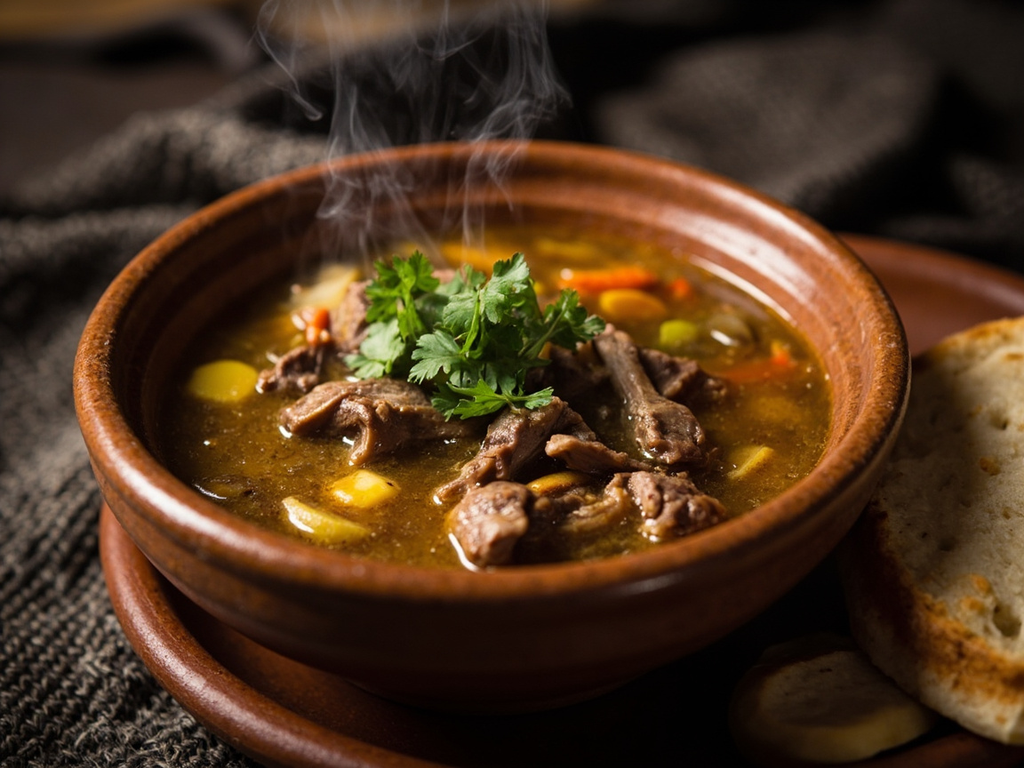
A clear, deep lamb broth long-simmered with bones and marrow, perfumed with turmeric, coriander, and black pepper, served piping hot with bread for dipping. A field dish that warms and restores strength.
When my armies cross the Hindu Kush passes in winter, it is neither gold nor promises that keep a man standing — it is a bowl of hot shorwa. My cooks throw the bones into the pot as soon as camp is pitched, and the broth boils while the men set up tents. Mutton, water, salt, a little turmeric — nothing more. But when you drink that after a day's march in the snow, it is as if life itself returns to your belly. A king who does not feed his soldiers does not deserve their swords.
- •Mutton with bone (neck, shank) — good marrow pieces (base, stock)
- •Onion — one or two (aromatic)
- •Turmeric — a pinch (color, warmth)
- •Coriander seeds — a few crushed seeds (aroma)
- •Black peppercorns — a few (heat)
- •Salt — to taste (seasoning)
- •Turnip or carrot — one or two (seasonal vegetable)
- •Water — plenty (broth)
Shorwa-ye Gosht
A clear, deep lamb broth long-simmered with bones and marrow, perfumed with turmeric, coriander, and black pepper, served piping hot with bread for dipping. A field dish that warms and restores strength.
Why this dish? Ahmad Shah led incessant military campaigns — nine invasions of India, expeditions against the Persians and Uzbeks. Shorwa, a nourishing meat broth easy to prepare in the field with minimal equipment, was the staple meal of his armies marching through the Hindu Kush passes and the plains of Punjab.
When my armies cross the Hindu Kush passes in winter, it is neither gold nor promises that keep a man standing — it is a bowl of hot shorwa. My cooks throw the bones into the pot as soon as camp is pitched, and the broth boils while the men set up tents. Mutton, water, salt, a little turmeric — nothing more. But when you drink that after a day's march in the snow, it is as if life itself returns to your belly. A king who does not feed his soldiers does not deserve their swords.
Ingredients (period version)
- Mutton with bone (neck, shank) — good marrow pieces (base, stock)
- Onion — one or two (aromatic)
- Turmeric — a pinch (color, warmth)
- Coriander seeds — a few crushed seeds (aroma)
- Black peppercorns — a few (heat)
- Salt — to taste (seasoning)
- Turnip or carrot — one or two (seasonal vegetable)
- Water — plenty (broth)
Ingredients
- Lamb shank or knuckle — 800 g, with bone (base, stock)
- Onions — 2, quartered (aromatic)
- Turnips — 2 small, chunked (vegetable)
- Carrots — 2, cut into chunks (vegetable)
- Ground turmeric — 1 tsp (color)
- Coriander seeds — 1 tsp, crushed (aroma)
- Black peppercorns — 6-8 (heat)
- Salt — to taste (seasoning)
- Fresh cilantro — a few sprigs (garnish)
- Water — 2 L (broth)
Method
- Place the lamb pieces with bone in a large pot, cover with cold water (2 L). Slowly bring to a boil, skimming off any scum that forms.
- Add the quartered onions, turmeric, crushed coriander, black peppercorns, and salt. Reduce to low heat.
- Simmer covered for 1.5 hours, until the meat falls off the bone.
- Add the turnip and carrot chunks. Continue cooking for 30 minutes, until the vegetables are tender.
- Adjust seasoning. The broth should be clear, golden from turmeric, and deeply savory.
- Serve in deep bowls: the hot broth first, then the meat and vegetables, sprinkled with fresh cilantro. Accompany with thick naan for dipping.
How it was made : Shorwa is the mother soup of Central Asia, found from the Caucasus to Afghanistan. On military campaign, it was prepared in large communal pots suspended over the fire. Marrow bones were especially prized for their caloric richness. The broth could be stretched with water and recooked for several days, each addition of meat enriching the stock — a pragmatic practice for armies on the move.
The contemporary twist : Strain some of the broth and serve it separately in cups as a consommé, with a pinch of sumac for acidity.
Sources : Charles Masson, Narrative of Various Journeys in Balochistan, Afghanistan and the Panjab, 1842 — descriptions of meals in camps and caravanserais · Helen Saberi, Noshe Djan: Afghan Food and Cookery, Prospect Books, 2000
Ahmad Shah Durrani · Charactorium