 flip
flipKuku sabzi (Herb Frittata)
Kuku sabzi (Herb Frittata)
Why this dish? His profile highlights eggs, fresh herbs, and… the automobile. Yet Kiarostami is the filmmaker of the car (Taste of Cherry, Ten) and the roads of Gilan. Kuku sabzi, which travels cold and is eaten by hand, is precisely the snack for journeys and Nowrouz picnics.
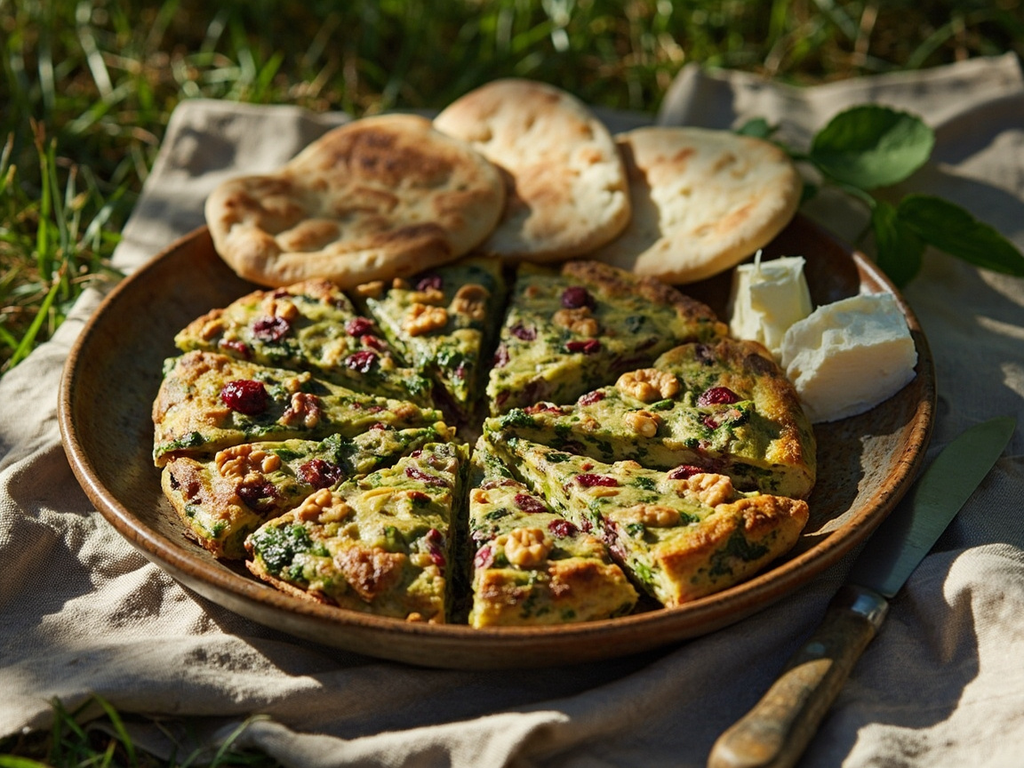
A thick egg patty packed with chopped herbs (parsley, cilantro, dill, fenugreek) with walnut halves and tart barberries. Green at heart, golden outside, it is cut into wedges that travel without trouble.
For the road, there is nothing better. We chop herbs until our hands are full of green fragrance, mix them with eggs, a few walnuts, and those little red berries that prickle the tongue, then let it set in the pan, slowly. Cut into wedges, slipped into a cloth with bread and cheese, it would follow us on the roads of the north, where rice grows and where I loved to film. We would eat by the roadside, watching the green hills.
- •Eggs — a few (binder)
- •Parsley, cilantro, dill, scallions — bunches, chopped (body of the dish)
- •Fenugreek leaves — a handful (bitter fragrance)
- •Walnut halves — a handful (texture)
- •Barberries (zereshk) — a spoonful (tart touch)
Kuku sabzi (Herb Frittata)
A thick egg patty packed with chopped herbs (parsley, cilantro, dill, fenugreek) with walnut halves and tart barberries. Green at heart, golden outside, it is cut into wedges that travel without trouble.
Why this dish? His profile highlights eggs, fresh herbs, and… the automobile. Yet Kiarostami is the filmmaker of the car (Taste of Cherry, Ten) and the roads of Gilan. Kuku sabzi, which travels cold and is eaten by hand, is precisely the snack for journeys and Nowrouz picnics.
For the road, there is nothing better. We chop herbs until our hands are full of green fragrance, mix them with eggs, a few walnuts, and those little red berries that prickle the tongue, then let it set in the pan, slowly. Cut into wedges, slipped into a cloth with bread and cheese, it would follow us on the roads of the north, where rice grows and where I loved to film. We would eat by the roadside, watching the green hills.
Ingredients (period version)
- Eggs — a few (binder)
- Parsley, cilantro, dill, scallions — bunches, chopped (body of the dish)
- Fenugreek leaves — a handful (bitter fragrance)
- Walnut halves — a handful (texture)
- Barberries (zereshk) — a spoonful (tart touch)
Ingredients
- Eggs — 6 (binder)
- Flat-leaf parsley — 1 large bunch (main herb)
- Cilantro — 1 bunch (herb)
- Dill — 1/2 bunch (herb)
- Scallions (green part) — 1 bunch (herb)
- Crushed walnut halves — 50 g (texture)
- Barberries (zereshk) — 2 tbsp (tart touch)
- Flour — 1 tbsp (binder)
- Baking powder — 1/2 tsp (fluffiness)
- Salt, pepper, turmeric — to taste (seasoning)
- Oil or butter — 3 tbsp (cooking)
Method
- Finely chop all herbs (the volume of herbs should far exceed that of the eggs). Pat them dry.
- Beat eggs with salt, pepper, turmeric, flour, and baking powder. Mix in herbs, walnuts, and barberries.
- Heat oil in a pan, pour in the mixture, cover, and cook on low heat for 12-15 minutes until the bottom is golden.
- Flip the patty (using a plate) and cook the other side for 8-10 minutes: it should remain green and moist at the center.
- Let cool slightly, cut into square pieces. Serve warm, or cold for a picnic with bread and cheese.
How it was made : Kuku sabzi is the emblematic dish of Nowrouz, the Persian New Year: the deep green of the herbs symbolizes the renewal of spring. Originally cooked in a heavy cast-iron pan over embers, it was flipped with skill. Its density and ability to hold cold have made it a travel and outdoor feast food since ancient times.
The contemporary twist : Baked in a muffin tin, it becomes individual bite-sized portions perfect for a road trip — a format that would have amused the filmmaker of cars.
Sources : Najmieh Batmanglij, Food of Life · Margaret Shaida, The Legendary Cuisine of Persia
Abbas Kiarostami · Charactorium