 flip
flipDema's Levantine Maqluba
Dema's Levantine Maqluba
Why this dish? Zewail's wife Dema regularly prepared Levantine dishes that reminded the chemist of his Mediterranean roots. Maqluba — literally "upside-down" — is the great shared dish of Syrian-Lebanese tables, spectacular when the pot is overturned onto the platter.
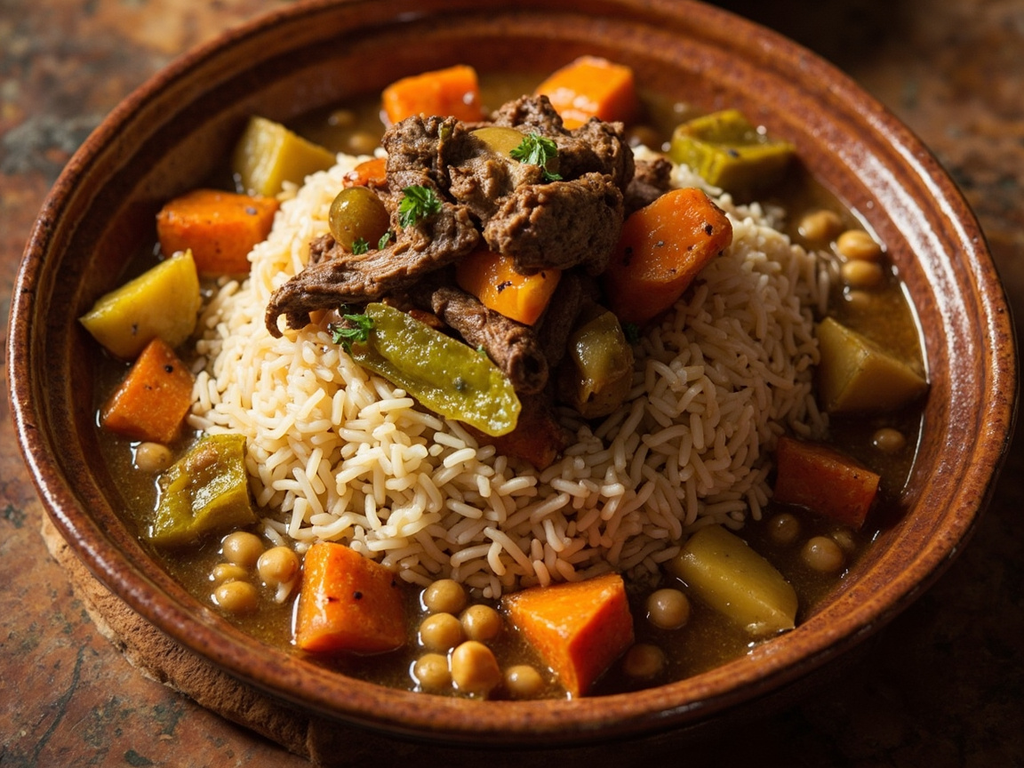
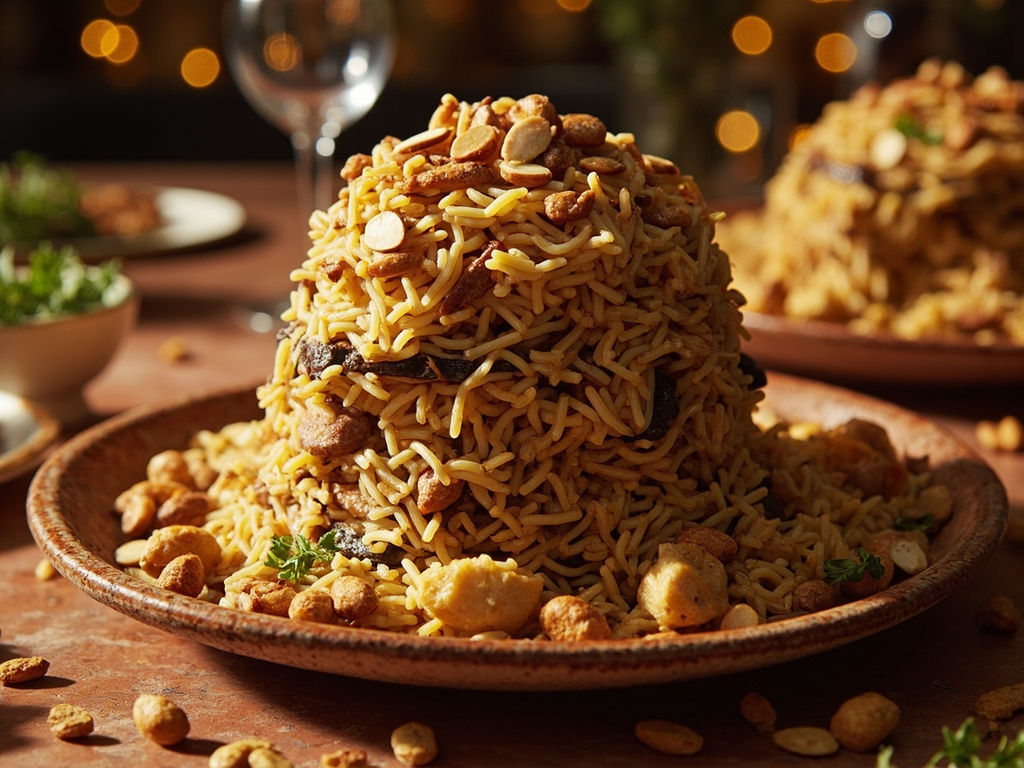
A layered construction of rice, golden fried eggplant and slow-cooked meat with baharat and cinnamon, cooked in a pot then flipped onto a large platter, crowned with toasted almonds and pine nuts. Broken and shared communally at the center of the table.
My wife Dema had, for gathering evenings, a gesture I admired as much as a successful experiment: she would grasp the heavy pot, invert it with a sure movement onto the large platter, and wait — a moment of perfect silence — before lifting it to reveal the tower of rice and eggplant intact. Maqluba, "the overturned one," we called it. I assure you, that flipping, that sudden and irreversible transformation of matter, spoke to the researcher in me. We would eat it all together, from the platter, perfumed with cinnamon and baharat — a little piece of the Levant set on our table in Pasadena.
- •Long-grain rice — for the table (base of the dish)
- •Lamb or chicken — stewed pieces (meat)
- •Eggplants — several, fried (melting layer)
- •Baharat, cinnamon, allspice — to taste (signature spices)
- •Almonds and pine nuts — a handful (toasted garnish)
- •Meat broth — for cooking rice (umami)
Dema's Levantine Maqluba
A layered construction of rice, golden fried eggplant and slow-cooked meat with baharat and cinnamon, cooked in a pot then flipped onto a large platter, crowned with toasted almonds and pine nuts. Broken and shared communally at the center of the table.
Why this dish? Zewail's wife Dema regularly prepared Levantine dishes that reminded the chemist of his Mediterranean roots. Maqluba — literally "upside-down" — is the great shared dish of Syrian-Lebanese tables, spectacular when the pot is overturned onto the platter.
My wife Dema had, for gathering evenings, a gesture I admired as much as a successful experiment: she would grasp the heavy pot, invert it with a sure movement onto the large platter, and wait — a moment of perfect silence — before lifting it to reveal the tower of rice and eggplant intact. Maqluba, "the overturned one," we called it. I assure you, that flipping, that sudden and irreversible transformation of matter, spoke to the researcher in me. We would eat it all together, from the platter, perfumed with cinnamon and baharat — a little piece of the Levant set on our table in Pasadena.
Ingredients (period version)
- Long-grain rice — for the table (base of the dish)
- Lamb or chicken — stewed pieces (meat)
- Eggplants — several, fried (melting layer)
- Baharat, cinnamon, allspice — to taste (signature spices)
- Almonds and pine nuts — a handful (toasted garnish)
- Meat broth — for cooking rice (umami)
Ingredients
- Basmati rice — 400 g (base)
- Chicken thighs (or lamb shoulder) — 800 g (meat)
- Eggplants — 2 large, sliced (melting layer)
- Baharat spice mix — 1.5 tsp (signature spice)
- Ground cinnamon — 1/2 tsp (spice)
- Onion — 1, sliced (aromatic)
- Chicken broth — 600 ml (rice cooking liquid)
- Almonds and pine nuts — 60 g (toasted garnish)
- Olive oil — for frying (cooking)
- Salt and pepper — to taste (seasoning)
Method
- Brown the chicken with onion, baharat and cinnamon, then cover with water and simmer 30 min; reserve meat and broth.
- Fry eggplant slices until golden, drain on paper.
- Rinse the rice. In a pot, line the bottom with chicken pieces, then a layer of eggplant, then the raw rice.
- Pour hot broth over until it covers the rice by a finger's width; season with salt, bring to a boil then cook covered over low heat 25-30 min.
- Let rest 10 min off heat, lid on.
- Place a large platter over the pot and flip it in one confident motion; lift gently and crown with toasted almonds and pine nuts.
How it was made : Maqluba is attested in the cuisine of the Bilad al-Sham region (Syria, Lebanon, Palestine, Jordan) since medieval times; a similar version already appears in the 13th-century Kitab al-Tabikh. Once cooked in a single clay or copper pot over the fire, it was — and remains — the dish for large gatherings, where the flipping gesture is performed before the guests.
The contemporary twist : Mold individual portions in small bowls inverted onto each plate: each diner "flips their own pot," re-enacting the spectacle on a personal scale.
Sources : Claudia Roden, The New Book of Middle Eastern Food · Anissa Helou, Levant: Recipes and Memories from the Middle East
Ahmed Zewail · Charactorium