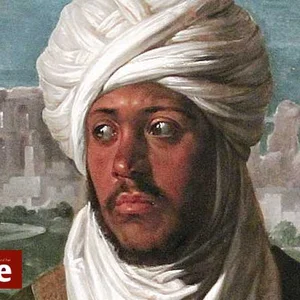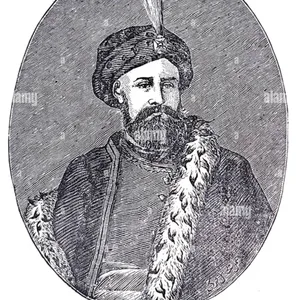

Seventh Abbasid caliph (reigned 813-833), son of Harun al-Rashid. A patron of scholars, he expanded the House of Wisdom (Bayt al-Hikma) in Baghdad, a center of translation and scientific research.
Al-Ma'mun(786 — 833)
Al-Ma’mūn
6 min read
Frequently asked questions
Key Facts
- Becomes Abbasid caliph in 813 after a civil war against his brother al-Amin
- Expands the House of Wisdom (Bayt al-Hikma) in Baghdad, a center of Greek-to-Arabic translation
- Supports the work of the mathematician al-Khwarizmi, including a world map and the field of algebra
- Funds scientific measurements such as the estimation of the Earth's circumference
- Dies in 833 during a military campaign against the Byzantine Empire
Works & Achievements
Al-Ma'mūn transformed this institution into a major center of translation and research, attracting the finest scholars of the empire. It ensured the transmission of the scientific heritage of antiquity to the Arab world and later to Europe.
He funded the systematic translation of the works of Aristotle, Ptolemy, Euclid, and Galen. This movement made Arabic the leading scientific language of the Middle Ages.
At his command, astronomers measured a degree of meridian in the plain of Sinjar to estimate the size of the globe. The result was astonishingly accurate for the time.
The caliph's geographers drew up a revised map of the known world, correcting Ptolemy's data. It stands among the first great scientific maps of medieval Islam.
He supported the creation of astronomical tables based on observation, including those associated with al-Khwarizmi. These tables were used to predict the positions of celestial bodies.
Under his patronage, al-Khwarizmi wrote his founding treatise on algebra. The word “algorithm” derives from the name of this scholar attached to the caliph's court.
Al-Ma'mūn imposed the Mu'tazilite doctrine of the created Quran through an official inquisition of judges and scholars. This controversial policy left a lasting mark on the relations between power and religion.
Anecdotes
According to the chroniclers, al-Ma'mūn sent envoys as far as Constantinople to buy or copy ancient Greek manuscripts. Legend has it that he demanded scientific manuscripts as war tribute from the Byzantine emperor, preferring books to gold.
The caliph funded an expedition of astronomers to the plain of Sinjar to measure the length of a degree of the Earth's meridian. By comparing the positions of the stars at different latitudes, his scholars calculated the circumference of the Earth with remarkable accuracy for the time.
Al-Ma'mūn came to the throne after a bloody civil war against his half-brother al-Amin, which ended with the siege of Baghdad in 813. He then had to move his court temporarily to Merv, in Central Asia, before restoring Abbasid authority over the capital.
A passionate lover of debate, he held controversies (majlis) in his palace where philosophers, Muslim, Christian, Jewish, and Zoroastrian theologians freely discussed questions of reason and faith. The caliph took part himself, defending the use of Greek logic.
Toward the end of his reign, al-Ma'mūn imposed the doctrine of the “created Quran” through an ordeal called the mihna, a kind of inquisition that forced judges and scholars to adopt this rationalist position, imprisoning those who refused, such as the famous theologian Ahmad ibn Hanbal.
Primary Sources
Al-Ma'mūn was the most learned of the caliphs in matters of jurisprudence and the sciences; he loved to surround himself with scholars and to debate with them.
Al-Ma'mūn saw Aristotle in a dream and questioned him about the good; this dream prompted him to send for the books of the philosophers from the lands of the Greeks and to have them translated.
He gathered around him the men of learning, founded the House of Wisdom, and had the works of the Ancients translated into the Arabic language.
No caliph before him had so greatly encouraged knowledge nor rewarded scholars and translators with such generosity.
Key Places
Capital of the Abbasid Empire and seat of the House of Wisdom, a global center of knowledge in the 9th century. Al-Ma'mūn ruled there after regaining control of the city in 819.
A great city of Khorasan (in present-day Turkmenistan) where al-Ma'mūn served as governor and then established his court at the beginning of his reign. It was there that he prepared the reconquest of Baghdad.
An institution for translation and research that the caliph expanded, bringing together astronomers, mathematicians, and translators. It was there that Greek, Persian, and Indian knowledge was rendered into Arabic.
A region of northern Mesopotamia where the caliph's astronomers measured the length of one degree of a meridian around 830. The experiment made it possible to estimate the circumference of the Earth.
A city in Cilicia, on the Byzantine frontier, where al-Ma'mūn died in 833 during a military campaign. He was buried there.
Typical Objects

Astronomical instrument made of brass used to measure the altitude of celestial bodies, tell the time, and determine the direction of Mecca. The scholars of the House of Wisdom greatly perfected it.

A paper codex in which translators such as Hunayn ibn Ishaq rendered the works of Aristotle, Ptolemy, or Galen into Arabic. These books were the raw material of the House of Wisdom.

A trimmed reed (qalam) dipped in ink, the everyday tool of the scribes and copyists who multiplied written works. The use of paper, imported from China, made copying faster and less costly.

A metal sphere depicting the starry sky and the constellations, used for astronomical teaching and calculation. The astronomers of al-Ma'mūn recorded their observations on it.

A gold coin struck in the name of the caliph, bearing Quranic inscriptions. It was used for trade throughout the empire and displayed the authority of the ruler.

A map of the known world made by the caliph's geographers from Ptolemy's corrected data. It depicted the lands, seas, and rivers of the empire and beyond.
School Curriculum
Vocabulary & Tags
Key Vocabulary
Tags
Daily Life
Morning
The caliph began his day with the dawn prayer, then received his ministers (viziers) and secretaries to handle the affairs of the empire. The official correspondence, delivered by the barid (postal) service, was read to him, and he dictated his decisions.
Afternoon
In the afternoon, he might hold a public audience (majlis), hear petitions, and dispense justice. He also devoted time to receiving scholars and translators, examining manuscripts and the results of observations.
Evening
In the evening, al-Ma'mūn enjoyed presiding over intellectual debates where theologians and philosophers confronted one another's ideas. Banquets, poetry, and music sometimes accompanied these refined gatherings of the Abbasid court.
Food
The caliph's table offered wheat bread, lamb and poultry, rice, vegetables, and fresh and dried fruits (dates, figs, pomegranates). Spices from the East, sugar, syrups, and sorbets scented with rose water reflected the refinement of the court's cuisine.
Clothing
He wore long robes (qaba, jubba) of silk and fine linen, often embellished with tiraz, the embroidered bands bearing inscriptions. The turban and the black cloak, the dynastic color of the Abbasids, marked his rank.
Housing
The caliph resided in vast palaces in Baghdad adorned with courtyards, gardens, pools, and audience halls decorated with stucco and carpets. These residences housed a large court, servants, and libraries.
Historical Timeline
Period Vocabulary
Liens externes & ressources
Références
Œuvres
Développement de la Maison de la Sagesse (Bayt al-Hikma)
vers 820-833
Programme de traductions gréco-arabes
règne 813-833
Mesure de la circonférence de la Terre
vers 830
Carte du monde al-Ma'mūniyya
vers 830
Patronage des Zij (tables astronomiques)
règne 813-833
Soutien aux mathématiques d'al-Khwarizmi
vers 820
Instauration de la mihna
833