
Giorgio Vasari was an Italian painter, architect, and writer of the Renaissance. Author of "Lives of the Most Excellent Painters, Sculptors, and Architects" (1550), he is considered the first art historian. He also designed the Uffizi Palace in Florence.
Giorgio Vasari(1511 — 1574)
Giorgio Vasari
République florentine, grand-duché de Toscane
7 min read
Frequently asked questions
Key Facts
- Born in Arezzo in 1511, he trained in Florence under the Medici
- Published in 1550 "Le Vite", the first major history of Italian artists (expanded edition in 1568)
- Popularized the notion of "Rinascita" (rebirth) of the arts since ancient Greece and Rome
- Designed from 1560 the Uffizi Palace in Florence for Cosimo I de' Medici
- Died in Florence in 1574 after working on the frescoes of the dome of Santa Maria del Fiore
Works & Achievements
Foundational work of art history gathering biographies of over 130 artists from Cimabue to Michelangelo. It introduces the concept of *rinascita* (Renaissance) and remains an essential primary source.
Monumental ensemble of frescoes and painted coffered ceilings celebrating the wars and glories of Florence, commissioned by Cosimo I in a hall 52 meters long and 18 meters high.
Building designed for the Florentine magistracies, which after Vasari's death became Italy's most famous museum, housing unparalleled collections of Renaissance painting.
Elevated passageway one kilometer long connecting the seat of government to the private Medici residence, allowing the duke to move safely and out of sight, built in six months.
Vasari entirely decorated his native home with allegorical frescoes featuring the arts and the Muses—a learned iconographic program that constitutes his personal artistic manifesto.
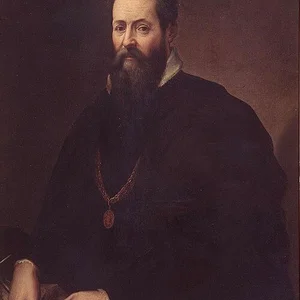
Held at the Uffizi, this official portrait shows Vasari in court attire holding a book, alluding to his *Lives*. It testifies to the social and intellectual ambition of an artist who saw himself as both creator and historian.
Anecdotes
As a child, Vasari was entrusted to the care of his great-uncle Luca Signorelli, a renowned painter, who introduced him to the arts. At twelve, he was sent to Florence to study under Michelangelo Buonarroti himself — a decisive encounter that fueled his entire career and explains the absolute admiration he held for the old master until the latter's death.
The first edition of *Lives* (1550) was born from a dinner at Cardinal Alessandro Farnese's in Rome: the humanist Paolo Giovio lamented that no collection existed on the great Italian artists. Vasari spoke up, revealed his notes, and Giovio encouraged him to turn them into a book. In barely two years, he wrote a work of several hundred pages that would establish art history as a discipline.
When Michelangelo died in Rome in 1564, it was Vasari who organized the secret repatriation of his remains to Florence, hidden in luggage to deceive the Roman authorities who wanted to keep the body. He then oversaw the solemn funeral at the Basilica of San Lorenzo, turning the event into a demonstration of the glory of Florentine arts.
The Vasari Corridor, commissioned by Cosimo I in 1565, was built in less than six months: this one-kilometer elevated passage connected the Palazzo Vecchio to the Medici residence by crossing over the Ponte Vecchio. A logistical and architectural feat that his contemporaries deemed almost miraculous, accomplished without interrupting traffic on the bridge.
Primary Sources
I have set myself to describe the lives and works of the most excellent painters, sculptors, and architects, as those who have with their art brought glory to their homeland and nation.
He took such pleasure whenever something rare and strange came into his hands that Leonardo began to make some laughing female heads and heads of old men with such beards and hair, drawn with the pen, that they are divine.
God sent to the art of design a universal spirit in every art and every profession, one who alone could show in himself what the perfection of the art of design is.
Design, the father of our three arts—architecture, sculpture, and painting—proceeding from the intellect, draws from many things a universal judgment.
Key Places
Vasari's birthplace, where he had his own house (Casa Vasari) built and decorated, now a museum. He returned there regularly throughout his life.
Seat of Medici power that Vasari transformed from 1555 to 1572 with immense fresco cycles glorifying the Medici family and the history of Florence, including the famous Sala dei Cinquecento.
U-shaped building designed by Vasari starting in 1560 for Cosimo I's administrative offices; today it houses one of the greatest art museums in the world.
Elevated covered passageway one kilometer long, built in 1565, connecting the Palazzo Vecchio to the Palazzo Pitti over the Ponte Vecchio, allowing the duke to move safely.
Vasari stayed here several times for ecclesiastical patrons, notably Cardinal Farnese. He studied antiquities and works by Raphael, which lastingly influenced his style.
Typical Objects

Vasari's everyday tools in his large-scale mural painting projects. His mastery of the fresco technique is detailed in his own introductory treatise to the *Lives*.

The annotated folios in his own hand, corrected and expanded between 1550 and 1568, constitute the founding document of art history; autograph corrections survive in several Italian libraries.

Essential tools for Vasari in designing the **Uffizi** and the **Corridoio Vasariano**. He constantly juggled his roles as painter and architect in the service of the **Medici**.

Vasari wrote his texts by hand, in literary Tuscan, often late at night after his workdays. His correspondence with **Cosimo I** and **Michelangelo** is abundant and precious.

Vasari assembled a famous collection of original drawings by great masters, mounted on sheets adorned with borders drawn by himself — one of the first systematic collections of graphic art in history.

The 1568 *Lives* is illustrated with engraved medallions depicting the biographed artists, sometimes reconstructed from memory. Vasari personally supervised their execution to reinforce the authority of his work.
School Curriculum
Vocabulary & Tags
Key Vocabulary
Daily Life
Morning
Vasari rose early to take advantage of the natural light essential for fresco painting. He began by inspecting ongoing worksites—the Palazzo Vecchio or the Uffizi—giving instructions to his assistants and masons before the heat of the day made the work difficult.
Afternoon
The afternoon was devoted to meetings with patrons, notably Cosimo I de' Medici, to discuss iconographic programs, deadlines, and costs. Vasari managed a large workshop with several apprentices and collaborators, overseeing both painted works and architectural projects.
Evening
In the evening, by candlelight, Vasari wrote his letters and worked on his *Lives*. A prolific correspondent, he maintained regular exchanges with Michelangelo, humanists, and artists from all over Italy to gather information and anecdotes about masters of the past and present.
Food
The table of a prosperous 16th-century Florentine painter included white bread, roasted meats, freshwater fish, seasonal vegetables, and Tuscan wines. Meals were often shared with collaborators or patrons, the banquet being a key social space in Renaissance artistic life.
Clothing
Vasari wore the attire of the gentleman-artist: a doublet of fine cloth, hose, and a cloak, sometimes in dark colors to avoid stains during painting sessions. Received at the Medici court, he dressed carefully, mindful of the social image of the artist that he theorized in his own writings.
Housing
Vasari owned a house in Arezzo that he decorated himself and lodged in Florence near the Medici worksites. His Florentine workspace was a studio-workshop crowded with drawings, books, models, and collections of prints—a reflection of his dual identity as creator and scholar.
Historical Timeline
Period Vocabulary
Visual Style
Le style de Vasari reflète le maniérisme florentin : figures élancées aux poses savantes, couleurs froides et lumineuses, compositions denses héritées de Michel-Ange et Raphaël dans un cadre architectural solennel et ornemental.
Sound Ambience
L'univers sonore de Vasari mêle les bruits du chantier architectural et de la peinture à fresque aux grattements nocturnes de la plume sur le parchemin lors de ses longues sessions d'écriture à la chandelle.
Liens externes & ressources
Références
Œuvres
Le Vite de' più eccellenti pittori, scultori e architettori
1550 — 1568
Corridoio Vasariano
1565
Autoportrait (huile sur panneau)
vers 1566 — 1568