 flip
flipSalt Oat Porridge
Salt Oat Porridge
Why this dish? Born in Edinburgh into a middle-class Scottish family, Bell grew up with salted morning porridge, the national dish that every Scottish child stirred with a spurtle, that wooden stick. It was the taste of childhood he carried with him all the way to Canada.
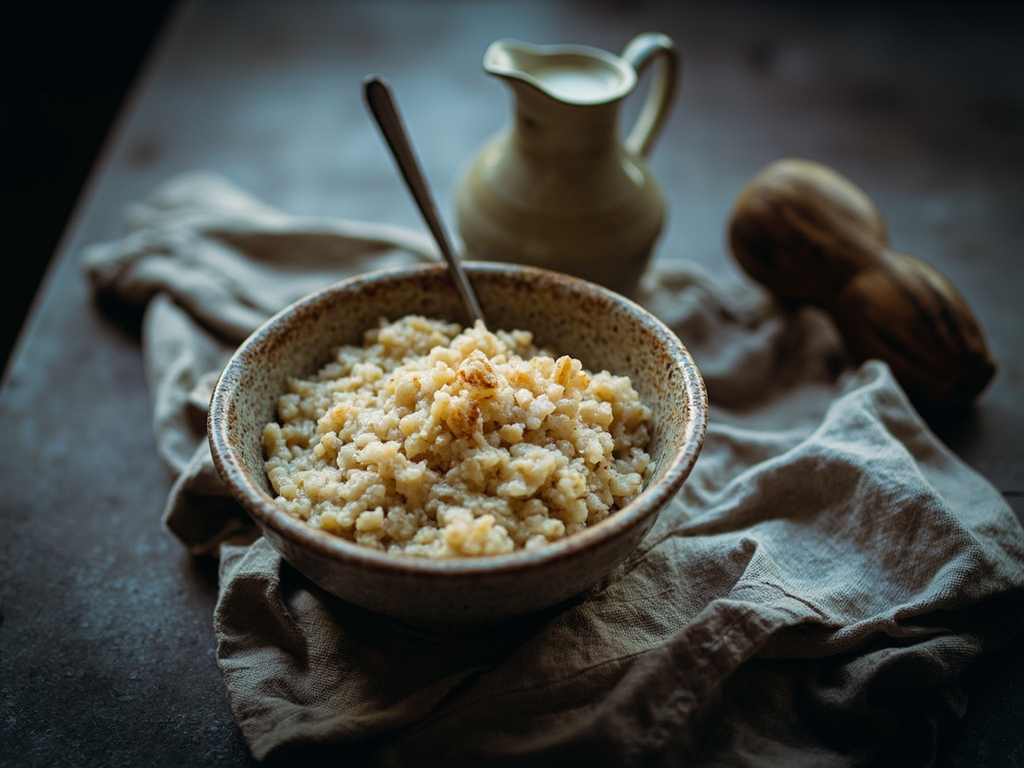
A thick, comforting oatmeal slowly cooked in water, salted and never sweetened according to Scottish tradition. Eaten hot, sometimes dipped alternately into a bowl of cold milk set beside it.
In our home in Edinburgh, we did not trifle with porridge: we salted it, never sweetened it, and always stirred it clockwise with the spurtle, lest we bring bad luck — or so my mother's cook said. I ate it standing, as any good Scotsman should, dipping my spoonful into a bowl of cold milk before swallowing. Believe me, my young friend, on misty mornings on the Forth, nothing beats that warmth of oatmeal in the pit of your stomach.
- •Pinhead oatmeal — a good handful per person (nourishing base)
- •Spring water — as needed (cooking liquid)
- •Salt — a pinch (seasoning (added at the end of cooking))
- •Fresh milk — a separate bowl (accompaniment)
Salt Oat Porridge
A thick, comforting oatmeal slowly cooked in water, salted and never sweetened according to Scottish tradition. Eaten hot, sometimes dipped alternately into a bowl of cold milk set beside it.
Why this dish? Born in Edinburgh into a middle-class Scottish family, Bell grew up with salted morning porridge, the national dish that every Scottish child stirred with a spurtle, that wooden stick. It was the taste of childhood he carried with him all the way to Canada.
In our home in Edinburgh, we did not trifle with porridge: we salted it, never sweetened it, and always stirred it clockwise with the spurtle, lest we bring bad luck — or so my mother's cook said. I ate it standing, as any good Scotsman should, dipping my spoonful into a bowl of cold milk before swallowing. Believe me, my young friend, on misty mornings on the Forth, nothing beats that warmth of oatmeal in the pit of your stomach.
Ingredients (period version)
- Pinhead oatmeal — a good handful per person (nourishing base)
- Spring water — as needed (cooking liquid)
- Salt — a pinch (seasoning (added at the end of cooking))
- Fresh milk — a separate bowl (accompaniment)
Ingredients
- Rolled oats (or pinhead oatmeal) — 50 g per person (base)
- Water — 250 ml per person (cooking liquid)
- Fine salt — 1 generous pinch (seasoning)
- Cold milk — 1 small bowl per person (for dipping)
Method
- Bring the water to a simmer in a heavy-bottomed saucepan.
- Sprinkle in the oatmeal while stirring constantly to prevent lumps.
- Reduce the heat and cook gently for 5 minutes (rolled oats) to 25 minutes (pinhead oatmeal), stirring often.
- Salt only at the end of cooking — salting too early hardens the grains.
- Serve piping hot in a bowl, with a second bowl of cold milk alongside to dip each spoonful.
How it was made : In Scottish farms and homes, a large batch of porridge was often made and poured into a lined drawer (the 'porridge drawer'); once cooled and set, it was cut into slices to take to the fields. Porridge was referred to in the plural ('they are ready') out of respect.
The contemporary twist : For less traditional palates, a drizzle of heather honey and a few raspberries turn this austere breakfast into a treat — but don't say it too loudly in Scotland.
Sources : F. Marian McNeill, The Scots Kitchen (1929)
Alexander Graham Bell · Charactorium