 flip
flipConfit Duck from the Reserve
Confit Duck from the Reserve
Why this dish? Before modern refrigeration, confit allowed the South-West to eat meat all year round. Falguière, son of a region of geese and ducks, knew this pot of fat from which one drew over the months — the same logic of patient reserve as a workshop that keeps its plaster molds ready to use.
Duck legs salted then cooked very slowly in their own fat, then preserved in it, protected from air. A preservation technique that is also one of the greatest delicacies of the Gascon table.
Here is the treasure of the Gascon house, the confit pot. We salted the legs the night before, with plenty of coarse salt, then cooked them very gently in the fat, never letting it boil — just a simmer, like the patience needed before clay that you don't rush. Then we stored everything in the toupin, that earthenware pot, completely submerged in fat, in the cellar. And all winter we drew from it: a piece for the garbure, another pan-fried for busy days. Nothing was wasted, everything was kept. It's the wisdom of the poor that became a king's delight.
- •Fat duck (or goose) legs — according to desired reserve (meat)
- •Coarse salt — a good handful (curing and preservation)
- •Duck or goose fat — enough to submerge (cooking and protection)
- •Garlic, thyme, bay leaf, pepper — to taste (aromatics)
Confit Duck from the Reserve
Duck legs salted then cooked very slowly in their own fat, then preserved in it, protected from air. A preservation technique that is also one of the greatest delicacies of the Gascon table.
Why this dish? Before modern refrigeration, confit allowed the South-West to eat meat all year round. Falguière, son of a region of geese and ducks, knew this pot of fat from which one drew over the months — the same logic of patient reserve as a workshop that keeps its plaster molds ready to use.
Here is the treasure of the Gascon house, the confit pot. We salted the legs the night before, with plenty of coarse salt, then cooked them very gently in the fat, never letting it boil — just a simmer, like the patience needed before clay that you don't rush. Then we stored everything in the toupin, that earthenware pot, completely submerged in fat, in the cellar. And all winter we drew from it: a piece for the garbure, another pan-fried for busy days. Nothing was wasted, everything was kept. It's the wisdom of the poor that became a king's delight.
Ingredients (period version)
- Fat duck (or goose) legs — according to desired reserve (meat)
- Coarse salt — a good handful (curing and preservation)
- Duck or goose fat — enough to submerge (cooking and protection)
- Garlic, thyme, bay leaf, pepper — to taste (aromatics)
Ingredients
- Fat duck legs — 4 (meat)
- Coarse salt — 60 g (curing)
- Duck fat — 1 kg (enough to submerge) (cooking and preservation)
- Garlic — 3 cloves, crushed (aromatic)
- Thyme and bay leaf — a few sprigs (aromatic)
- Black peppercorns — 1 tsp (aromatic)
Method
- The day before: rub the legs with coarse salt, crushed garlic, thyme, bay leaf, and pepper. Cover and refrigerate for 12 to 24 h.
- The next day, rinse and thoroughly dry the legs to remove excess salt.
- Melt the fat over low heat in a large pot. Submerge the legs completely.
- Cook very gently, without boiling (around 85 °C), for 2 h 30 to 3 h: the meat should fall off the bone.
- To preserve: place the legs in a stoneware pot or jar, cover entirely with strained warm fat. Keep cool.
- To serve: take out a leg, pan-fry skin-side down until crispy. Serve with sarladaise potatoes (sautéed in a bit of the same fat).
How it was made : Confit was the great protein reserve of the year on South-West farms: preserved under fat in a stoneware 'toupin' in the cellar, it could last several months. It is the natural by-product of raising geese and ducks for foie gras.
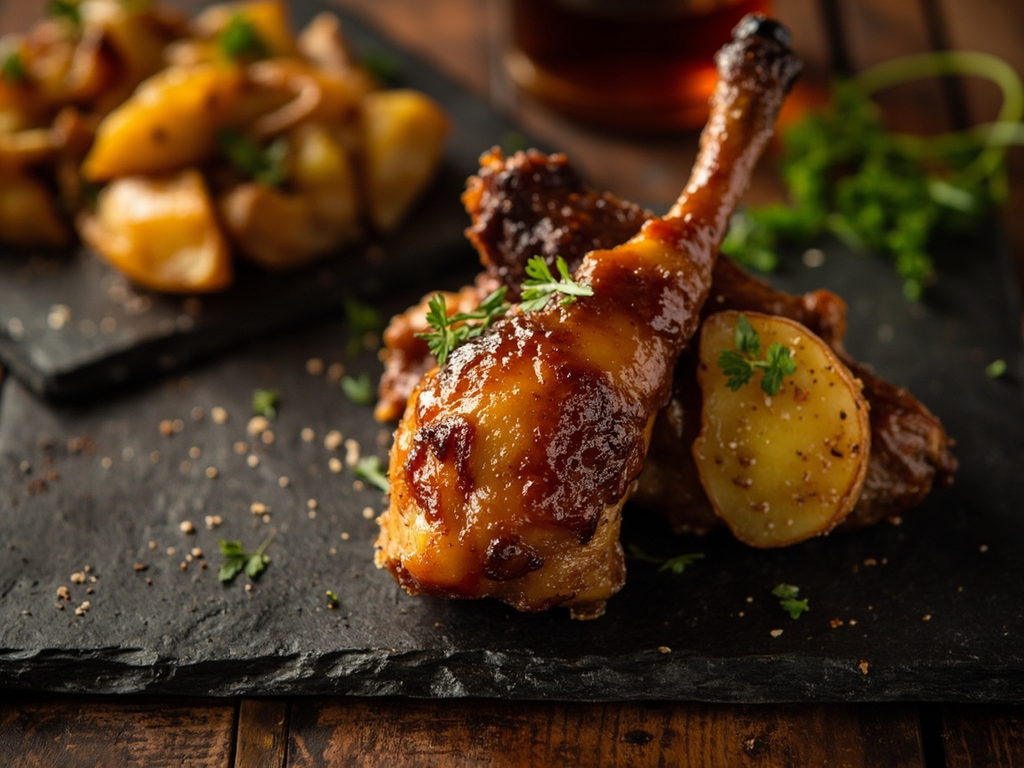
The contemporary twist : Serve the crispy leg on a raw slate board with sarladaise potatoes and a pinch of fleur de sel: the matte contrast of the slate and the golden crisp evokes bronze and its patina.
Sources : 19th-century Gascon domestic economy treatises on preservation under fat · Prosper Montagné, on confit techniques of the South-West
Alexandre Falguière · Charactorium