 flip
flipPlateau des fromages de France
Plateau des fromages de France
Why this dish? No food is more Gaullian than cheese. The General is still associated with the famous quip about the difficulty of governing a country with hundreds of cheese varieties. His table always included cheese, a symbol of the French diversity he loved and defended.
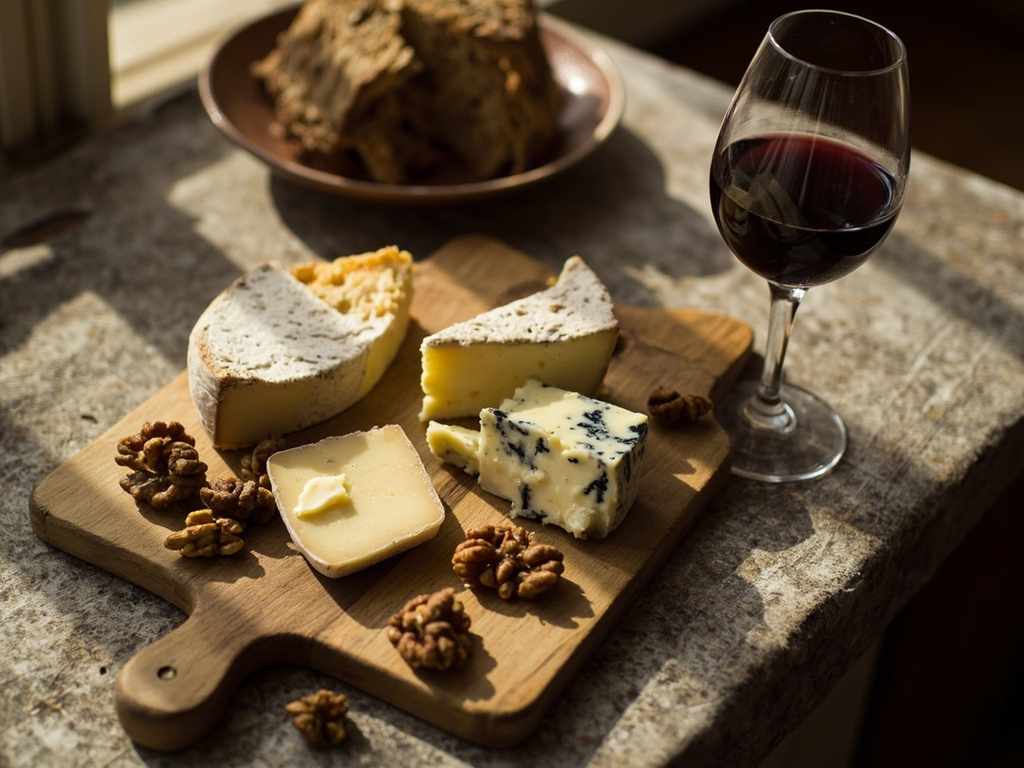
Not a recipe but an art of assembly: a selection of French cheeses with varied textures and aging, presented on a board, served with good bread and accompanied by a glass of wine. Cheese is a preservation product par excellence, born from the need to keep milk.
I have often been credited with that saying, and I am happy to own it: how, I ask you, can one govern a country that has so many varieties of cheese? But that, precisely, is all of France! Every valley, every village has its milk, its rind, its aging. At my table, we never skipped the platter: an aged Comté, a crottin, a blue from the region. Taste them with bread and an honest glass of wine, and you will hold the entire nation on your plate.
- •Hard cooked pressed cheese (e.g., aged Comté) — a wedge (hard cheese, long keeping)
- •Farmhouse goat cheese — 1 to 2 (fresh to aged cheese)
- •Soft-ripened cheese (e.g., Camembert, Brie) — 1 (bloomy rind)
- •Blue cheese (e.g., Roquefort, Fourme) — a piece (blue-veined cheese)
- •Country bread — 1 loaf (accompaniment)
Plateau des fromages de France
Not a recipe but an art of assembly: a selection of French cheeses with varied textures and aging, presented on a board, served with good bread and accompanied by a glass of wine. Cheese is a preservation product par excellence, born from the need to keep milk.
Why this dish? No food is more Gaullian than cheese. The General is still associated with the famous quip about the difficulty of governing a country with hundreds of cheese varieties. His table always included cheese, a symbol of the French diversity he loved and defended.
I have often been credited with that saying, and I am happy to own it: how, I ask you, can one govern a country that has so many varieties of cheese? But that, precisely, is all of France! Every valley, every village has its milk, its rind, its aging. At my table, we never skipped the platter: an aged Comté, a crottin, a blue from the region. Taste them with bread and an honest glass of wine, and you will hold the entire nation on your plate.
Ingredients (period version)
- Hard cooked pressed cheese (e.g., aged Comté) — a wedge (hard cheese, long keeping)
- Farmhouse goat cheese — 1 to 2 (fresh to aged cheese)
- Soft-ripened cheese (e.g., Camembert, Brie) — 1 (bloomy rind)
- Blue cheese (e.g., Roquefort, Fourme) — a piece (blue-veined cheese)
- Country bread — 1 loaf (accompaniment)
Ingredients
- Comté aged 18 months — 150 g (hard cooked pressed cheese, umami notes)
- Crottin de chèvre — 1 (goat cheese)
- Camembert au lait cru — 1/2 (soft-ripened bloomy rind)
- Roquefort or Fourme d'Ambert — 100 g (blue-veined cheese)
- Sourdough country bread — 1/2 loaf (accompaniment)
- Salted butter, a few walnuts — to taste (garnish)
Method
- Take the cheeses out of the refrigerator 1 hour before serving: they must be at room temperature to release all their aromas.
- Arrange them on a wooden board or platter, from mildest (goat cheese, Comté) to strongest (blue), clockwise.
- Provide one knife per cheese family to avoid mixing flavors, and slice the country bread.
- Serve with a little salted butter, a few walnuts, and a glass of red or white wine depending on the cheeses.
How it was made : Cheese is one of the oldest techniques for preserving milk: by transforming a perishable product into aged cheese, French peasants got through the winter. In the 20th century, each region jealously defended its cheeses, and their diversity was — and still is — a source of national pride.
The contemporary twist : Present a handwritten card placed near the board, indicating the origin and age of each cheese, like a little gastronomic tour of France.
Charles de Gaulle · Charactorium