Sambusa-ye Gushti (Spiced Lamb Stuffed Pastries)
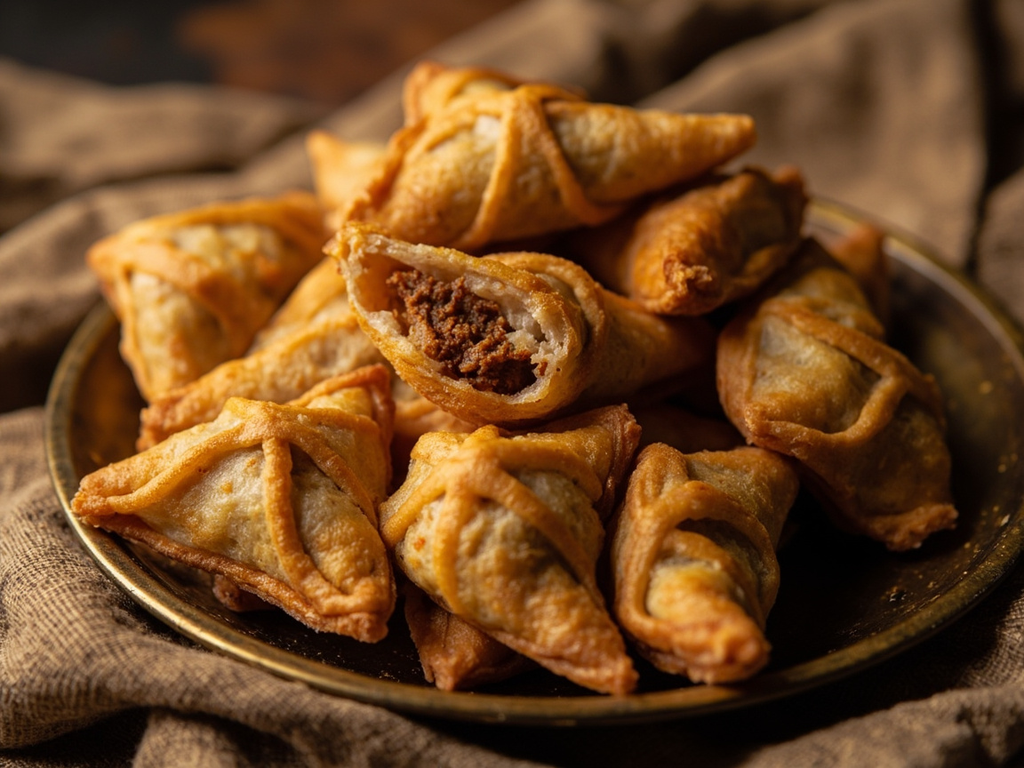
Triangular pastries of thin dough, filled with minced lamb seasoned with onion, cumin, and black pepper, baked (or fried). Crisp on the outside, juicy and spiced within.
Triangular pastries of thin dough, filled with minced lamb seasoned with onion, cumin, and black pepper, baked (or fried). Crisp on the outside, juicy and spiced within.
In the bazaar of Herat, between the silk merchant and the calligrapher's stall, one can always find a man folding his sambusa with the dexterity of an illuminator. I sometimes buy two or three when my duties press me and I have no leisure to sit at table. The dough must be thin as a manuscript leaf, and the filling seasoned just enough to awaken the palate without overwhelming it. When I traveled toward Samarkand, these little parcels wrapped in cloth were my most faithful traveling companions — after my poems, of course.
- •Wheat flour — for the dough (Wrapper)
- •Minced lamb — a good portion (Filling)
- •Onion — one, finely chopped (Aromatic for the filling)
- •Cumin — half a spoonful (Dominant spice)
- •Black pepper — to taste (Heat)
- •Salt — to taste (Seasoning)
- •Sheep's tail fat or sesame oil — for frying (Cooking)
Sambusa-ye Gushti (Spiced Lamb Stuffed Pastries)
Triangular pastries of thin dough, filled with minced lamb seasoned with onion, cumin, and black pepper, baked (or fried). Crisp on the outside, juicy and spiced within.
Why this dish? Sambusa are mentioned in medieval Persian culinary treatises and were sold in the bazaars of Herat and Samarkand that Navoi frequented. A traveler between Herat, Samarkand, and Mashhad in the sultan's service, Navoi knew these easily carried pastries — food for the road, the bazaar, and the poet in a hurry.
In the bazaar of Herat, between the silk merchant and the calligrapher's stall, one can always find a man folding his sambusa with the dexterity of an illuminator. I sometimes buy two or three when my duties press me and I have no leisure to sit at table. The dough must be thin as a manuscript leaf, and the filling seasoned just enough to awaken the palate without overwhelming it. When I traveled toward Samarkand, these little parcels wrapped in cloth were my most faithful traveling companions — after my poems, of course.
Ingredients (period version)
- Wheat flour — for the dough (Wrapper)
- Minced lamb — a good portion (Filling)
- Onion — one, finely chopped (Aromatic for the filling)
- Cumin — half a spoonful (Dominant spice)
- Black pepper — to taste (Heat)
- Salt — to taste (Seasoning)
- Sheep's tail fat or sesame oil — for frying (Cooking)
Ingredients
- Flour — 300 g (Dough)
- Warm water — 150 ml (Hydration)
- Salt — 1 tsp (Dough + filling)
- Vegetable oil — 2 tbsp (dough) + for brushing (Pliability)
- Minced lamb — 350 g (Filling)
- Onion — 1 large, finely sliced (Filling)
- Ground cumin — 1.5 tsp (Spice)
- Ground black pepper — 0.5 tsp (Heat)
- Ground coriander — 0.5 tsp (Spice)
- Egg yolk — 1 (for glazing) (Finish)
Method
- Prepare the dough: mix the flour, salt, oil, and warm water. Knead for 5 minutes until smooth. Cover and let rest for 30 minutes.
- Prepare the filling: combine the raw minced lamb with the finely sliced onion, cumin, coriander, pepper, and salt. Mix well.
- Divide the dough into 10-12 portions. Roll out each portion into a thin circle (2 mm thick).
- Place a generous spoonful of filling in the center, fold into a triangle, and seal the edges by pressing with a fork.
- Preheat the oven to 200°C (390°F). Arrange the sambusa on a baking sheet lined with parchment paper, brush with egg yolk.
- Bake for 25 minutes until golden brown and crisp.
- Serve hot, with a bowl of plain yogurt if desired.
How it was made : The word sambusa (source of the Indian samosa) appears in Persian culinary texts as early as the 10th century (Kitab al-Tabikh). Ibn Battuta mentions sanbusak during his travels in Central Asia in the 14th century. In the Timurid era, they were fried in sheep's tail fat. The triangular shape is the oldest form documented in the region.
The contemporary twist : Bake rather than fry for a lighter version. Serve with a pomegranate and walnut chutney to stay within the Persian spirit.
Sources : Charles Perry, A Baghdad Cookery Book (translation of Kitab al-Tabikh), Prospect Books, 2005 · Ibn Battuta, Rihla (Travels), 14th century — mentions of sanbusak in Central Asia
Alisher Navoi · Charactorium