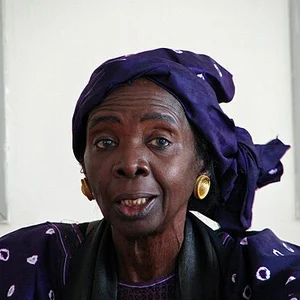

Aminata Sow Fall (born in 1941) is a pioneering Senegalese novelist of Francophone African literature. Her novel La Grève des Bàttu (1979) brought her international recognition and explores social inequalities in postcolonial Africa.
Frequently asked questions
Famous Quotes
« Money doesn't bring happiness, but it certainly helps.»
Key Facts
- Born on April 27, 1941 in Saint-Louis, Senegal
- Publication of La Grève des Bàttu in 1979, shortlisted for the Prix Goncourt
- Founder of the Centre africain d'Animation et d'Échanges culturels (CAEC) in Dakar
- First African woman to be considered for the Prix Goncourt
- Author of several novels including L'Appel des arènes (1982) and Le Revenant (1976)
Works & Achievements
Aminata Sow Fall's debut novel, exploring the social and family pressure weighing on a young Senegalese man unable to keep up the appearance of success. It marks the entry of a woman into Francophone African fiction.
Her most celebrated novel, shortlisted for the Prix Goncourt and translated into several languages. It tells the story of a beggars' strike in Dakar, using irony to expose the hypocrisies of postcolonial African urban elites.
A novel about a young Senegalese teenager drawn to traditional wrestling, in conflict with parents who want to Westernize him. A reflection on cultural identity and the transmission of values.
A political satire about an African president imprisoned by his former allies. Aminata Sow Fall examines postcolonial disillusionment and the corruption of power.
A novel about a Senegalese woman deported from Europe who returns to her homeland with fresh eyes. A meditation on exile, belonging, and reclaimed dignity.
A narrative exploring the mechanisms of poverty and solidarity in a contemporary Senegal caught in its own contradictions.
A novel about the manipulation of information and the trampling of truth in modern societies, extending the critical and committed spirit that runs through her entire body of work.
Anecdotes
Aminata Sow Fall is one of the first African women to have published a novel in French. In 1976, her debut novel, *Le Revenant*, appeared at a time when Francophone African literature was almost exclusively dominated by male voices. In doing so, she opened a decisive breach for women writers across the continent.
In 1979, *La Grève des Bàttu* was shortlisted for the Prix Goncourt, France's most prestigious literary award. Aminata Sow Fall became the first African woman author to reach that shortlist, though the novel did not win. The international recognition nonetheless gave the book worldwide reach and brought Senegalese literature to audiences far beyond the continent.
The title *La Grève des Bàttu* comes from Wolof: the *bàttu* are the beggars, those who have been driven away. In this novel, Aminata Sow Fall imagines a strike by Dakar's beggars, thereby depriving the wealthy of their ability to give alms — an essential religious act in the Muslim tradition. This satirical reversal is as unsettling as it is thought-provoking.
Convinced that Africa must control its own publishing channels, Aminata Sow Fall co-founded Éditions Khoudia in Dakar in 1991, an independent publishing house dedicated to African authors — bypassing Parisian publishers entirely. This activist gesture extends her lifelong commitment to the continent's cultural sovereignty.
Aminata Sow Fall spent many years teaching French and working at Senegal's Ministry of Culture. She sees school as a fundamental space for passing on knowledge: she has always fought to bring African literature into school curricula, believing that African children should be able to read stories that speak to their own world.
Primary Sources
They are there, on their territory, in their kingdom, masters of a begging trade that is organized, institutionalized, almost bureaucratized.
Bakar had staked everything on appearances. He believed that social success was measured by the clothes one wears and the money one spends.
Nalla did not like the school that was imposed on him. He loved the wrestling arenas, the drums, the songs — everything his parents wanted him to forget.
Writing, for me, is first and foremost about observing. I look at my society, its contradictions, its hypocrisies, and I try to bring them to light without passing judgment.
Asta had left everything behind to find a better life in Europe. But home, with its familiar smells and faces, kept calling her back.
Key Places
Aminata Sow Fall's birthplace and former capital of French West Africa. Its position as a cultural crossroads between African traditions and colonial heritage profoundly shaped the writer's worldview.
Capital of Senegal where Aminata Sow Fall lived, taught, worked at the Ministry of Culture, and founded her publishing house Éditions Khoudia. Dakar is also the main setting of *The Beggars' Strike*, with its contrasting neighborhoods.
The city where Aminata Sow Fall pursued her studies in classical literature and linguistics. There she discovered French literature while becoming acutely aware of the absence of African voices in the literary canon.
The publishing house where her first novels appeared in the 1970s and 1980s. By being published in Africa, Aminata Sow Fall made clear her intention to speak first and foremost to African readers.
Typical Objects

The writer's primary working tool. Aminata Sow Fall composes her novels word by word, endlessly revising and correcting her texts before submitting them for publication.

The central object of *The Beggars' Strike*: the sébile is the bowl in which beggars receive alms. Its emptiness symbolizes the social upheaval at the heart of the novel.

A loose traditional garment, often made of embroidered bazin fabric, worn by both men and women in Senegal. It is central to the clothing descriptions in her novels, marking social rank and cultural identity.

An Islamic devotional object deeply embedded in Senegalese daily life. Religious practice and its social instrumentalization are recurring themes throughout Aminata Sow Fall's work.

A symbol of colonial and then postcolonial schooling. In *The Call of the Arena*, the exercise book represents a school world disconnected from the African realities and values lived by young people.

Aminata Sow Fall devoted a significant part of her life to promoting African reading and publishing. For her, the physical book — produced and distributed on the continent — is a tool of cultural sovereignty.
School Curriculum
Vocabulary & Tags
Key Vocabulary
Daily Life
Morning
Aminata Sow Fall rises early, before the heat of Dakar settles in. She devotes the first hours of the day to writing, in the relative quiet of the morning, before the sounds of the street and professional obligations begin. This is the time when she reviews and revises her manuscripts.
Afternoon
The afternoon is often dedicated to her professional activities: teaching, work at the ministry, or managing her publishing house Khoudia. She meets with authors, reads submitted manuscripts, and takes part in cultural or literary events in Dakar.
Evening
In the evening, family and social life reasserts itself according to Senegalese traditions: meals shared together, conversations with the extended family, sometimes ceremonies or visits from neighbors. Aminata Sow Fall is also a keen observer of these everyday moments, which feed her writing.
Food
Food in Senegal is dominated by *thiéboudienne* (rice with fish), the national dish, and *yassa* (chicken or fish marinated with onions and lemon). Meals are often shared from a large communal platter, following the Senegalese tradition of eating together. Spiced *café Touba* or mint tea (*ataya*) accompany moments of relaxation.
Clothing
Aminata Sow Fall typically wears the Senegalese *boubou*, a loose, colorful garment made of *bazin* or printed wax fabric, often adorned with embroidery. For official or literary occasions, she chooses polished outfits that blend African elegance with understated style. A headscarf or braid often completes her look.
Housing
She lives in Dakar in a family home, a common type of dwelling in Senegal where several generations live together or gather regularly. Dakar homes often combine an inner courtyard — a shared living space — with more private interior rooms. The writer's personal library holds a central place within it.
Historical Timeline
Period Vocabulary
Liens externes & ressources
Références
Œuvres
Le Revenant
1976
La Grève des Bàttu
1979
L'Appel des arènes
1982
L'Ex-père de la nation
1987
Douceurs du bercail
1998
Festins de la détresse
2005
L'Empire du mensonge
2017