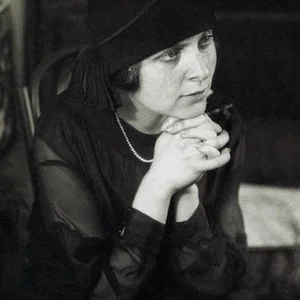

Elsa Triolet (1896–1970) was a French novelist of Russian origin, partner of the poet Louis Aragon. The first woman to receive the Prix Goncourt, in 1945 for her short story collection 'A Fine of Two Hundred Francs', she was also a committed figure in the Resistance and the Communist movement.
Frequently asked questions
Famous Quotes
« Woman is the future of man.»
« A Fine of Two Hundred Francs.»
Key Facts
- 1896: Born in Moscow as Elsa Kagan
- 1928: Meets Louis Aragon in Paris, beginning of a shared life and intellectual partnership
- 1938: Obtains French citizenship
- 1945: First woman to win the Prix Goncourt for 'A Fine of Two Hundred Francs'
- 1970: Dies in Saint-Arnoult-en-Yvelines
Works & Achievements
The first novel Elsa Triolet wrote directly in French. It marks her definitive integration into French literature and allowed her to find her own voice in a language that was not her mother tongue.
A Resistance novella published clandestinely under the pseudonym Laurent Daniel by Les Éditions de Minuit. It tells the story of a young woman who carries forged papers for the Resistance, and stands as a direct literary testimony of the Occupation.
A collection of short stories that won the Prix Goncourt in 1945, making Elsa Triolet the first woman to receive this award. The volume brings together several texts written during the Occupation, including "Les Amants d'Avignon."
A novel written during the Occupation, following the fate of a provincial doctor caught up in the upheavals of history. The work demonstrates Elsa Triolet's ability to sustain demanding literary creation even under the most difficult conditions.
Elsa Triolet's first work of fiction, written in Russian. It reflects her origins and her early experiences as an émigré, before she made the definitive choice to write in French.
Elsa Triolet translated a number of texts by Vladimir Mayakovsky and Anton Chekhov into French, helping to bring Russian literature to French readers and acting as a cultural bridge between the two countries.
Anecdotes
In 1945, Elsa Triolet became the first woman to win the Prix Goncourt, for her short-story collection 'Le premier accroc coûte deux cents francs'. The all-male jury had long overlooked women writers: this victory marked a symbolic turning point in the literary recognition of women in France.
During the Occupation, Elsa Triolet played an active role in the intellectual Resistance. In 1943 she published 'Les Amants d'Avignon' under the pseudonym 'Laurent Daniel' through the clandestine Éditions de Minuit — an underground publishing network founded to keep French culture alive in defiance of Nazi censorship.
Born Ella Kagan in Moscow in 1896, Elsa Triolet was the sister of Lili Brik, companion of the Russian poet Vladimir Mayakovsky. When she arrived in Paris in the 1920s, she was already immersed in Russian avant-garde circles and moved among the greatest artists of her time, long before she ever met Aragon.
Elsa Triolet met Louis Aragon in November 1928 at a party in Paris. The encounter transformed both writers' lives: they were never to be separated again, married in 1939, and shaped each other's work throughout their lives. Aragon dedicated his collection 'Les Yeux d'Elsa' (1942) to her, making her an immortal figure in French poetry.
Although she first wrote in Russian, Elsa Triolet adopted French as her literary language from 1938 onwards. She justified this choice with a phrase that has since become famous: to write in French is to choose one's country, one's intellectual and emotional homeland. She also translated Chekhov and Mayakovsky into French.
Primary Sources
Juliette was sitting on the train, a suitcase on her knees. She was thinking of the man she was going to meet, in Avignon, of the mission she had been entrusted with. She was not afraid, or rather she had learned to stop being afraid.
I wrote this book in French because I live in France, because France is where I chose to live. A country's language is its very soul, and I wanted to make that soul my own.
We are what we have done. Those terrible years made us, you and I, what we are. I regret none of it — not even the fear, not even the danger — because we were on the right side.
I accept this prize on behalf of all women who write and have not yet been read, of all those who will write and who may never be read enough.
Key Places
Birthplace of Elsa Triolet, born Ella Kagan in 1896. She grew up in a bourgeois Jewish intellectual milieu, amid the artistic ferment of pre-revolutionary Russia.
Elsa Triolet settled permanently in Paris in the late 1920s. She frequented literary cafés, Surrealist and later Communist circles, making Paris the center of her intellectual and emotional life alongside Aragon.
During the Occupation, Elsa and Aragon took refuge in the unoccupied zone. Avignon and the Provençal region provided the backdrop for her Resistance novel *Les Amants d'Avignon*, written from her own experience of living underground.
The permanent home of Elsa Triolet and Aragon from the 1960s onward. It was here that she wrote her final works and died on **June 16, 1970**. The mill is now a listed historic site open to the public as a place of remembrance.
As a committed Communist, Elsa Triolet made several post-war trips to the USSR, taking part in Soviet writers' congresses and maintaining close ties with the Soviet intelligentsia.
Typical Objects

Elsa Triolet typed her own manuscripts on a portable typewriter that she took with her wherever she went, including during the years of the Occupation, when writing had to be done quickly and discreetly.

Like many stateless Russian émigrés after 1917, Elsa initially traveled on a Nansen passport, a document issued by the League of Nations to refugees without nationality, before obtaining French citizenship.

A clandestine literary journal founded in 1942, to which Elsa Triolet contributed. These mimeographed sheets, secretly distributed under the Occupation, stand as a symbol of cultural resistance.

Elsa Triolet worked on her texts with great stylistic rigor, covering her typescripts with handwritten corrections. She paid particular attention to the rhythm of the sentence, shaped by her deep familiarity with Russian poetry.

Her childhood photographs from Moscow and pictures of her sister Lili Brik were carefully preserved. They bear witness to her Russian roots, which she never denied despite her adoption of the French language and culture.

Elsa Triolet translated several works by the poet Vladimir Mayakovsky — her sister Lili's great love — into French. These bilingual volumes symbolize her role as a bridge between Russian and French cultures.
School Curriculum
Vocabulary & Tags
Key Vocabulary
Daily Life
Morning
Elsa Triolet rose early and devoted her mornings to writing, her most productive working hours. She would settle at her desk with her typewriter, often at dawn, before visits and political or social commitments could break her concentration.
Afternoon
Her afternoons leaned more toward intellectual encounters: visits from writer friends, meetings at the French Communist Party or solidarity associations, reading sessions at libraries or at the shops of bookseller friends. During the Occupation, these activities took on a clandestine dimension, sometimes involving the passing of forbidden documents or texts.
Evening
Elsa and Aragon's evenings were often lively: dinners with artists, writers, or activists, readings aloud from works in progress, political and literary discussions that could go on well into the night. The couple entertained frequently, especially in their house at Saint-Arnoult in their later years.
Food
Coming from a Russian bourgeois family, Elsa had kept a taste for slow-cooked dishes and convivial shared meals. In France, she embraced French cuisine while holding on to Slavic eating habits, particularly the custom of drinking tea at all hours. During the war years, like all French people, she endured food rationing and ration books.
Clothing
Elsa Triolet was known for her understated elegance and sense of style. She dressed carefully but without ostentation, favoring practical clothes that allowed freedom of movement — essential during the years of clandestine life — yet always with an attention to appearance that reflected her bourgeois intellectual milieu.
Housing
The Aragon-Triolet couple lived in a wide variety of homes depending on the period: Parisian apartments in the 1930s, precarious rentals in the unoccupied zone during the war, until their final move to the Moulin de Villeneuve in Saint-Arnoult-en-Yvelines in the 1960s. This mill, converted into a writer's home with its library and garden, represents the culmination of their life together.
Historical Timeline
Period Vocabulary
Liens externes & ressources
Références
Œuvres
Bonsoir Thérèse
1938
Les Amants d'Avignon
1943 (clandestin), 1945
Le premier accroc coûte deux cents francs
1945
Le Cheval blanc
1943
L'Âme (Zemliànika)
1927
Traductions de Maïakovski et Tchekhov
1940-1960