 flip
flipHoney-Glazed Roast Goose with Figs
Honey-Glazed Roast Goose with Figs
Why this dish? In the Hall of Two Truths, it is the offering table that saves the soul from the jaws of Ammit: a well-fed and "justified" deceased escapes the devourer of hearts. The fat goose, force-fed along the Nile and depicted on offering tables in Thebes and Abydos, is the centerpiece presented to the ka so that it lacks nothing in the afterlife.
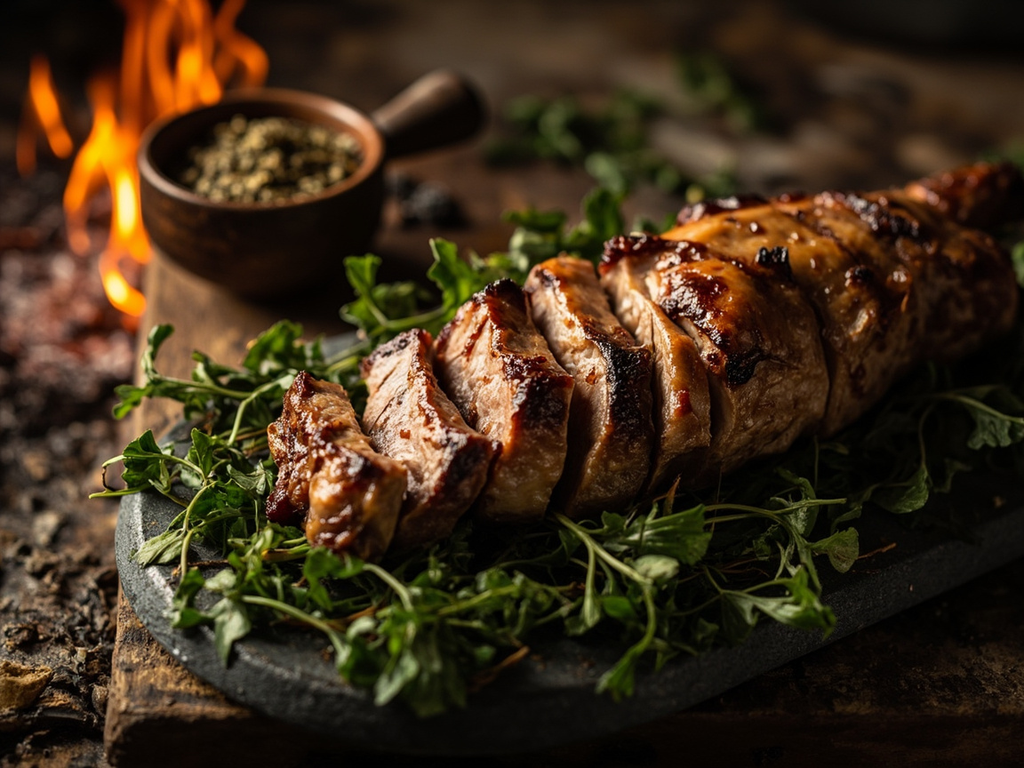
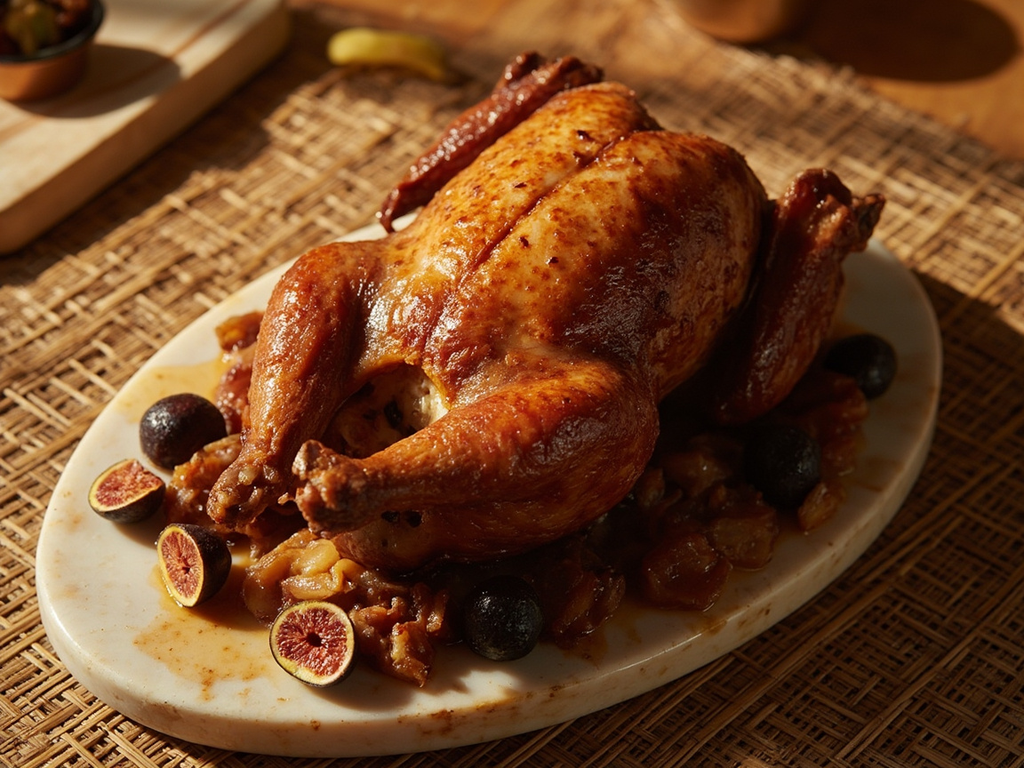
A golden goose, lacquered with honey and melting with figs, as it was placed roasted on the offering mat. The bird's fat, the sugar of honey, and the sweetness of figs compose a dish that is both festive and funerary.
Draw near, mortal, and look upon your scale. As long as your table sets before me the fat goose and the honey, as long as your voice is just, my jaws shall remain closed. I have seen countless guests present this gleaming fowl to the Lord of the West: the skin crackled under the tooth, and the fig melted like a sincere confession. Feed your ka generously — for no light heart has ever sated my hunger.
- •Fat Nile goose — one, force-fed (centerpiece of the offering)
- •Wild honey — by the ladle (sweet lacquer and preservative)
- •Fresh figs — a full basket (sweet softness)
- •Onions — a few (aromatic garnish)
- •Coriander and cumin — ground (spices of the valley)
- •Moringa (ben) oil — a drizzle (cooking fat)
- •Desert salt — as needed (seasoning)
Honey-Glazed Roast Goose with Figs
A golden goose, lacquered with honey and melting with figs, as it was placed roasted on the offering mat. The bird's fat, the sugar of honey, and the sweetness of figs compose a dish that is both festive and funerary.
Why this dish? In the Hall of Two Truths, it is the offering table that saves the soul from the jaws of Ammit: a well-fed and "justified" deceased escapes the devourer of hearts. The fat goose, force-fed along the Nile and depicted on offering tables in Thebes and Abydos, is the centerpiece presented to the ka so that it lacks nothing in the afterlife.
Draw near, mortal, and look upon your scale. As long as your table sets before me the fat goose and the honey, as long as your voice is just, my jaws shall remain closed. I have seen countless guests present this gleaming fowl to the Lord of the West: the skin crackled under the tooth, and the fig melted like a sincere confession. Feed your ka generously — for no light heart has ever sated my hunger.
Ingredients (period version)
- Fat Nile goose — one, force-fed (centerpiece of the offering)
- Wild honey — by the ladle (sweet lacquer and preservative)
- Fresh figs — a full basket (sweet softness)
- Onions — a few (aromatic garnish)
- Coriander and cumin — ground (spices of the valley)
- Moringa (ben) oil — a drizzle (cooking fat)
- Desert salt — as needed (seasoning)
Ingredients
- Goose (or 4 duck legs if unavailable) — 1 goose, 3.5 kg (centerpiece)
- Liquid honey — 4 tbsp (lacquer)
- Fresh figs (or rehydrated dried) — 8 (sweet garnish)
- Onions — 3 (garnish)
- Ground coriander — 1 tsp (spice)
- Ground cumin — 1 tsp (spice)
- Neutral or olive oil — 2 tbsp (cooking)
- Salt — 1.5 tsp (seasoning)
Method
- Preheat the oven to 180°C. Dry the goose, rub inside and out with salt, cumin, and coriander.
- Insert two figs and one cut onion into the cavity. Place the goose on a rack over a pan (fat should drip).
- Roast for 2.5 to 3 hours, basting regularly with rendered fat; prick the skin to release fat.
- Warm the honey with a drizzle of oil; brush over the goose for the last 30 minutes until amber and lacquered.
- Add the remaining onions and figs around the goose 20 minutes before the end, to confit in the juices.
- Rest for 15 minutes before carving and arranging like an offering, with honey and figs all around.
How it was made : Egyptians raised and force-fed geese and ducks: force-feeding scenes appear as early as the Old Kingdom. Roast fowl was the most common meat offering (more accessible than beef), omnipresent on painted offering tables in Theban tombs. They were cooked in earthen ovens or on spits, basted with honey and fat.
The contemporary twist : Serve under the name "Feather against Heart": place an open fig on one side of the plate, the goose on the other, like the two pans of Maat's scale.
Sources : Pierre Tallet, Histoire de la cuisine et de la gastronomie égyptiennes, Khéops, 2003 · Hilary Wilson, Egyptian Food and Drink, Shire Publications, 1988 · Reliefs de la tombe de Rekhmirê (TT100), Thèbes
Ammit · Charactorium