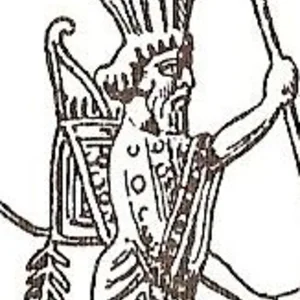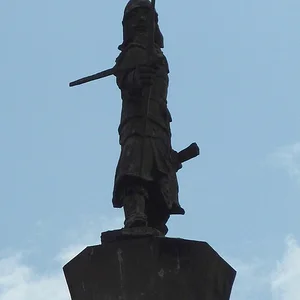

An Dương Vương, whose real name was Thục Phán, was the founder and sole ruler of the kingdom of Âu Lạc, formed by the union of the Âu Việt and the Lạc Việt after his victory over the last Hùng king of Văn Lang. He reigned until his defeat by Triệu Đà in 179 BCE, which brought his kingdom to an end.
An Dương Vương(250 av. J.-C. — 206 av. J.-C.)
Thục Phán
Vietnam
5 min read
Frequently asked questions
Key Facts
- Around 208 BCE (or 257 BCE according to later sources): Thục Phán defeats the last Hùng king and founds the kingdom of Âu Lạc, taking the title An Dương Vương.
- 218 BCE: the resistance begins against the invading Qin armies led by Đồ Thư, ending in a victory for the Âu Việt after nearly ten years of struggle.
- Construction of the Cổ Loa citadel, associated with the legend of the golden turtle and the magic crossbow made by Cao Lỗ.
- 179 BCE: defeat at the hands of Triệu Đà, king of Nam Việt, which brings the kingdom of Âu Lạc to an end; An Dương Vương is said to have taken his own life.
- Debated historical status: his existence is better attested than that of the Hùng kings (he is mentioned in Sima Qian's Shiji), but many episodes (Mỵ Châu, Trọng Thủy, the golden turtle) belong to legend.
Works & Achievements
Political unification of the Âu Việt and Lạc Việt peoples into a single kingdom following the victory over the last Hùng king.
Construction of a fortified capital with concentric ramparts, considered a major advance in ancient Vietnamese military organization.
Leadership of a nearly decade-long guerrilla campaign that exhausted and defeated the invading army of Qin Shi Huang, killing General Đồ Thư.
Retention of the local chiefs (Lạc tướng, Bồ chính) of the former Văn Lang, ensuring a stable political transition.
Strengthening of Âu Lạc's weaponry and navy, giving the kingdom a lasting strategic advantage.
Anecdotes
According to legend, Thục Phán is said to have asked for the hand of Mỵ Nương, daughter of the last Hùng king, but the advisor Hùng Hầu allegedly opposed the match, suspecting a ruse to seize the kingdom — this refusal is said to have fueled Thục Phán's resentment [1].
Traditional accounts hold that the last Hùng king, overconfident in “supernatural powers,” neglected his military defenses; when Thục Phán's army approached, his own soldiers reportedly surrendered without a fight — an episode of semi-legendary status [1].
Around 218 BCE, the Qin emperor Tần Thủy Hoàng sent some 500,000 soldiers to conquer the Bách Việt; General Đồ Thư advanced into Âu Việt territory but met prolonged resistance led by Thục Phán for nearly ten years, until his own death in battle [1].
To fortify his capital, Thục Phán is said to have had the Cổ Loa citadel built with the help of chieftain Cao Lỗ, inventor of a multi-fire crossbow (nỏ liên châu); legend tells that a golden turtle (Kim Quy) appeared to help stabilize walls that kept collapsing — a clearly legendary episode [1].
The end of his reign is tied to the legend of Mỵ Châu and Trọng Thủy: King Triệu Đà of Nam Việt is said to have married his son to An Dương Vương's daughter in order to infiltrate Âu Lạc and steal the secret of the magic crossbow — a tale of mainly symbolic value, not corroborated by contemporary Chinese sources [1].
Primary Sources
Cuối thời Hùng Vương, vua có con gái gọi là Mỵ Nương... Thục vương vì chuyện ấy để bụng oán giận.
Giao Chỉ có ruộng Lạc... con vua Thục đem quân đánh Lạc hầu, tự xưng là An Dương vương, trị ở huyện Phong Khê.
Vua Thục đem ba vạn lính đánh diệt Hùng vương đi, nhân đó cho con mình làm An Dương vương, trị đất Giao Chỉ.
Nước Thục từ năm thứ 5 đời Chu Thận Tịnh Vương đã bị nhà Tần diệt rồi, làm gì còn vua nữa?
Key Places
Capital of the kingdom of Âu Lạc, site of the citadel with its concentric ramparts, today a major archaeological zone.
Ancient administrative name of the region where the capital of Âu Lạc was located, identified with Cổ Loa.
Kingdom conquered by Thục Phán, whose lands and administration were absorbed into Âu Lạc.
Neighboring Chinese commandery from which Triệu Đà launched his southward expansion after the death of Nhâm Hiêu.
Typical Objects

Weapon attributed to Cao Lỗ, said by legend to be able to fire several arrows at once; a symbol of Âu Lạc's military power.

Fortified capital of Âu Lạc, built with several concentric ramparts traced, according to tradition, after the tracks of a golden turtle.

Insignia of office worn by the Lạc hầu and Lạc tướng, the administrative equivalent of officials of the time.

Legendary creature said to have helped stabilize the walls of Cổ Loa and revealed how to overcome the spirits disrupting its construction.

Platform from which the king oversaw his soldiers' crossbow-shooting training.

Farmland cultivated according to the rhythm of the tides, the origin of the name of the Lạc Việt people.
School Curriculum
Vocabulary & Tags
Key Vocabulary
Daily Life
Morning
As a warrior-king, An Dương Vương devoted his mornings to overseeing military training, particularly crossbow drills, from his watchtower, the Ngự xa đài.
Afternoon
The afternoon was often taken up with the administrative affairs of the newly unified kingdom, in coordination with the Lạc hầu and Lạc tướng inherited from the former Văn Lang.
Evening
Evenings could be devoted to religious rituals or to planning the defenses of the Cổ Loa citadel, whose construction is said to have preoccupied him for years.
Food
The diet was based on rice grown in the Lạc paddies according to the rhythm of the tides, supplemented by fish and other catches typical of the Red River delta region.
Clothing
The clothing of the elite combined locally woven fabrics with bronze ornaments, along with insignia of power such as seals worn by high officials.
Housing
The royal residence was located within the Cổ Loa citadel, a fortified structure with multiple enclosures, designed for defense as much as for governing the kingdom.
Historical Timeline
Period Vocabulary
Liens externes & ressources
Références
Œuvres
Fondation du royaume d'Âu Lạc
vers 257-208 av. J.-C.
Citadelle de Cổ Loa
non daté précisément, durant son règne
Résistance victorieuse contre l'invasion Tần
218-210 av. J.-C. environ
Maintien de l'administration locale Lạc
durant son règne
Développement militaire (arbalète, marine)
durant son règne