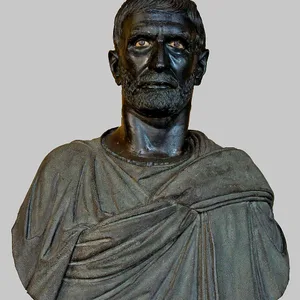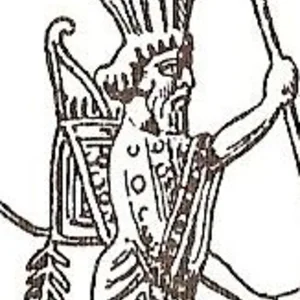

Cambyses II was a king of the Achaemenid Persian Empire, son and successor of Cyrus the Great. He conquered Egypt in 525 BC and proclaimed himself pharaoh, thereby greatly expanding the empire founded by his father.
Frequently asked questions
Key Facts
- Son of Cyrus the Great, founder of the Achaemenid Persian Empire, he succeeded him on the throne in 530 BC
- Conquered Egypt in 525 BC after the Battle of Pelusium, putting an end to the Saite dynasty
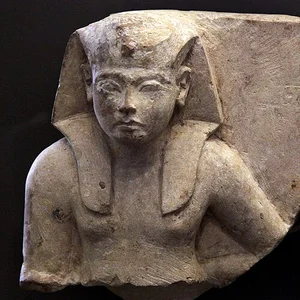
- Had himself recognized as pharaoh of Egypt, inaugurating the 27th Dynasty (Persian rule)
- Died in 522 BC under uncertain circumstances, while a usurper (the false Smerdis/Bardiya) seized power
- His reign is known mainly through the account of Herodotus, who portrays him unfavorably
Works & Achievements
A major military victory that added Egypt to the Achaemenid Empire, making Persia the greatest power in the ancient world of the time.
By proclaiming himself pharaoh, Cambyses ushered in the first period of Persian rule over Egypt, which was incorporated as a satrapy of the empire.
Cambyses took on Egyptian royal titles and a coronation name (Mesutire), relying on local notables such as Udjahorresnet to govern.
Contrary to his reputation for impiety, inscriptions confirm that a sacred Apis bull was buried with full honors during his reign, a sign of a policy of religious conciliation.
The establishment of Persian control over the Nile Valley, paving the way for the system of satrapies that Darius I would later refine.
Attempts to extend the empire toward the Kingdom of Kush (Nubia) and the Oasis of Ammon, which ended in famously remembered failures.
Anecdotes
According to the Greek historian Herodotus, Cambyses II is said to have descended into madness after his conquest of Egypt, going so far as to stab the sacred Apis bull venerated by the Egyptians. Modern historians believe this legend was largely exaggerated by Egyptian priests hostile to the Persian conqueror, since inscriptions show, on the contrary, that an Apis bull was buried with full honors during his reign.
Herodotus recounts that an army of 50,000 men sent by Cambyses to attack the oasis of Ammon (Siwa) is said to have vanished entirely in the desert, swallowed up by a sandstorm. This “lost army of Cambyses” has become a famous enigma, and archaeologists have long searched for its traces in the Western Desert of Egypt.
To defeat the Egyptians at the Battle of Pelusium in 525 BC, a clever trick is reported: the Persian soldiers are said to have placed cats — sacred animals in Egypt — in front of their ranks, paralyzing the defenders, who dared not harm these revered creatures. The story illustrates the importance of sacred animals in Egyptian religion, even if it is probably embellished.
Cambyses died in 522 BC while returning from Egypt, under murky circumstances: according to Herodotus, he accidentally wounded himself in the thigh with his own sword while mounting his horse. His death without an heir opened a serious succession crisis, which was exploited by a usurper posing as his brother Bardiya.
To conquer Egypt, Cambyses negotiated the crucial help of the Phoenicians, whose fleet dominated the eastern Mediterranean, and secured the support of an Arab chieftain to cross the Sinai desert by ensuring his army's water supply. This preliminary diplomacy shows that his victory rested on more than military force alone.
Primary Sources
Cambyses, son of Cyrus, marched against Psammenitus, son of Amasis, who reigned over the Egyptians. [...] The Persians, having defeated the Egyptians in this battle, took Memphis.
The king of Upper and Lower Egypt Cambyses came to Egypt [...]. He gave me the office of chief physician and made me live beside him as a companion and administrator of the palace.
Cambyses, son of Cyrus, of our family, was king here. This Cambyses had a brother named Bardiya, of the same mother and the same father as Cambyses. Then Cambyses killed this Bardiya.
Year 6, third month of the Shemu season, under the majesty of the king of Upper and Lower Egypt Mesutire (Cambyses) [...] the god was conducted in peace to the beautiful necropolis of the West.
Key Places
Heart of the Achaemenid Empire founded by Cyrus the Great, where the Persian royal dynasty resided. Cambyses grew up here as heir to the throne.
Fortress city at the eastern entrance to the Nile Delta, where Cambyses won the decisive battle against the Egyptian army in 525 BC.
Ancient capital of Egypt, captured by Cambyses after Pelusium. He was crowned pharaoh there and stayed to administer the conquered country.
Oasis in the western desert home to the oracle of Ammon, toward which Cambyses sent an army that is said to have vanished in the sands.
Great metropolis of the empire of which Cambyses was for a time named king during the lifetime of his father Cyrus. A major administrative and religious center.
Place where, according to Herodotus, Cambyses met his death on his way back from Egypt in 522 BC after wounding himself in the thigh.
Typical Objects

Short double-edged dagger-sword, the emblematic weapon of Persian nobles and warriors, worn at the belt. According to Herodotus, it was with a weapon of this type that Cambyses mortally wounded himself.

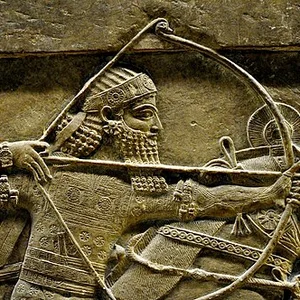
A formidable ranged weapon made of wood, horn and sinew, the main strength of the Achaemenid army. Persian archers formed the elite of the royal troops.

Tall headdress worn by the Achaemenid Great King, upright and encircled by a band, a symbol of sovereignty. Only the king could wear it upright.

Double red-and-white crown symbolizing the union of Upper and Lower Egypt, which Cambyses adopted when proclaiming himself pharaoh. It legitimized his power in the eyes of the Egyptians.

A small engraved cylinder rolled over clay to authenticate documents and decrees. An essential tool of the Persian Empire's administration, often decorated with scenes of the triumphant king.

A high-purity gold coin struck by the Achaemenid Empire, depicting the king as an archer. Although named after Darius, it illustrates the monetary system established in Cambyses's empire.

A luxury vessel shaped like a horn or an animal's head, made of precious metal, used at the banquets of the Persian court. It bears witness to the refinement of Achaemenid art.
School Curriculum
Vocabulary & Tags
Key Vocabulary
Tags
Daily Life
Morning
As Great King, Cambyses began his day surrounded by servants and guards, the elite of the “Immortals.” The first hours were devoted to audiences, where dignitaries and messengers from across the empire brought news and requests.
Afternoon
The afternoon might be taken up with military and administrative affairs: preparing campaigns, receiving tributes, and dispensing justice according to Persian law. During the Egyptian campaign, he inspected the troops and organized the occupation of conquered cities.
Evening
In the evening, the king presided over lavish banquets where wine was drunk from precious cups to the sound of music. The Achaemenid court was renowned for its splendor, its refined dishes, and the strict protocol surrounding the royal person.
Food
The Persian royal diet was abundant and varied: bread, meats (mutton, poultry, game), fruits, dates, and fine wine. Herodotus reports that the Persians loved desserts and ended their meals with many sweet treats.
Clothing
The king wore long purple robes richly embroidered, soft trousers and boots typical of the Persians, as well as gold jewelry. The upright tiara and the scepter signaled his dignity as supreme sovereign.
Housing
Cambyses resided in the royal palaces of Persia, such as Pasargadae, and later in the palaces of conquered cities such as Memphis in Egypt. These residences, adorned with columns, reliefs, and gardens, displayed the power of the empire.
Historical Timeline
Period Vocabulary
Liens externes & ressources
Références
Œuvres
Conquête de l'Égypte
525 av. J.-C.
Fondation de la XXVIIe dynastie égyptienne
525 av. J.-C.
Adoption d'un protocole pharaonique
525-522 av. J.-C.
Inhumation du taureau Apis
524 av. J.-C.
Organisation administrative de la satrapie d'Égypte
525-522 av. J.-C.
Expéditions vers la Nubie et la Libye
524 av. J.-C.