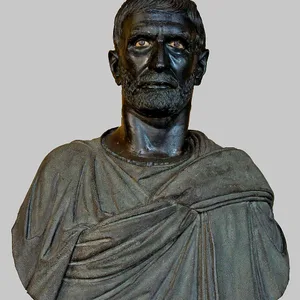

A Roman senator and statesman of the late Republic, Brutus was one of the main instigators of the assassination of Julius Caesar on the Ides of March, 44 BC. Defeated by the triumvirs Octavian and Mark Antony at Philippi, he took his own life in 42 BC.
Brutus(1983 — ?)
Brutus
Royaume des Pays-Bas
6 min read
Frequently asked questions
Famous Quotes
« Sic semper tyrannis»
Key Facts
- Took part in the assassination of Julius Caesar on the Ides of March (15 March 44 BC)
- Came from a family linked to the legendary founding of the Republic (Lucius Junius Brutus)
- Led the republican opposition against the Second Triumvirate
- Defeated at the Battle of Philippi in 42 BC by Octavian and Mark Antony
- Took his own life after his defeat at Philippi in 42 BC
Works & Achievements
The founding act of his fame: Brutus leads the conspiracy of senators aiming to end Caesar's personal rule and restore the Republic.
Brutus administered this important province on Caesar's behalf, a testament to his career as a magistrate before the break.
A propaganda coin celebrating Caesar's assassination, exceptional in the history of Roman numismatics.
Together with Cassius, Brutus raised and led powerful legions in Greece and Asia Minor to defend the republican cause.
A scholar trained in Stoicism, Brutus exchanged writings with Cicero and composed now-lost treatises on virtue and duty.
Anecdotes
According to tradition, Brutus was descended from Lucius Junius Brutus, the legendary founder of the Roman Republic who had driven out the kings in the 6th century BC. This prestigious family heritage weighed heavily: for many Romans, a Brutus was expected to fight tyranny, which made him the target of public appeals to act against Caesar.
Julius Caesar had a particular fondness for Brutus, whom he spared after the Battle of Pharsalus in 48 BC, even though Brutus had fought in the opposing camp of Pompey. Caesar then appointed him governor of Cisalpine Gaul, which makes his participation in the plot all the more striking.
During the assassination on the Ides of March (15 March 44 BC), the conspirators struck Caesar with 23 dagger blows at the foot of Pompey's statue, in the senate house. Ancient tradition reports that Caesar stopped defending himself upon recognizing Brutus among his attackers.
Brutus had coins struck to commemorate the assassination: the reverse depicted two daggers flanking a Phrygian cap (the pileus), a symbol of the freeing of slaves, with the legend EID MAR (“Ides of March”). It is one of the rare cases in which an ancient coin openly celebrates a political murder.
Before the decisive Battle of Philippi in 42 BC, Plutarch recounts that Brutus was visited by a menacing spectre in his tent, which announced that he would see him again at Philippi. Defeated, Brutus took his own life by throwing himself onto his sword, held by a friend.
Primary Sources
Caesar, it is said, seeing Brutus draw his sword, covered his head with his toga and let himself fall at the foot of Pompey's statue.
When he saw Brutus rushing upon him, he said, it is said, in Greek: “You too, my child!”
The conspirators surrounded Caesar and struck him one after another, so that he fell pierced by many wounds at the foot of Pompey's statue.
Correspondence exchanged between Cicero and Brutus after the Ides of March, debating the fate of the Republic and the course to take in dealing with Mark Antony.
Key Places
Capital of the Roman Republic and the presumed birthplace of Brutus. It was in the heart of the city that he pursued his political career as a senator.
The meeting hall where the Senate was sitting that day, on the Campus Martius in Rome. It was here that Caesar was assassinated on the Ides of March, 44 BC.
A town in northern Greece near which the decisive battle of 42 BC took place. Defeated, Brutus took his own life there.
A plain in Greece where Caesar crushed Pompey in 48 BC. Brutus, who was fighting for Pompey, was captured there and then pardoned by Caesar.
A great Greek city where Brutus stayed and studied philosophy and rhetoric. There he rallied supporters after fleeing Rome.
Typical Objects

Short, broad-bladed dagger carried by Roman soldiers and citizens. It is the weapon used by the conspirators to strike Caesar.

Draped woollen garment reserved for Roman citizens, a sign of social status. Senators wore one bordered with purple, the toga praetexta.

Silver coin struck by Brutus showing two daggers and a cap of liberty with the inscription "Ides of March". It celebrates Caesar's assassination as an act of liberation.

Conical cap given to freed slaves, a symbol of regained freedom. Brutus had it depicted on his coins to present the killing of Caesar as a liberation of Rome.

Short sword of the Roman infantry, the main weapon of the legions. Brutus commanded it during the campaigns at Philippi and used it, according to tradition, to take his own life.

Wooden tablet coated with wax on which one wrote using a pointed stylus. An everyday tool of Roman senators and scholars for correspondence and notes.
School Curriculum
Vocabulary & Tags
Key Vocabulary
Daily Life
Morning
Like every Roman senator, Brutus began his day at dawn with the salutatio: at home he received his clients, who came to seek advice and favors. He then ate a light meal before heading to the Forum.
Afternoon
The afternoon was divided between sessions of the Senate, judicial affairs, and political discussions under the porticoes of the Forum. A lover of philosophy, Brutus also devoted time to reading and writing.
Evening
In the evening, well-to-do Romans held banquets (cena), reclining on couches around low tables. There Brutus would converse about politics, literature, and philosophy with his educated friends.
Food
The Roman diet was based on bread, cereal porridges, olive oil, water-diluted wine, vegetables, cheese, and fruit. Meat and fish were more common among the wealthy, such as Brutus.
Clothing
Brutus wore a tunic of linen or wool and, over it, the purple-bordered toga (toga praetexta) reserved for magistrates and senators. Leather sandals and a gold ring marked his rank.
Housing
A member of the aristocracy, Brutus lived in a vast domus in Rome, arranged around a central atrium and a columned peristyle, adorned with mosaics and wall paintings. He no doubt also owned villas in the countryside.
Historical Timeline
Period Vocabulary
Liens externes & ressources
Références
Œuvres
Assassinat de Jules César aux Ides de mars
15 mars 44 av. J.-C.
Gouvernement de la Gaule cisalpine
46 av. J.-C.
Émission du denier EID MAR
43-42 av. J.-C.
Commandement des armées républicaines en Orient
43-42 av. J.-C.
Correspondance philosophique et politique
vers 45-43 av. J.-C.