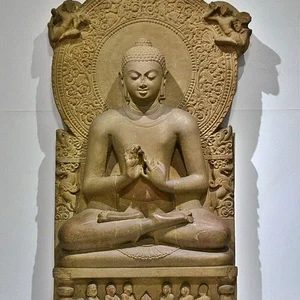

An Indian prince born around 563 BCE in Nepal, he renounced his privileged life to seek the truth about human suffering. After years of asceticism and meditation, he attained Enlightenment beneath the Bodhi tree and became the Buddha, the "Awakened One."
Siddhartha Gautama(500 av. J.-C. — 500 av. J.-C.)
Siddhartha Gautama
9 min read
Frequently asked questions
Famous Quotes
« Peace comes from within. Do not seek it without.»
« Three things cannot be long hidden: the sun, the moon, and the truth.»
Key Facts
- Around 563 BCE: born in Lumbini (present-day Nepal) into a royal family
- Around 528 BCE: attains Enlightenment (bodhi) at Bodh Gaya beneath a fig tree
- Around 528 BCE: delivers his first sermon at Sarnath (the Turning of the Wheel of Dharma)
- 5th century BCE: founds the monastic community (sangha) and teaches for 45 years
- Around 483 BCE: death (parinirvana) at Kushinagar
Works & Achievements
The Buddha's first teaching at Sarnath, laying the foundations of all Buddhist thought: the reality of suffering (dukkha), its origin (desire), the possibility of its cessation, and the path to achieve it.
An eight-step ethical and meditative program taught by the Buddha as the path to liberation: right understanding, right intention, right speech, right action, right livelihood, right effort, right mindfulness, right concentration.
The establishment of the first Buddhist monastic community, governed by a detailed code of discipline (Vinaya). The Sangha is one of the Three Jewels of Buddhism, alongside the Buddha and the Dharma.
A collection of 152 medium-length discourses attributed to the Buddha, covering subjects as varied as meditation, ethics, cosmology, and psychology. One of the foundational texts of the Theravada Pali canon.
A collection of 423 verses attributed to the Buddha, distilling his wisdom into memorable, poetic sayings. Translated into dozens of languages, it is one of the most widely read religious texts in the world.
A fundamental philosophical concept rejecting both indulgence and extreme asceticism as paths to Enlightenment. This 'middle way' would profoundly influence all Buddhist thought and find echoes in many later philosophical traditions.
Anecdotes
According to Buddhist tradition, the young prince Siddhartha lived in absolute luxury: his father, King Suddhodana, had three palaces built — one for each season — to shield him from all suffering. Prophets had foretold that he would become either a great king or a great spiritual sage, and his father did everything to steer him toward kingship by keeping the world's misery hidden from him.
The legend of the 'Four Encounters' is foundational: while riding out in his chariot, Siddhartha came across, one after another, an old man, a sick man, a corpse, and then a serene wandering monk. These four sights shook the prince to his core, revealing the reality of human suffering that his father had concealed from him since childhood.
After leaving his palace, Siddhartha practiced extreme asceticism for six years, sometimes eating as little as a single grain of rice per day. According to the Pali texts, his body became so emaciated that when he touched his stomach, he could feel his spine. He ultimately abandoned this path, convinced that neither excess nor deprivation leads to Enlightenment — this was the birth of the 'Middle Way'.
Siddhartha's Enlightenment beneath the Bodhi tree at Bodh Gaya lasted an entire night. Tradition holds that Mara, the demon of illusion, tried to break his meditation by sending armies of monsters and then his seductive daughters. Siddhartha simply touched the earth with his right hand, calling the Earth itself as witness to his merit — this gesture, known as the 'bhumisparsha mudra', is one of the most depicted in Buddhist art.
After the Enlightenment, the Buddha hesitated to teach, believing his understanding was too profound to be conveyed to others. It was the god Brahma who reportedly implored him to share his teaching, arguing that there were beings with 'little dust in their eyes' who were capable of understanding. The Buddha agreed and delivered his first sermon at the Deer Park in Sarnath to five of his former companions in asceticism.
Primary Sources
"This, monks, is the Noble Truth of suffering: birth is suffering, aging is suffering, illness is suffering, death is suffering; union with what is disliked is suffering; separation from what is loved is suffering."
"I too was subject to birth, aging, illness, death, sorrow, and defilement. Recognizing the danger in all that is subject to these things, I sought the unborn, the unaging, the unailing, the undying, the sorrowless, the undefiled — the supreme security from bondage: Nibbana."
"Mind is the forerunner of all actions. If one speaks or acts with an impure mind, suffering follows like a shadow that never departs. If one speaks or acts with a serene mind, happiness follows like a shadow that never leaves."
"All conditioned things are impermanent. Work out your salvation with diligence." These were the Buddha's last words before entering Parinirvana.
"King Piyadasi [Ashoka], beloved of the gods, twenty years after his coronation, came in person and worshipped this place because the Buddha Shakyamuni was born here."
Key Places
Birthplace of Siddhartha Gautama, around 563 BCE. The site is confirmed by the Ashoka Pillar (249 BCE), erected during the emperor's pilgrimage there. Listed as a UNESCO World Heritage Site.
The site of the Buddha's Enlightenment, beneath the Bodhi Tree, around 528 BCE. The Mahabodhi Temple, built on this sacred ground, is the most important Buddhist pilgrimage site in the world and a UNESCO World Heritage Site.
Site of the Buddha's first sermon in the Deer Park (Mrigadava), where he first taught the Four Noble Truths to his five former companions. This is where the Sangha (Buddhist community) was founded.
Capital of the Magadha kingdom and one of the main cities where the Buddha taught for decades. The First Buddhist Council was held here after his death to codify his teachings.
The site of the Buddha's Parinirvana (death), at around the age of 80. It was here that he spoke his final words, urging his disciples toward diligent effort. The site is home to the Mahaparinirvana Temple.
Royal city of the Shakya clan where Prince Siddhartha grew up in luxury, sheltered from the reality of suffering. It was from here that he slipped away in the night at age 29 to begin his spiritual quest.
Liens externes & ressources
See also
Related Characters
Alexander II of Macedon
Anaxagoras of Clazomenae
499 av. J.-C. — 427 av. J.-C.
Anaximander
609 av. J.-C. — 545 av. J.-C.
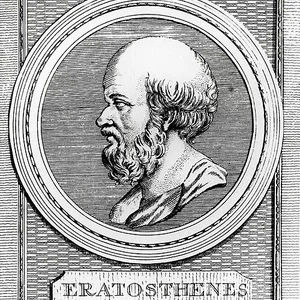
Eratosthenes
275 av. J.-C. — 193 av. J.-C.
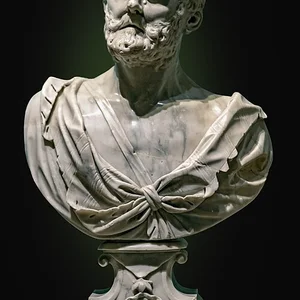
Heraclitus
534 av. J.-C. — 470 av. J.-C.
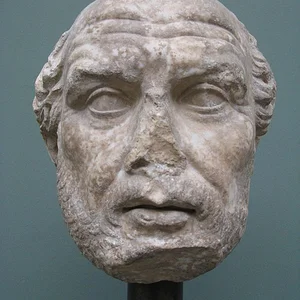
Phidias
499 av. J.-C. — 429 av. J.-C.