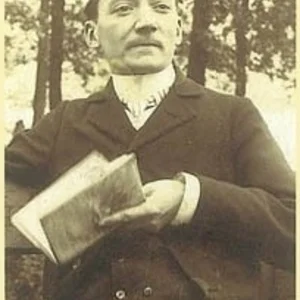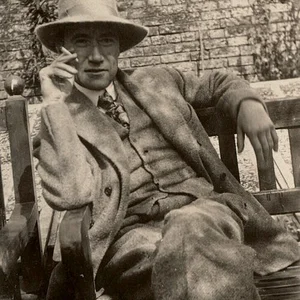

French writer, a major figure of 20th-century literature and co-founder of La Nouvelle Revue française. His work explores sincerity, morality, and individual emancipation. He received the Nobel Prize in Literature in 1947.
André Gide(1869 — 1951)
André Gide
France
6 min read
Frequently asked questions
Famous Quotes
« Families, I hate you!»
« One must follow one's inclination, but always upward.»
Key Facts
- Publishes The Immoralist in 1902, a novel of moral liberation
- Co-founds La Nouvelle Revue française (NRF) in 1908-1909
- Publishes The Counterfeiters in 1925, the only work he called a novel
- Denounces colonialism in Travels in the Congo (1927)
- Receives the Nobel Prize in Literature in 1947
Works & Achievements
A lyrical hymn to fervor, desire, and openness to life, which would influence generations of young readers.
A narrative in which a man seeks to free himself from moral conventions; one of the great texts of Gidean sincerity.
A novel of renunciation and of love sacrificed to a religious ideal, an inverted mirror of The Immoralist.
A work in which Gide invents the notion of the “gratuitous act,” an act without motive or reason, which caused a scandal.
A short tale of a pastor blinded by his passion, a study of moral and religious blindness.
His only “novel” in his own view, a bold construction weaving together several plots and a reflection on writing itself.
An autobiography of great frankness about his childhood and his quest for personal truth.
Sixty years of intimate notes, an exceptional testimony to the intellectual and literary life of his era.
Anecdotes
In 1913, André Gide was a reader for the young Nouvelle Revue française. He was handed the manuscript of a certain Marcel Proust: *Swann's Way*. Gide rejected it almost without reading it, judging the author to be a socialite and a snob. When he realized his mistake, he wrote to Proust that this rejection would remain “one of the most bitter regrets of my life.”
In **1895**, during a trip to Algeria, the young Gide met the Irish writer **Oscar Wilde** and his friend **Lord Alfred Douglas** in Blida. This encounter, which prompted Gide to question his own freedom and desires, would deeply shape his reflection on sincerity, a central theme throughout his work.
In **1918**, his wife **Madeleine**, hurt by André's behavior, burned all the letters he had written to her since adolescence. Gide, who regarded them as the most precious thing he had ever written, wept for several days: he felt he had lost “the best of himself.”
In **1925-1926**, Gide travelled across French Equatorial Africa and discovered the abuses of forced labor imposed on local populations by the great colonial companies. His account *Travels in the Congo* denounced this violence and sparked a debate in the French Parliament: literature became for him a political weapon.
Enthusiastic about communism, Gide went to the USSR in **1936**. But there he discovered poverty, surveillance, and the cult of Stalin. On his return, he published *Return from the U.S.S.R.*, a critical book that cost him his friendship with many on the left, but which bore witness to his demand for truth.
Primary Sources
Families, I hate you! Closed homes; shut doors; jealous possessions of happiness.
I was born on 22 November 1869. At the time, my parents occupied an apartment on the fourth or fifth floor on the rue de Médicis.
I doubt whether in any other country today, even Hitler's Germany, the mind is less free, more bowed, more fearful, more reduced to vassalage.
More often than not, I write in this notebook only to fill the waiting, in those hours when the true work refuses to be grasped.
Key Places
Gide was born on rue de Médicis in 1869 and died on rue Vaneau in 1951; the capital is the center of his literary life and of the NRF.
The country house of the family of his wife Madeleine, in Seine-Maritime, where Gide spent long periods writing and reading.
Birthplace of his father's Protestant family, where Gide spent part of his childhood and which he recalls in his memoirs.
During decisive stays beginning in 1893-1895, Gide discovered a different kind of freedom there and met Oscar Wilde; he would later take refuge there during the war.
A stop on his journey through French Equatorial Africa in 1925-1926, which inspired his account denouncing colonial abuses.
Typical Objects

Gide kept a private diary for more than sixty years, recording his readings, his doubts and his encounters in it. This *Journal* became a literary work in its own right.

A passionate pianist, Gide played Chopin almost every day and devoted an essay to him. Music gave rhythm to his life as a writer.

A literary review co-founded by Gide in 1908, which became the heart of French literary life and the origin of the Gallimard publishing house.

A great traveler, Gide journeyed across North Africa and then the Congo with his trunks, bringing back notebooks and impressions that fed his narratives.

The tools of the writer's daily work, with which Gide composed novels, narratives and his immense correspondence.

In the Norman château of Cuverville, Gide worked surrounded by thousands of books — a place for reading, translating and writing.
School Curriculum
Vocabulary & Tags
Key Vocabulary
Daily Life
Morning
Gide rises early and devotes his mornings to writing and reading, in the silence of his study. He records his thoughts in his *Journal* and works on his translations, notably of **Shakespeare** and **Conrad**.
Afternoon
In the afternoon, he goes for walks, receives fellow writers, or attends to the affairs of the **NRF**, reading the manuscripts that young authors send him. He also enjoys swimming and taking long strolls through the Norman countryside.
Evening
In the evening, Gide often sits down at the piano to play **Chopin**, whom he reveres, before continuing his reading by lamplight. His evenings are devoted to correspondence, which he maintains with many intellectuals across Europe.
Food
Born into the well-off bourgeoisie, Gide eats simply and in moderation, enjoying fresh produce. While travelling, in North Africa or the Congo, he adapts to local foods, true to his taste for discovery.
Clothing
Gide wears the sober attire of the educated bourgeois of the early twentieth century: a tweed jacket, a waistcoat, a collared shirt, sometimes a cape or a cloak. While travelling, he adopts more practical clothing, a canvas hat and light garments suited to the heat.
Housing
He divides his life between Paris, where he keeps apartments, and the family château of **Cuverville** in Normandy, a vast residence surrounded by gardens. These comfortable houses, filled with books and a piano, are places of studious work.
Historical Timeline
Period Vocabulary
Liens externes & ressources
Références
Œuvres
Les Nourritures terrestres
1897
L'Immoraliste
1902
La Porte étroite
1909
Les Caves du Vatican
1914
La Symphonie pastorale
1919
Les Faux-Monnayeurs
1925
Si le grain ne meurt
1926