 flip
flipShchi, the everyday cabbage soup
Shchi, the everyday cabbage soup
Why this dish? Tarkovsky ate like most Soviets of his generation: simply. Shchi, a cabbage soup said to be a thousand years old in Russia, was the staple dish of studio canteens and family kitchens alike — the one shared, modest and warm, with the crew on location.
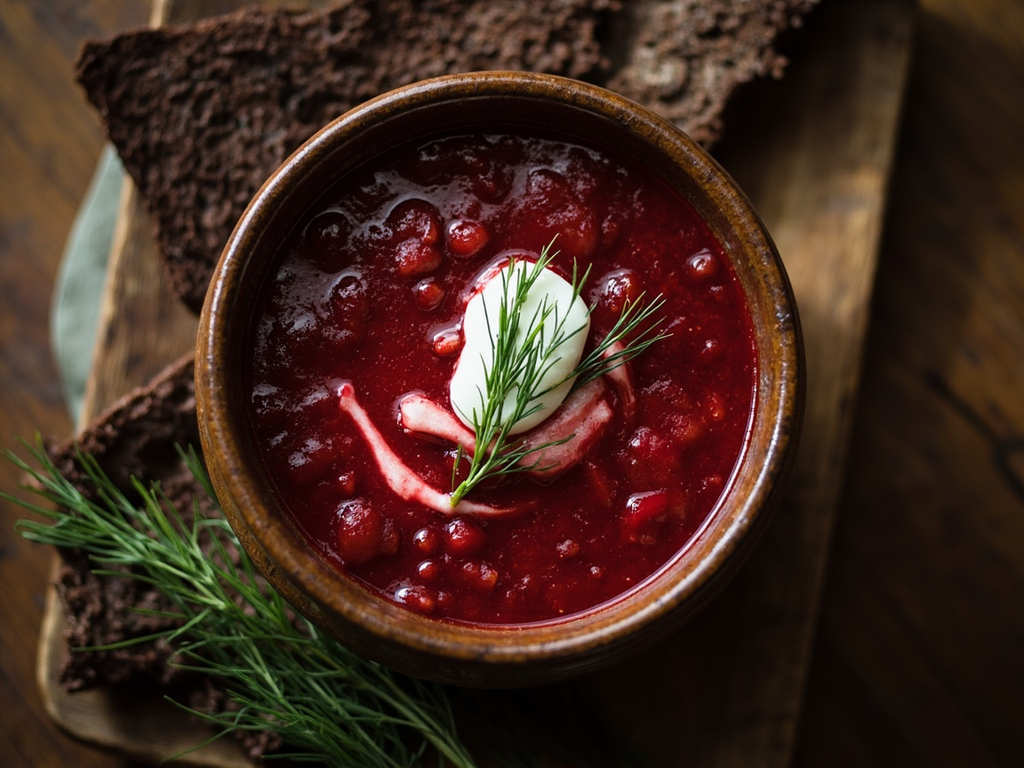
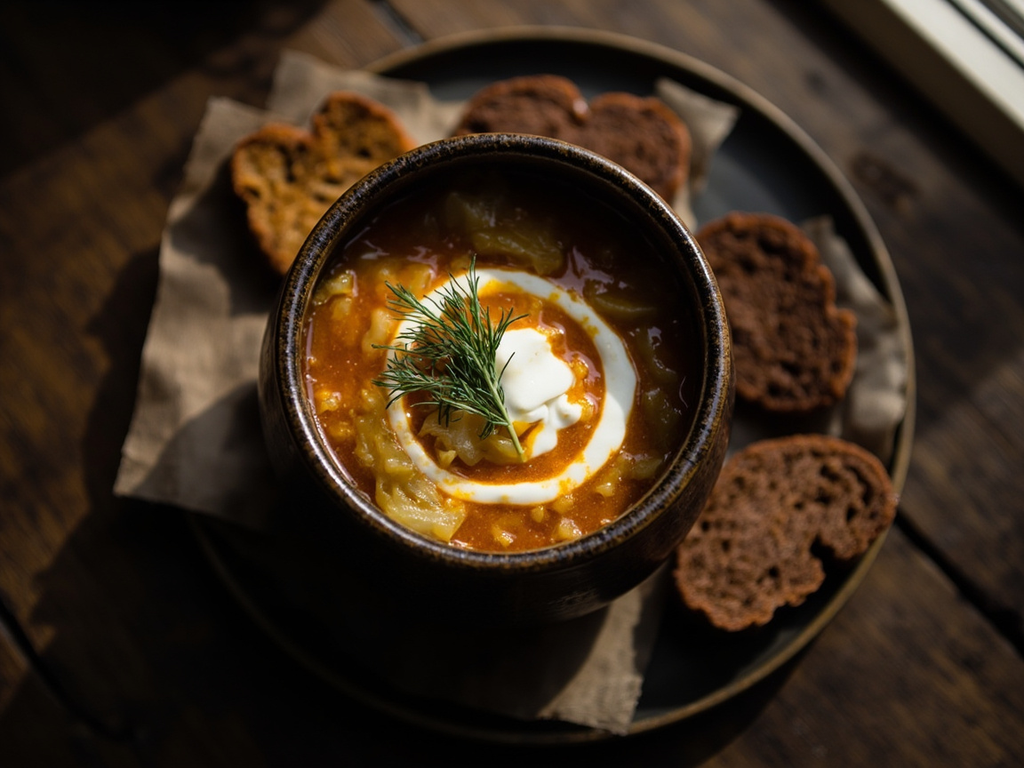
A cabbage soup simmered long with a little meat, root vegetables, and herbs, soured by the cabbage or a dash of brine, and crowned with a spoonful of smetana. Served with black bread, it nourishes and comforts in all weather.
There is no Russian table without soup — it is our patience made into food. At home we used to say: shchi and kasha, that's our life. You take the cabbage that winter has kept, you let it melt for hours over a low fire, without haste, because nothing true is ever done in haste. At the last moment, a spoonful of smetana that whitens the surface like snow on black earth, and you break the rye bread. We are silent, we eat, we are together: that was enough.
- •Cabbage (fresh in summer, sauerkraut in winter) — one large head (base of the soup, provides acidity)
- •Boiling beef — a nice piece (broth and umami)
- •Onion and carrot — to hand (aromatic roots)
- •Smetana (sour cream) — one ladle (final binding)
- •Dill, bay leaf, peppercorns — to taste (flavor)
- •Black rye bread — one loaf (accompaniment)
Shchi, the everyday cabbage soup
A cabbage soup simmered long with a little meat, root vegetables, and herbs, soured by the cabbage or a dash of brine, and crowned with a spoonful of smetana. Served with black bread, it nourishes and comforts in all weather.
Why this dish? Tarkovsky ate like most Soviets of his generation: simply. Shchi, a cabbage soup said to be a thousand years old in Russia, was the staple dish of studio canteens and family kitchens alike — the one shared, modest and warm, with the crew on location.
There is no Russian table without soup — it is our patience made into food. At home we used to say: shchi and kasha, that's our life. You take the cabbage that winter has kept, you let it melt for hours over a low fire, without haste, because nothing true is ever done in haste. At the last moment, a spoonful of smetana that whitens the surface like snow on black earth, and you break the rye bread. We are silent, we eat, we are together: that was enough.
Ingredients (period version)
- Cabbage (fresh in summer, sauerkraut in winter) — one large head (base of the soup, provides acidity)
- Boiling beef — a nice piece (broth and umami)
- Onion and carrot — to hand (aromatic roots)
- Smetana (sour cream) — one ladle (final binding)
- Dill, bay leaf, peppercorns — to taste (flavor)
- Black rye bread — one loaf (accompaniment)
Ingredients
- Beef for pot-au-feu (chuck or shank) — 500 g (broth)
- Green cabbage — ½ head (about 600 g) (base)
- Raw sauerkraut — 150 g (for acidity) (traditional sour note)
- Carrot — 2 (sweetness)
- Onion — 1 large (aromatic)
- Potato — 2 (body (modern variation))
- Bay leaf, peppercorns, salt — 2 leaves, 6 berries (seasoning)
- Thick crème fraîche or smetana — 4 tbsp (finish)
- Fresh dill — 1 small bunch (final herb)
- Rye bread — for serving (accompaniment)
Method
- Cover the beef with cold water, bring gently to a simmer, skim, add bay leaf and peppercorns, and let simmer covered for 1 hour 30 minutes.
- Slice onion and carrot, sauté gently, then add them to the broth with cubed potatoes.
- Add the shredded cabbage and rinsed sauerkraut; cook another 30-40 minutes over low heat until everything is tender.
- Adjust salt, remove bay leaf, take out the meat and shred it back into the soup.
- Serve very hot, place a spoonful of smetana in each bowl, sprinkle with dill, accompany with black bread.
How it was made : Shchi was once cooked in an earthenware pot placed in the Russian stove (the pechka), where it remained for hours at very low temperature, sometimes from one day to the next — it was said that reheated shchi was the best. In winter, lacking fresh cabbage, fermented cabbage (Russian sauerkraut) was used, giving it its famous sour note.
The contemporary twist : Serve shchi in a dark bowl, the thread of smetana drawn in a spiral like a trace in the snow, a slice of rye bread placed across — a minimalist presentation, Tarkovsky-style.
Andrei Tarkovsky · Charactorium