 flip
flipGalti steiktr — Roasted wild boar from the great hearth
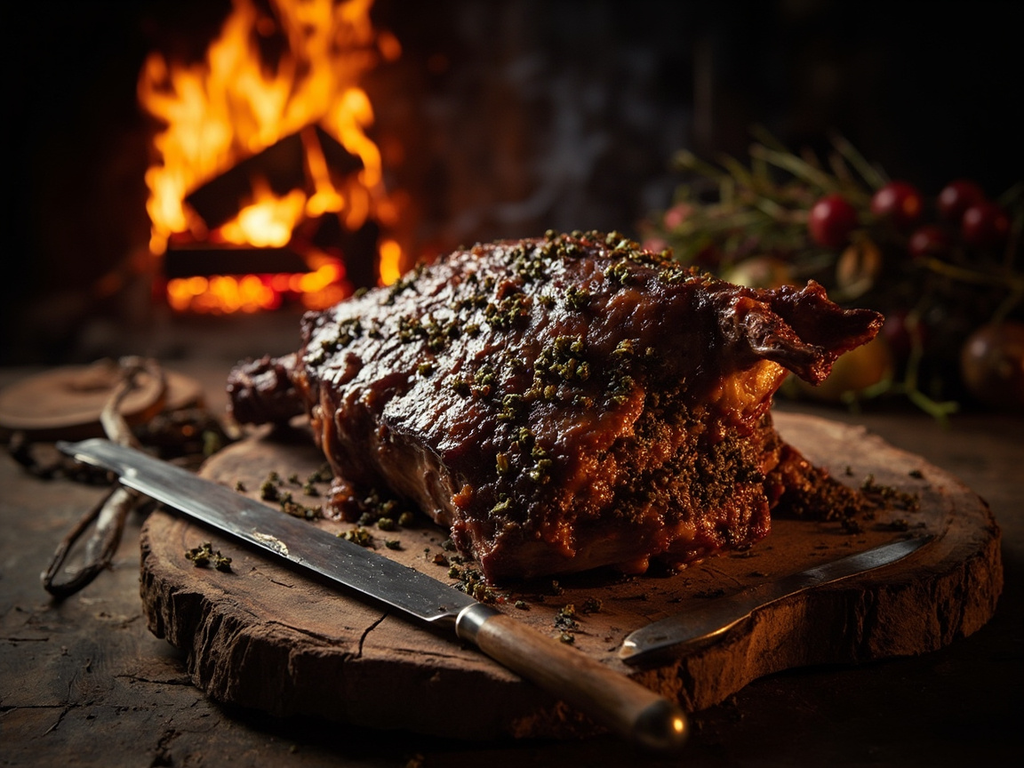
Galti steiktr — Roasted wild boar from the great hearth
Why this dish? Angrboða is a giantess of Jötunheimr, where wild beasts are hunted in the dark woods of Járnviðr, the Iron Forest. Roasted wild boar over an open fire, the noble and fatty meat of Nordic feasts, embodies the brutal abundance of her table — where one feasts without manners, on the scale of the giants.
A wild boar shoulder rubbed with salt and crushed juniper berries, roasted slowly near the embers until the fat crackles and the flesh falls apart. It is placed whole on the board, and each one cuts their share with a knife.
Come close to the fire, you who are not afraid of the dark of the woods. In Járnviðr, where my wolves grow, the beast is taken with the spear and given to the hearth. Rub it with salt and those bitter berries that grow under the frost, then let it turn near the coals for as long as it takes — a giant does not hurry the fire. When the fat sings and blackens, cut wide, and let none count their portion: at my table, hunger alone makes the law.
- •Wild boar shoulder — one whole piece (feast meat)
- •Sea salt — a handful (seasoning and crust)
- •Juniper berries — a good pinch, crushed (resinous Northern fragrance)
- •Butter or suet — as needed (basting during cooking)
Galti steiktr — Roasted wild boar from the great hearth
A wild boar shoulder rubbed with salt and crushed juniper berries, roasted slowly near the embers until the fat crackles and the flesh falls apart. It is placed whole on the board, and each one cuts their share with a knife.
Why this dish? Angrboða is a giantess of Jötunheimr, where wild beasts are hunted in the dark woods of Járnviðr, the Iron Forest. Roasted wild boar over an open fire, the noble and fatty meat of Nordic feasts, embodies the brutal abundance of her table — where one feasts without manners, on the scale of the giants.
Come close to the fire, you who are not afraid of the dark of the woods. In Járnviðr, where my wolves grow, the beast is taken with the spear and given to the hearth. Rub it with salt and those bitter berries that grow under the frost, then let it turn near the coals for as long as it takes — a giant does not hurry the fire. When the fat sings and blackens, cut wide, and let none count their portion: at my table, hunger alone makes the law.
Ingredients (period version)
- Wild boar shoulder — one whole piece (feast meat)
- Sea salt — a handful (seasoning and crust)
- Juniper berries — a good pinch, crushed (resinous Northern fragrance)
- Butter or suet — as needed (basting during cooking)
Ingredients
- Wild boar shoulder (or pork collar if unavailable) — 1.5 kg (feast meat)
- Coarse salt — 2 tbsp (crust)
- Juniper berries — 1 tbsp crushed (fragrance)
- Butter — 50 g melted (basting)
- Fresh thyme — a few sprigs (wild herb)
Method
- Rub the shoulder with salt and crushed juniper, let rest 1 hour at room temperature.
- Preheat oven to 150°C (or set the meat near the embers of a hearth).
- Place the meat on a rack over a pan, scatter thyme over it.
- Roast 3 to 4 hours, basting with melted butter every 40 minutes, until the flesh pulls apart.
- Increase to 220°C for the last 15 minutes to crackle the skin.
- Let rest 15 minutes, place whole on a board and slice with a knife.
How it was made : Sagas and excavations show that pork and wild boar were among the most prized meats in Nordic feasts (Valhalla itself serves the boar Sæhrímnir). Large cuts were roasted on a spit or hung near an open fire for hours, without a thermometer: by sight, smell, and touch.
The contemporary twist : Serve on a large rough wooden board with a separate juniper butter dip, and name the dish 'Fenrir's portion' for children's tables fond of mythology.
Sources : Daniel Serra & Hanna Tunberg, An Early Meal: A Viking Age Cookbook (ChronoCopia, 2013) · Snorri Sturluson, Edda — Gylfaginning (XIIIe s.)
Angrboða · Charactorium