 flip
flipTharid of mutton with soaked bread
Tharid of mutton with soaked bread
Why this dish? Tharid was the prestige dish of the early Islamic Arab world — the one served to honored guests. For a man of Abdallah's rank, foster-brother of Caliph Uthman and governor, it is the dish of victories and receptions, when a sheep is slaughtered to honor the table.
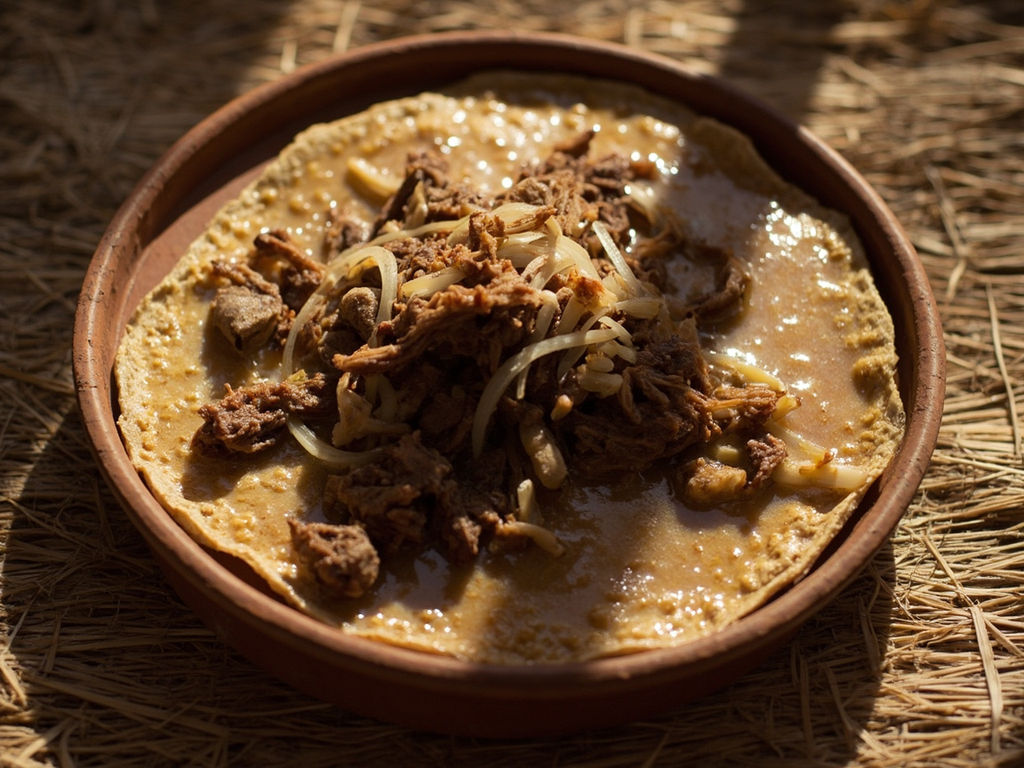
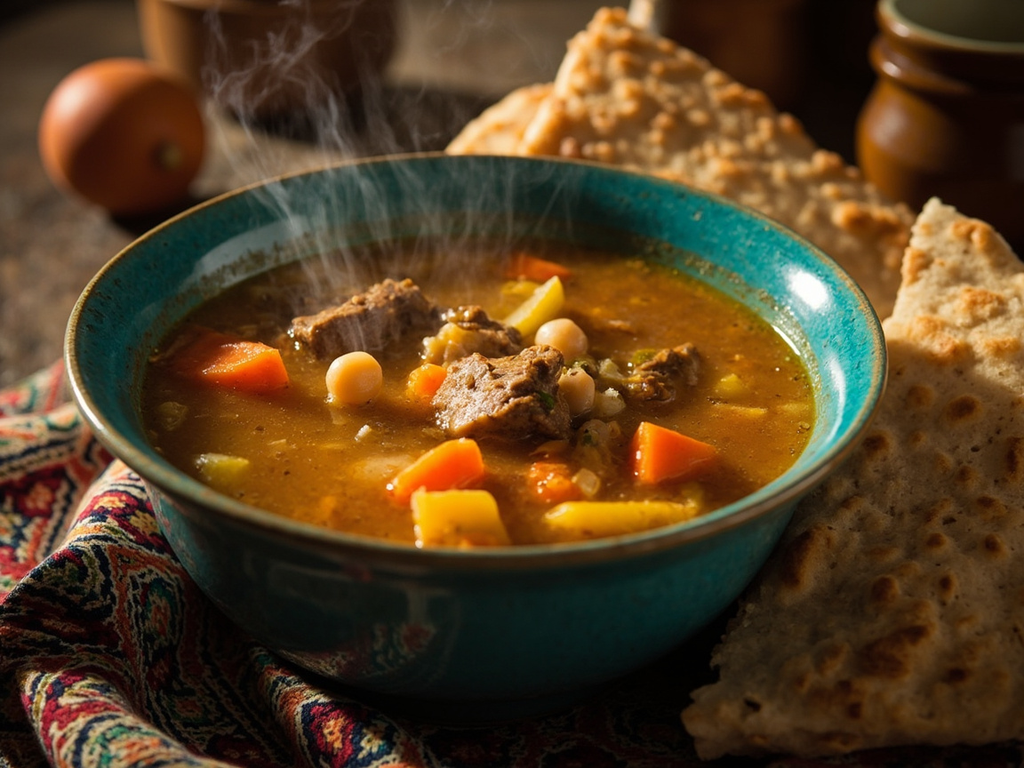
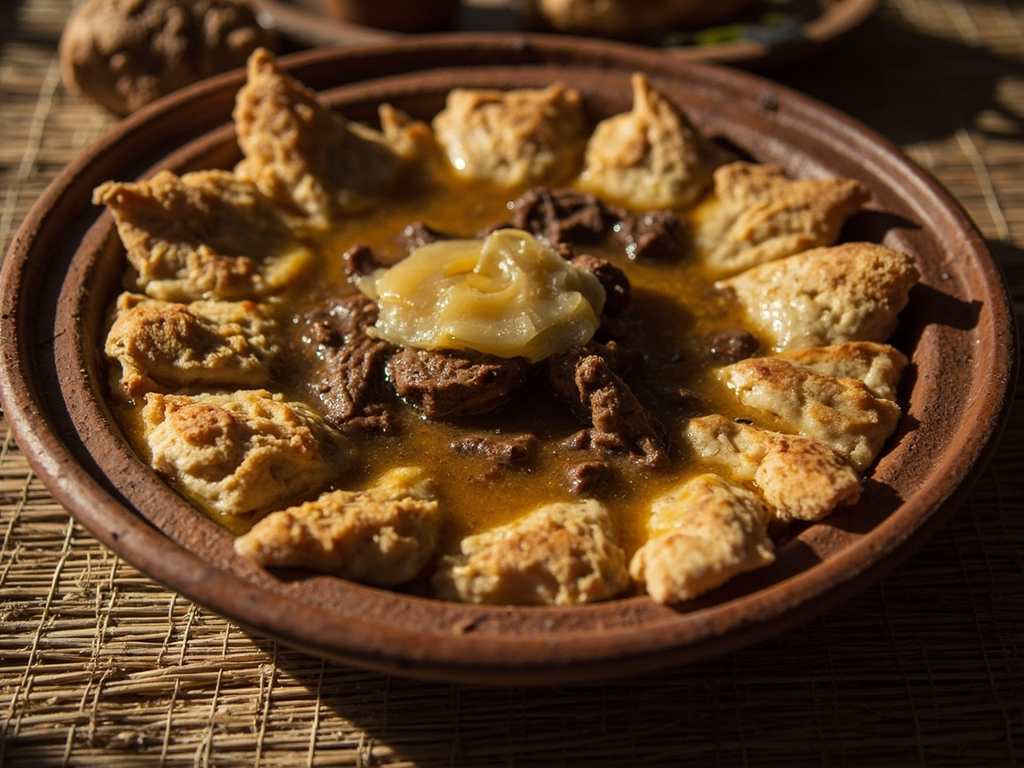
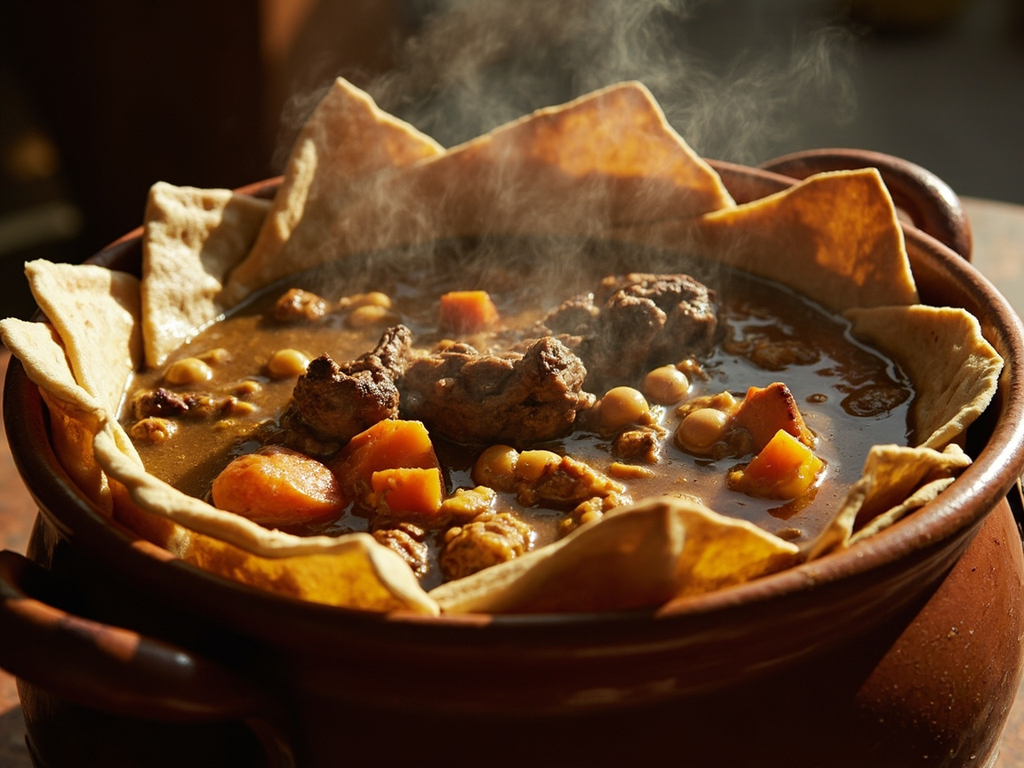
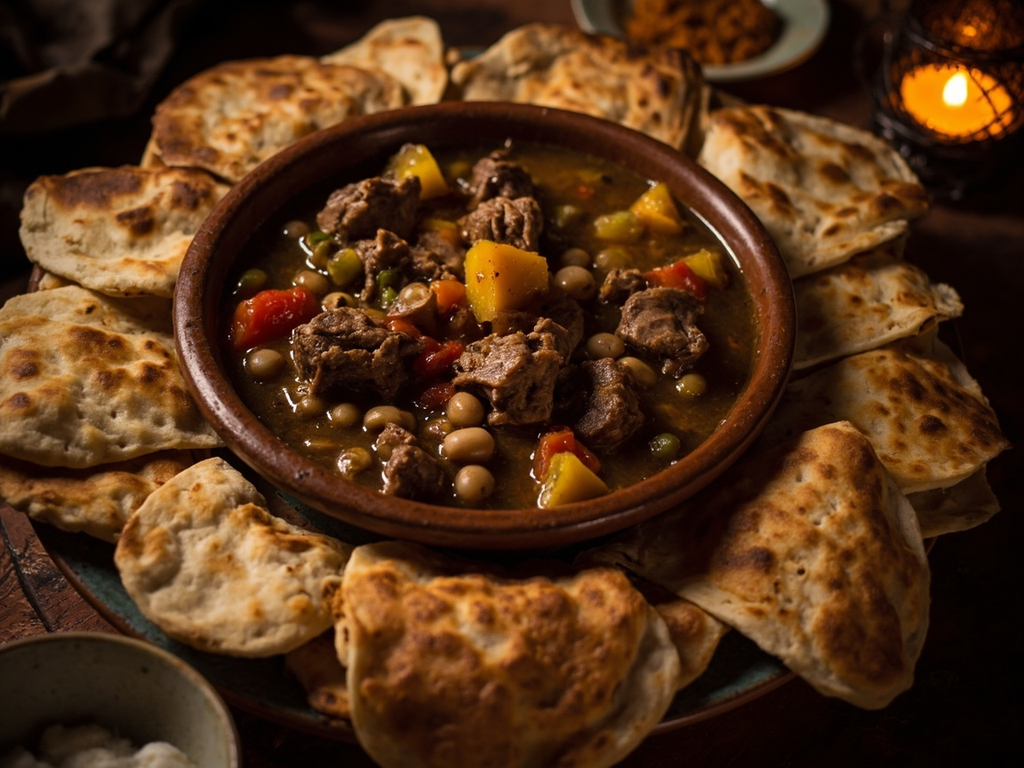
A mutton stew slow-cooked with onion, seasonal squash, and broad beans, poured boiling hot over pieces of bread that soak up the broth. Eaten from the communal dish, each person taking from the portion in front of them.
Approach, guest, and peace be upon you: today we have bled a sheep, so it is a day of tharid. See how we crumble the bread at the bottom of the dish before pouring the fat broth over it — let it soak a moment, so it becomes tender as marrow. Among us it is said that tharid surpasses other dishes as the moon surpasses the stars; I will not contradict that. Take from what is in front of you, never from the middle, and do not hurry: the meat is for him who waits until the bread has taken the taste of the pot.
- •Mutton shoulder with bone — a fine piece (meat and broth)
- •Onions — two (aromatic base)
- •Squash (Old World variety, edible gourd type) — a piece (melting vegetable)
- •Fresh or soaked dried broad beans — a handful (garnish)
- •Cumin, coriander seeds, pepper — to taste (spices)
- •Samn (clarified butter) — a spoonful (fat)
- •Stale barley or wheat bread — several flatbreads (base that soaks up the broth)
Tharid of mutton with soaked bread
A mutton stew slow-cooked with onion, seasonal squash, and broad beans, poured boiling hot over pieces of bread that soak up the broth. Eaten from the communal dish, each person taking from the portion in front of them.
Why this dish? Tharid was the prestige dish of the early Islamic Arab world — the one served to honored guests. For a man of Abdallah's rank, foster-brother of Caliph Uthman and governor, it is the dish of victories and receptions, when a sheep is slaughtered to honor the table.
Approach, guest, and peace be upon you: today we have bled a sheep, so it is a day of tharid. See how we crumble the bread at the bottom of the dish before pouring the fat broth over it — let it soak a moment, so it becomes tender as marrow. Among us it is said that tharid surpasses other dishes as the moon surpasses the stars; I will not contradict that. Take from what is in front of you, never from the middle, and do not hurry: the meat is for him who waits until the bread has taken the taste of the pot.
Ingredients (period version)
- Mutton shoulder with bone — a fine piece (meat and broth)
- Onions — two (aromatic base)
- Squash (Old World variety, edible gourd type) — a piece (melting vegetable)
- Fresh or soaked dried broad beans — a handful (garnish)
- Cumin, coriander seeds, pepper — to taste (spices)
- Samn (clarified butter) — a spoonful (fat)
- Stale barley or wheat bread — several flatbreads (base that soaks up the broth)
Ingredients
- Lamb shoulder or neck — 800 g (meat and broth)
- Onions — 2 large (aromatic base)
- Zucchini or potimarron squash — 300 g (melting vegetable)
- Shelled broad beans (fresh or frozen) — 200 g (garnish)
- Ground cumin + ground coriander + pepper — 1 tsp each (spices)
- Clarified butter (or butter) — 30 g (fat)
- Stale flatbread (pita or Lebanese bread) — 4 portions (base that soaks up the broth)
- Salt — to taste (seasoning)
Method
- Melt the clarified butter, brown the meat on all sides, then add the sliced onions.
- Cover with water, salt, add spices, and simmer covered for 1 hour 30 minutes over low heat.
- Add the squash in pieces and the broad beans, continue for 30 minutes until the meat falls off the bone.
- Crumble the stale bread into the bottom of a large communal serving dish.
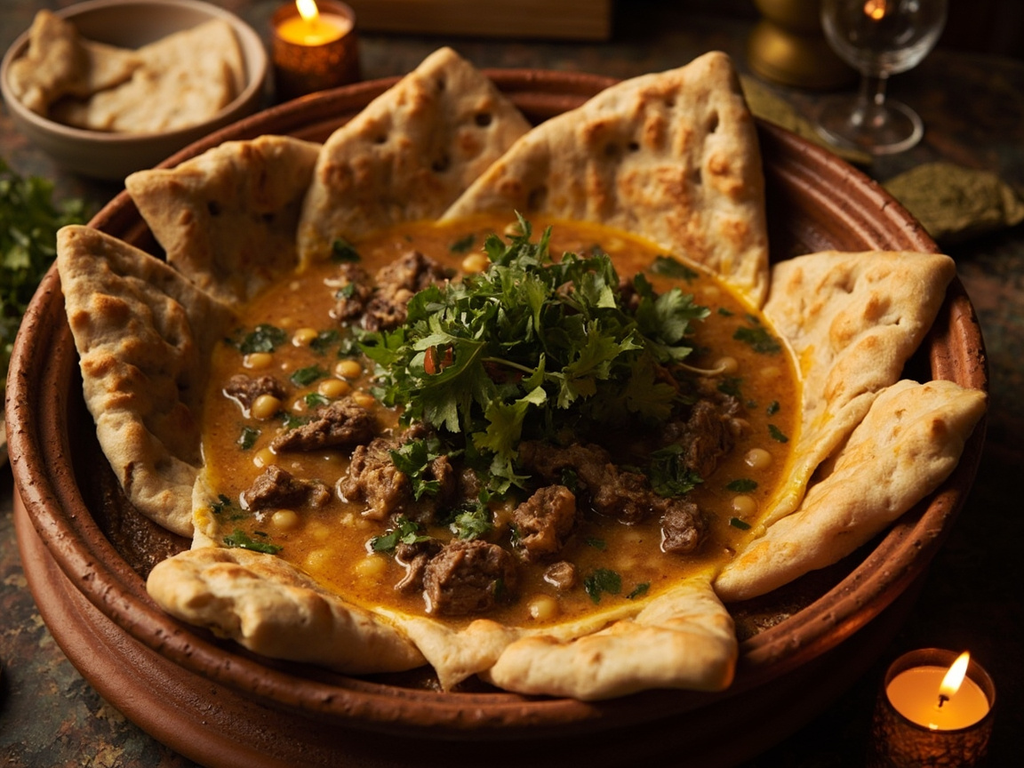
- Pour the boiling broth over the bread, let soak for 2 minutes, then arrange the meat and vegetables on top. Serve in the center of the table, to share.
How it was made : Tharid (or tharîd) is one of the earliest attested dishes of Arab cuisine, celebrated since early Islam as a superior dish. It was prepared in a single pot and poured over counted-out bread, a thrifty and convivial way to satisfy many guests with a single animal.
The contemporary twist : Served as individual portions, with the bread crisped in the oven underneath to maintain a tender-crunchy contrast, and a few fresh coriander leaves.
Sources : Maxime Rodinson, « Recherches sur les documents arabes relatifs à la cuisine », Revue des études islamiques, 1949 · Ibn Sayyar al-Warraq, Kitab al-Tabikh (10th century, collection of Abbasid recipes)
Abdallah ibn Saad · Charactorium