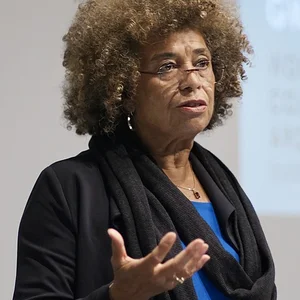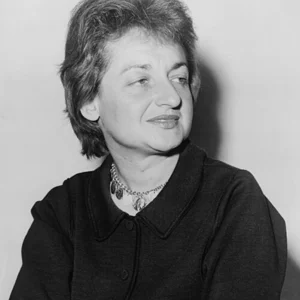

Anita Hill is an African American lawyer and law professor. In 1991, her testimony before the U.S. Senate, accusing Judge Clarence Thomas of sexual harassment during his nomination to the Supreme Court, marked a turning point in public awareness of workplace harassment.
Anita Hill(1956 — ?)
Anita Hill
États-Unis
6 min read
Frequently asked questions
Key Facts
- Born on July 30, 1956, in Lone Tree, Oklahoma (United States)
- Earned a law degree from Yale University in 1980
- In October 1991, testified before the Senate Judiciary Committee during the confirmation hearings for Clarence Thomas's appointment to the Supreme Court
- Her testimony reignited the public debate on workplace sexual harassment in the United States
- Became a law professor at Brandeis University and a leading figure in the fight against sexual violence
Works & Achievements
Her public testimony accusing Clarence Thomas of sexual harassment became a defining moment in the national reckoning over workplace harassment.
Autobiography in which Anita Hill reflects on her life and on the 1991 case, defending the truthfulness of her testimony.
Collective volume analyzing the Hill-Thomas affair through the lens of race, gender, and power relations in the United States.
Essay in which she connects the issues of housing, equality, and citizenship for women and minorities.
A reckoning that, thirty years on, takes stock of gender-based violence and proposes ways to bring it to an end.
Teaching and research in law, social policy, and gender studies, notably at the University of Oklahoma and later Brandeis University.
Anecdotes
In October 1991, Anita Hill, then a law professor, was called to testify before the Senate Judiciary Committee, which was made up entirely of men. Her testimony, broadcast live on television, was watched by millions of Americans and transformed the public debate about workplace harassment.
Before the hearing, Anita Hill agreed to take a lie detector test (a polygraph), the results of which supported the truthfulness of her testimony. Clarence Thomas, for his part, refused to take one.
During his testimony, Clarence Thomas described the hearing as a “high-tech lynching for uppity Blacks,” a phrase that struck public opinion and shifted part of the debate onto the question of race.
The year after the testimony, in 1992, a record number of women were elected to the U.S. Congress: the press called it the “Year of the Woman,” and many saw it as a direct consequence of the Hill-Thomas affair.
After the hearings, complaints of sexual harassment filed with the relevant federal agency (the EEOC) rose sharply, a sign that Anita Hill's testimony had given many women the confidence to speak out.
Primary Sources
“My working relationship became even more strained when Judge Thomas began to use work situations to discuss sex.” (My working relationship became even more strained when Judge Thomas began to use work situations to discuss sex.)
In it, Anita Hill looks back on her childhood in a family of Oklahoma farmers and on her experience of the 1991 hearings, defending the sincerity and the personal cost of her testimony.
Here Hill places the 1991 case within a long history of gender-based violence and calls for a collective response, from schools to businesses.
Key Places
Rural community in Oklahoma where Anita Hill was born in 1956, the youngest of thirteen siblings in a family of African American farmers.
Law school of Yale University where Anita Hill earned her Juris Doctor (J.D.) in 1980.
Seat of the Senate where Anita Hill testified before the Judiciary Committee in October 1991, during hearings broadcast across the entire country.
Anita Hill taught commercial law here from the 1980s onward; it was from this post that she was called to testify in 1991.
Anita Hill became a professor of social policy, law, and gender studies here, continuing her academic and activist engagement.
Typical Objects

The 1991 hearings were broadcast live, bringing the issue of harassment into American homes. The media apparatus turned a Senate procedure into a national event.

Anita Hill submitted a written deposition to the senators detailing her accusations before reading it aloud. The document became a central piece of the case.

Before testifying, Anita Hill swore to tell the truth with her hand on a Bible, following the ritual of American hearings.

Anita Hill voluntarily took a polygraph test whose results supported her testimony. The device measures physiological reactions such as heart rate.

A lawyer and professor, Anita Hill teaches and works from compilations of laws and case law, particularly labor and discrimination law.

For her highly publicized hearing, Anita Hill wore a plain suit, the coded attire of female professional respectability before institutions.
School Curriculum
Vocabulary & Tags
Key Vocabulary
Tags
Daily Life
Morning
A law professor, Anita Hill often begins her day by preparing her classes and reading court decisions and legal articles. Coffee and a review of the day's news accompany this foundational work.
Afternoon
Her afternoons are split between lecturing in the auditorium, mentoring students, and attending university meetings. She also devotes time to writing articles and books.
Evening
In the evening, she prepares lectures and public talks, responds to media requests, and takes part in debates on equality and gender-based violence.
Food
Her diet is that of a contemporary American academic, mixing everyday cooking with meals sometimes taken on campus. She recalls her rural roots in Oklahoma and the family cooking of her childhood.
Clothing
For her public and academic duties, she favors understated professional attire — suits and structured jackets — the codes of respectability within American institutions.
Housing
She lives in the Boston area, where she teaches at Brandeis University, in a residential setting typical of a university professor in the United States.
Historical Timeline
Period Vocabulary
Liens externes & ressources
Références
Œuvres
Témoignage devant le Sénat américain
1991
Speaking Truth to Power
1997
Race, Gender, and Power in America (codirection)
1995
Reimagining Equality
2011
Believing: Our Thirty-Year Journey to End Gender Violence
2021
Carrière de professeure de droit
1986-aujourd'hui