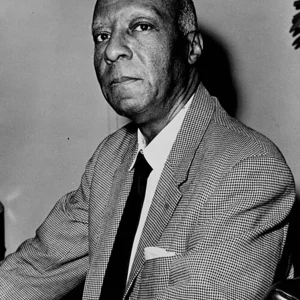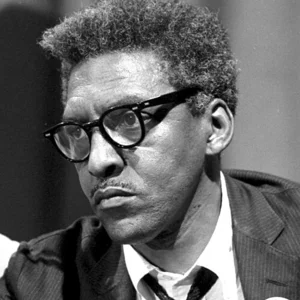

African-American civil rights activist, advisor to Martin Luther King and chief organizer of the 1963 March on Washington. A pacifist and advocate of nonviolence, he was also a pioneering figure in the gay rights movement.
Bayard Rustin(1912 — 1987)
Bayard Rustin
États-Unis
6 min read
Frequently asked questions
Famous Quotes
« We need in every community a group of angelic troublemakers.»
Key Facts
- Born in 1912 in West Chester (Pennsylvania), died in 1987
- Advises Martin Luther King and introduces him to Gandhi's principles of nonviolence starting in 1955–1956 (Montgomery bus boycott)
- Chief organizer of the March on Washington for Jobs and Freedom in August 1963
- Co-founder of the Southern Christian Leadership Conference (SCLC) in 1957
- Posthumously awarded the Medal of Freedom in 2013 under the presidency of Barack Obama
Works & Achievements
Co-organized the first interracial bus trip through the South to test the desegregation of transportation, a forerunner of the Freedom Rides.
Logistical coordination of a demonstration of more than 250,000 people, regarded as a masterpiece of peaceful organization.
Helped create the Southern Christian Leadership Conference led by Martin Luther King.
An influential essay calling on the movement to shift from protest to coalition-based political action.
Led an institute bridging the civil rights movement and the African American labor movement.
Defended refugees and human rights around the world, and spoke out as a pioneer for gay rights late in life.
Anecdotes
In 1963, Bayard Rustin organized the March on Washington in just eight weeks: he had to coordinate transportation for more than 250,000 people and arrange for water, restrooms, and marshals to keep order. It was he who decided the demonstration should end in front of the Lincoln Memorial, where Martin Luther King delivered his famous “I Have a Dream” speech.
A committed believer in nonviolence, Rustin traveled to India after Gandhi's death to study the methods of peaceful resistance. He later applied these principles to the American movement and was one of the advisers who helped Martin Luther King fully embrace the philosophy of active nonviolence.
In 1947, Rustin took part in the “Journey of Reconciliation,” a bus trip through the South to test the ban on segregation in transportation. Arrested in North Carolina, he was sentenced to hard labor on a chain gang, an experience he later denounced in the press.
During the Second World War, Rustin refused to be drafted as a conscientious objector and spent more than two years in federal prison. There he led actions against the racial segregation that prevailed even behind bars.
Because he was openly gay at a deeply hostile time, he was often kept in the shadows of the movement. It was not until 2013, twenty-six years after his death, that President Barack Obama posthumously awarded him the Presidential Medal of Freedom, the highest civilian honor in the United States.
Primary Sources
The March on Washington for Jobs and Freedom calls for a peaceful and orderly demonstration for jobs and freedom for all Americans.
In it, Rustin recounts his arrest and his sentence to hard labor for refusing to give up his seat at the back of a bus in the South.
In it, Rustin argues that the movement must shift from protest to a political strategy of coalition-building in order to achieve lasting change.
Bayard Rustin is hailed as the architect of the March on Washington and a tireless champion of equality, long left in the shadows.
Key Places
Birthplace of Bayard Rustin, where he was raised in the pacifist Quaker tradition by his grandparents.
The endpoint of the 1963 March on Washington, organized by Rustin, where the “I Have a Dream” speech was delivered.
The neighborhood where Rustin lived for much of his life and which lay at the heart of African American activist and labor union networks.
The city of the 1955-1956 bus boycott, where Rustin came to advise Martin Luther King on the strategy of nonviolence.
The prison where Rustin was incarcerated as a conscientious objector during World War II and where he fought against internal segregation.
The country Rustin traveled to after Gandhi's death to study nonviolent resistance methods up close.
Liens externes & ressources
Références
Œuvres
Journey of Reconciliation
1947
Organisation de la Marche sur Washington pour l'emploi et la liberté
1963
Co-fondation et structuration de la SCLC
1957
« From Protest to Politics: The Future of the Civil Rights Movement »
1965
A. Philip Randolph Institute
1965
Engagement pour les droits humains internationaux
1970-1987