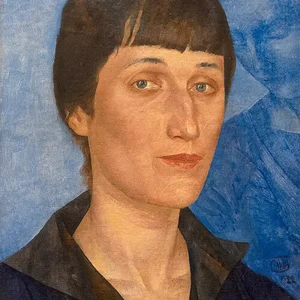

Major Russian poet of the 20th century and a leading figure of Acmeism. Her work *Requiem* bears witness to Stalinist persecution and the suffering of the Soviet people. She resisted Soviet censorship throughout her life.
Anna Akhmatova(1889 — 1966)
Anna Akhmatova
Union soviétique, Empire russe
8 min read
Frequently asked questions
Famous Quotes
« I was not with those who abandoned their land to the mercy of its enemies.»
« No, it is not I, it is somebody else who is suffering.»
Key Facts
- 1889: Born in Odessa (Russian Empire)
- 1910–1920: Central figure of Acmeism alongside Gumilev and Mandelstam
- 1935–1940: Clandestine composition of *Requiem*, a cycle of poems about the Stalinist terror
- 1946: Expelled from the Union of Soviet Writers by the Zhdanov Decree
- 1966: Died in Leningrad, rehabilitated only posthumously
Works & Achievements
Akhmatova's debut collection, immediately praised by critics. It reveals her Acmeist style: precise imagery, intense feeling, and an economy of words that would define her entire body of work.
Her most popular collection during her lifetime, reprinted many times before being banned. It celebrates love and spiritual life with a sensitivity that made Akhmatova the poetic voice of a generation.
The last collection published in the USSR for forty years. It bears witness to the chaos of revolution and civil war, and marks the end of a period of relative freedom for Russian poetry.
A cycle of poems composed clandestinely to bear witness to Stalinist arrests and terror. A masterpiece of literary resistance worldwide, it was not published in the USSR until 1987.
A long autobiographical and historical poem on which Akhmatova worked for twenty-five years. It weaves together the poet's personal history, Russia's fate, and the memory of the Silver Age.
A collection published a year before her death, gathering texts from an entire lifetime. It marks Akhmatova's partial rehabilitation in Soviet letters and allowed her to reach an official readership once more.
Anecdotes
For seventeen months, Akhmatova stood in line outside the Kresty (Crosses) prison in Leningrad, trying to get news of her son Lev, who had been arrested by the NKVD. One day, a woman who had recognized the poet whispered to her: “Can you describe this?” Akhmatova replied simply: “Yes, I can.” This scene appears in the dedication to her major work, Requiem.
To evade Soviet censorship, Akhmatova kept no written copies of her banned poems. She would recite them to her closest friends, who in turn memorized them. Once the text was committed to memory, the pages were burned. This is how the Requiem cycle survived for decades without ever being put to paper in the USSR.
In December 1945, the British philosopher Isaiah Berlin visited Akhmatova in Leningrad. Their long nocturnal conversation on literature and exile was reported to Stalin, who allegedly declared in fury: “So our nun is now receiving foreign spies.” Some historians believe this episode contributed to the hardening of Soviet cultural policy.
In August 1946, Soviet official Andrei Zhdanov issued an official decree describing Akhmatova as both a “half-nun, half-harlot” and an enemy of the socialist people. She was expelled from the Soviet Writers' Union, losing all rights to publish and to receive food rations. She lived in extreme poverty, surviving thanks to the solidarity of her friends.
Despite decades of persecution — her first husband shot, her son imprisoned multiple times, her works censored — Akhmatova always refused to leave Russia. She maintained that she was a witness to her people and that her place was in Russia. At the end of her life, she was partially rehabilitated and in 1964 received the Etna-Taormina International Literary Prize in Italy.
Primary Sources
No, not under the vault of alien skies, and not under the shelter of alien wings — I was with my people then, there, where my people, unfortunately, were.
During the frightening years of the Yezhovshchina, I spent seventeen months waiting in prison lines in Leningrad. One day, someone recognized me. Then a woman with bluish lips who was standing behind me — she had never heard my name — woke from the stupor we all shared and whispered in my ear: 'Can you describe this?' And I said: 'Yes, I can.'
I have learned to live simply and wisely, to look at the sky and pray to God, and to take long walks before evening to tire out my useless restlessness.
Weep not for me, Mother, since I am in the grave. The choir of angels glorified the great hour, the heavens dissolved in fire. To the Father He said: 'Why hast Thou forsaken me!' And to the Mother: 'Oh, weep not for me…'
From the year forty, as from a tower's top, I survey everything: the summons, the arrests, the lists. I hear the monotonous tread of those being led away. I see the faces of those who will not return.
Key Places
Anna Akhmatova was born on June 23, 1889 in this coastal neighborhood on the Black Sea. She left the region in childhood to settle in Tsarskoye Selo, but her southern origins always nourished her imagination.
Akhmatova grew up in this imperial residential town where she attended the lycée and developed her love of poetry. This place, associated with Pushkin, lastingly shaped her imagination and her relationship with the Russian literary tradition.
Akhmatova spent most of her adult life in this city, renamed Leningrad under the Soviet regime. It was here that she wrote the bulk of her work, lived through the Stalinist purges, and endured the siege of 1941–1944.
It was in front of this prison that Akhmatova stood in line for seventeen months trying to get news of her son Lev. This experience lies at the heart of *Requiem* and stands as a symbol of the suffering endured by the families of Stalin's victims.
Evacuated during the siege of Leningrad, Akhmatova lived in Tashkent from 1941 to 1944. She continued to write there and gave public readings, maintaining a vital link between poetry and cultural resistance.
In the final years of her life, Akhmatova was given a small dacha in Komarovo, affectionately nicknamed “the cabin.” She died there on March 5, 1966 and was buried on the grounds; her grave has since become a site of literary pilgrimage.
Typical Objects

Akhmatova wrote her poems with a quill on loose sheets of paper that were burned immediately afterward to prevent seizure by the NKVD. The quill was both her creative tool and an instrument of silent resistance.

The dark shawl, present in her portraits and evoked in her poems, symbolized mourning and Acmeist restraint. It was also a practical garment for the long hours spent queuing outside prisons.

Akhmatova kept a photograph of her son Lev, who was arrested several times by the NKVD, and treasured it dearly. This image was her vital link to the person she loved most, whose fate she often did not know.

A heavy smoker, Akhmatova regarded cigarettes as a companion to her late-night writing. They were also a valuable commodity for barter in a Soviet Russia defined by chronic shortages.

As in every Russian home, the samovar set the rhythm of daily life and clandestine literary evenings. Over tea, Akhmatova would recite her poems to the rare trusted friends who committed them to memory on her behalf.

Akhmatova had an encyclopedic knowledge of Russian poetry and devoted several critical essays to Pushkin. Even in her often cramped apartments, books held a central place despite the difficult material conditions of her life.
School Curriculum
Vocabulary & Tags
Key Vocabulary
Daily Life
Morning
Akhmatova rose late, after nights often devoted to writing. She began her day with strong tea brewed in a samovar — a deeply ingrained Russian habit — and sometimes received visitors as early as the morning in her communal apartment (kommunalka) in Leningrad.
Afternoon
Afternoons were devoted to writing, reading, and visits from friends and fellow poets. During periods of persecution, she would whisper her poems to trusted female friends who memorized them, then burn the pages to prevent seizure by the NKVD's political police.
Evening
In the evenings, Akhmatova loved to gather in small circles to recite poems, listen to music, or discuss literature. These clandestine gatherings of intellectuals were at once an artistic necessity and an act of cultural resistance against the Soviet regime.
Food
Like most residents of Leningrad, Akhmatova lived under strict rationing, especially during and after the war. Her diet was simple: rye bread, potatoes, kasha (a grain porridge), and occasionally fish. After her expulsion from the Writers' Union in 1946, she lost her ration entitlements and depended on the generosity of her friends.
Clothing
Akhmatova was known for her restrained, dignified elegance, even in poverty. She often wore long dark dresses and a shawl, an appearance that gave her an air at once aristocratic and nun-like — something Zhdanov turned against her by branding her a “nun.” Her portraits show a woman of proud bearing, whose dress reflected a quiet dignity in the face of adversity.
Housing
Akhmatova spent most of her adult life in communal apartments (kommunalki), sharing a kitchen and hallway with other families. She lived notably in the apartment known as the Fountain House in Leningrad, now a museum. In her later years, she was given a small dacha in Komarovo, which she affectionately nicknamed “the Booth.”
Historical Timeline
Period Vocabulary
Liens externes & ressources
Références
Œuvres
Le Soir (Vecher)
1912
Le Chapelet (Chetki)
1914
Anno Domini MCMXXI
1922
Requiem
1935-1940 (écrit en secret), 1963 (publié à Munich)
Poème sans héros (Poema bez geroya)
1940-1965
La Course du temps (Beg vremeni)
1965