 flip
flipPirozhki with cabbage and egg
Pirozhki with cabbage and egg
Why this dish? The Dostoevskys spent four years traveling across Europe — Dresden, Bad Homburg, Wiesbaden — often in straitened circumstances, counting every kopeck. Pirozhki, small stuffed pastries that keep well and can be eaten by hand, were the quintessential Russian travel snack, tucked into a basket for the train or carriage.
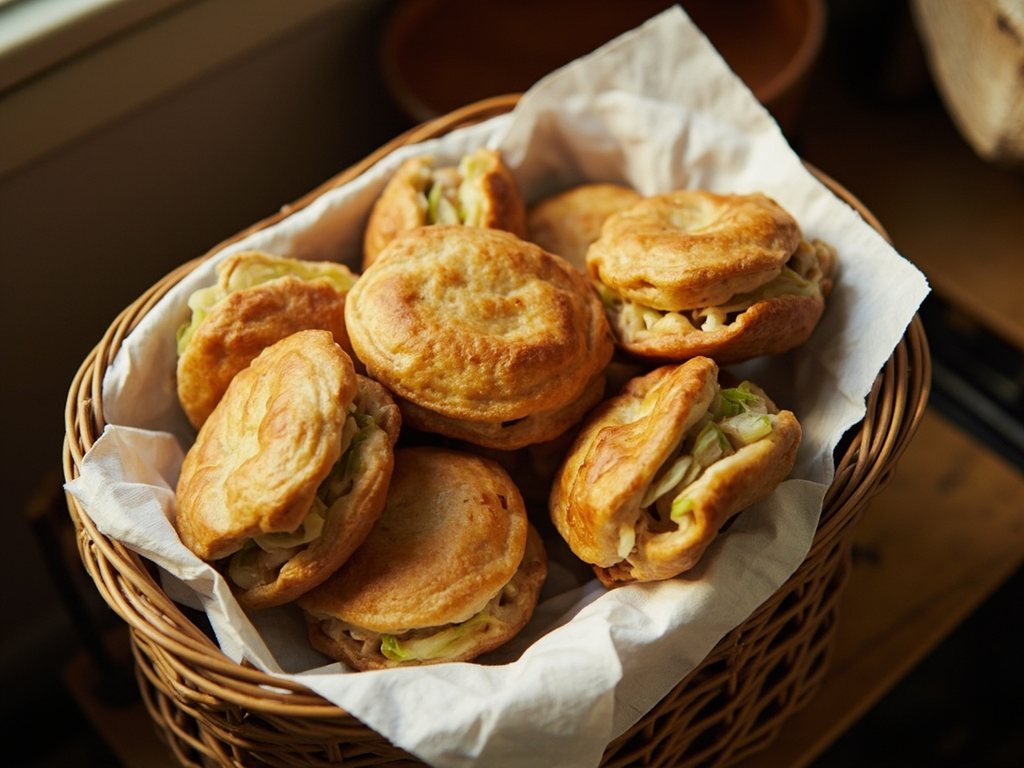
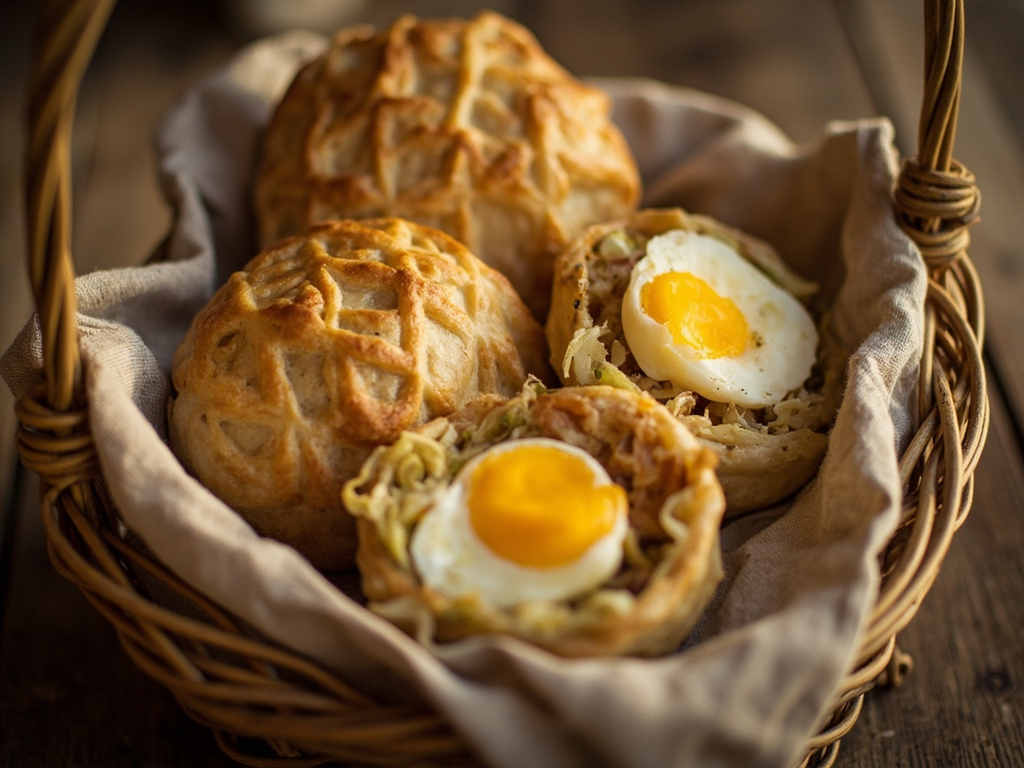
Small baked leavened pastries filled with softened cabbage and hard-boiled egg, golden and tender, perfect for taking along and eating cold on the road.
When we had to take the train to a new city — and God knows how often we moved! — I never left without a cloth full of pirozhki at the bottom of the basket. I would let the cabbage melt slowly in butter with a mashed hard-boiled egg; nothing costly, but it stays with you for hours. On the hard benches, between foreign stations, these little pastries reminded us of home. You eat them with your fingers, you see, without ceremony or utensils.
- •Wheat flour — as needed (dough)
- •Yeast — a little (leavening)
- •Milk, butter, egg — for the dough (softness)
- •Fresh cabbage — one head (filling)
- •Hard-boiled eggs — two or three (filling)
- •Onion — one (aromatic)
Pirozhki with cabbage and egg
Small baked leavened pastries filled with softened cabbage and hard-boiled egg, golden and tender, perfect for taking along and eating cold on the road.
Why this dish? The Dostoevskys spent four years traveling across Europe — Dresden, Bad Homburg, Wiesbaden — often in straitened circumstances, counting every kopeck. Pirozhki, small stuffed pastries that keep well and can be eaten by hand, were the quintessential Russian travel snack, tucked into a basket for the train or carriage.
When we had to take the train to a new city — and God knows how often we moved! — I never left without a cloth full of pirozhki at the bottom of the basket. I would let the cabbage melt slowly in butter with a mashed hard-boiled egg; nothing costly, but it stays with you for hours. On the hard benches, between foreign stations, these little pastries reminded us of home. You eat them with your fingers, you see, without ceremony or utensils.
Ingredients (period version)
- Wheat flour — as needed (dough)
- Yeast — a little (leavening)
- Milk, butter, egg — for the dough (softness)
- Fresh cabbage — one head (filling)
- Hard-boiled eggs — two or three (filling)
- Onion — one (aromatic)
Ingredients
- Wheat flour — 400 g (dough)
- Baker's yeast — 10 g (leavening)
- Warm milk — 200 ml (liquid)
- Butter — 60 g (dough + cabbage cooking) (softness)
- Egg — 1 for dough + 1 for egg wash (binder and glaze)
- Green cabbage — ½ head (≈400 g) (filling)
- Hard-boiled eggs — 2 (filling)
- Onion — 1 (aromatic)
- Salt, pepper — to taste (seasoning)
Method
- Knead a soft leavened dough (flour, yeast, milk, butter, egg, salt) and let it double in size for 1 hour.
- Finely chop the cabbage and onion, cook in butter for 20 minutes until tender, season with salt and pepper.
- Off the heat, mix in the chopped hard-boiled eggs; let cool.
- Roll out disks of dough, fill, and seal the edges into pasties.
- Brush with egg wash, bake at 190°C for about 20 minutes until golden brown. Serve warm or cold.
How it was made : Pirozhok (plural pirozhki) accompanied Russians on journeys long before the railroad; they were baked in batches and wrapped in a cloth to take along. Fillings varied with the season and budget: cabbage, kasha, fish, mushrooms, or simply egg.
The contemporary twist : Mark the cabbage pirozhki with a small dough cross on top to distinguish them — an edible label for travel baskets of old.
Sources : Elena Molokhovets, A Gift to Young Housewives, 1861
Anna Grigorievna Snitkina · Charactorium