 flip
flipCha siu — roast lacquered pork (叉燒)
Cha siu — roast lacquered pork (叉燒)
Why this dish? Cha siu — that red lacquered pork you saw hanging in Chinatown windows — was the very taste of home. During her long stays in Europe, Anna May Wong would seek out Chinese restaurants in big cities to find it: a portable flavor, eaten cold, slipped onto a bowl of rice to feel, for a moment, back home.
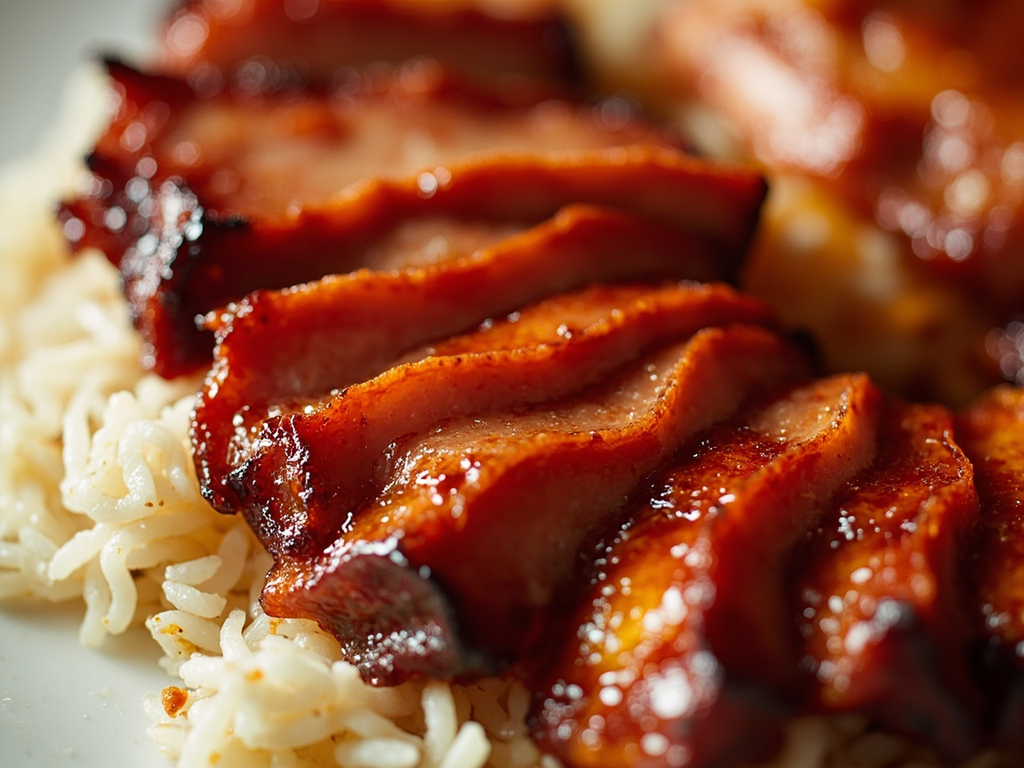
Strips of pork shoulder marinated in a sweet-savory glaze (soy, honey, five-spice, fermented red bean curd), roasted until caramelized at the edges. Eaten hot over rice or cold in slices as a portable snack.
Have you ever seen, behind the windows of Chinatown, those long strips of shiny red pork hanging on their hooks? That was my home. On tour in London, in Paris, I would scour the alleys to find a Cantonese kitchen that knew how to glaze pork properly: honey, a little soy, those five spices that tickle your nose. You keep some slices in the fridge, and the next day you put them cold on warm rice. A diva, you say? Maybe — but a diva who traveled with the nostalgia of cha siu in her trunk.
- •Pork shoulder or belly — in long strips (meat to glaze)
- •Soy sauce — to taste (salty base and color)
- •Honey or maltose — generous (shiny glaze and caramelization)
- •Fermented red bean curd (nam yu) — one spoonful (color and umami depth)
- •Five-spice powder — a pinch (signature fragrance)
- •Rice wine and garlic — to taste (marinade)
Cha siu — roast lacquered pork (叉燒)
Strips of pork shoulder marinated in a sweet-savory glaze (soy, honey, five-spice, fermented red bean curd), roasted until caramelized at the edges. Eaten hot over rice or cold in slices as a portable snack.
Why this dish? Cha siu — that red lacquered pork you saw hanging in Chinatown windows — was the very taste of home. During her long stays in Europe, Anna May Wong would seek out Chinese restaurants in big cities to find it: a portable flavor, eaten cold, slipped onto a bowl of rice to feel, for a moment, back home.
Have you ever seen, behind the windows of Chinatown, those long strips of shiny red pork hanging on their hooks? That was my home. On tour in London, in Paris, I would scour the alleys to find a Cantonese kitchen that knew how to glaze pork properly: honey, a little soy, those five spices that tickle your nose. You keep some slices in the fridge, and the next day you put them cold on warm rice. A diva, you say? Maybe — but a diva who traveled with the nostalgia of cha siu in her trunk.
Ingredients (period version)
- Pork shoulder or belly — in long strips (meat to glaze)
- Soy sauce — to taste (salty base and color)
- Honey or maltose — generous (shiny glaze and caramelization)
- Fermented red bean curd (nam yu) — one spoonful (color and umami depth)
- Five-spice powder — a pinch (signature fragrance)
- Rice wine and garlic — to taste (marinade)
Ingredients
- Pork shoulder — 600 g, cut into 3 cm strips (meat)
- Soy sauce + hoisin sauce — 2 tbsp + 2 tbsp (marinade base)
- Honey — 2 tbsp (reserve 1 for final glaze) (shine and caramel)
- Fermented red bean curd (nam yu) — 1 tbsp (or natural food coloring) (color and umami)
- Chinese five-spice powder — 1/2 tsp (fragrance)
- Shaoxing rice wine + crushed garlic — 1 tbsp + 2 cloves (marinade)
- Sugar — 1 tbsp (balance)
Method
- Mix all marinade ingredients (except 1 tbsp reserved honey) and marinate the pork in the fridge for 4 hours, ideally overnight.
- Preheat the oven to 200 °C. Drain the pork and place it on a wire rack over a pan of water.
- Roast for 25-30 minutes, turning halfway and basting with marinade.
- Mix the reserved honey with a little hot marinade; brush over the meat and roast for 5 more minutes at 220 °C to caramelize the edges.
- Let rest, then slice diagonally. Serve hot over rice, or cold as a snack.
How it was made : Cha siu belongs to siu mei, the Cantonese art of hanging roast meats, born from the need to cook and preserve meat in communal coal ovens. Its red color traditionally came from nam yu (fermented red tofu) rather than food coloring; maltose, rather than sugar, gave the characteristic glassy glaze.
The contemporary twist : Slide cold slices into a split steamed bun (gua bao) with a little cucumber: cha siu street-food style, portable just as Anna carried her nostalgia.
Sources : Eileen Yin-Fei Lo, The Chinese Kitchen, William Morrow, 1999 · Grace Young, The Breath of a Wok, Simon & Schuster, 2004
Anna May Wong · Charactorium