
A German princess of the House of La Marck, Anne of Cleves became the fourth wife of King Henry VIII of England in January 1540. The marriage, motivated by a diplomatic alliance with the Protestant princes, was annulled after six months.
Anne of Cleves(1515 — 1557)
Anne of Cleves
royaume d'Angleterre, duchés unis de Juliers-Clèves-Berg
5 min read
Frequently asked questions
Key Facts
- Born in 1515 in Düsseldorf into the House of La Marck, dukes of Cleves
- Marries Henry VIII on 6 January 1540 as part of an alliance with the German Protestant princes
- The marriage is annulled on 9 July 1540 for non-consummation and a prior engagement
- Receives in compensation the title of “sister of the king” and substantial estates, including Hever Castle
- Dies in 1557 during the reign of Mary I, having outlived all of Henry VIII's other wives
Works & Achievements
Her marriage was meant to seal a rapprochement between England and the German Protestant princes against the Emperor and France.
By consenting without resistance to the dissolution of her marriage, she preserved her life and negotiated an honourable and lasting position.
A unique honorary title that placed her just after the queen and the king's daughters in the hierarchy of the court.
Having become a great landowner (Hever, Richmond), she administered her property and lived independently, a rare thing for a woman of her time.
She maintained cordial ties with Henry VIII, Edward VI and Mary Tudor, weathering the religious upheavals without falling into disgrace.
Anecdotes
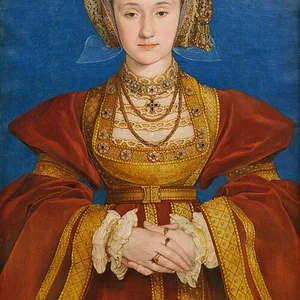
To seal the alliance, Henry VIII sent the painter Hans Holbein the Younger to make a portrait of Anne of Cleves. Charmed by the picture, the king agreed to the marriage without having met her — but at their first meeting in Rochester in January 1540, he was disappointed and reportedly nicknamed her his “Flanders mare.”
The marriage lasted only six months. Henry VIII obtained its annulment in July 1540 by citing the non-consummation of the union and a prior engagement between Anne and the Duke of Lorraine. Anne accepted without resistance, which spared her the tragic fate of two of the king's other wives.
As a reward for her compliance, Henry VIII granted Anne of Cleves rich estates, including Hever Castle (the former home of the Boleyn family), and the honorary title of “the king's beloved sister.” She thus became one of the wealthiest women in England.
Anne did not speak English when she arrived and had received only the typical education of German princesses: needlework and household management, but neither music nor languages — arts that were nonetheless prized at the Tudor court. She nevertheless learned to adapt and remained on good terms with the king.
Anne of Cleves outlived Henry VIII and all of the king's other wives. She died in 1557 during the reign of Mary Tudor and was the only one of Henry VIII's six wives to be buried in Westminster Abbey.
Primary Sources
The marriage between the king and Anne of Cleves is declared null and void, the king having never given his inward consent and the union not having been consummated.
The king complained openly that he did not find in the queen the beauty he had been promised and which he had believed from the portrait.
Alliance agreement sealing the union of the King of England with the sister of Duke William of Cleves, with a view to a rapprochement with the princes of the Schmalkaldic League.
Key Places
Anne's birthplace, capital of the Duchy of Cleves within the Holy Roman Empire.
Site of the awkward first meeting between Anne and Henry VIII, in disguise, in January 1540.
Royal residence where the marriage of Anne and Henry VIII was celebrated on 6 January 1540.
Former home of the Boleyns, granted to Anne after the annulment and becoming one of her residences.
Place where Anne of Cleves spent her final years and died in 1557.
Burial place of Anne of Cleves, the only one of Henry VIII's six wives to rest there.
Typical Objects

Miniature and portrait painted by Hans Holbein the Younger to present Anne to the king. This diplomatic object played a decisive role in bringing about the marriage.

Marriage ring exchanged during the union of January 1540. Anne symbolically returned it upon the annulment.

A heavy outfit in the fashion of Flanders and Cleves, deemed outdated by the English court. Anne later adopted English- and French-style gowns.

Official documents sealed with the royal seal granting her lands, Hever Castle and the title of "the King's Sister" after the annulment.

An English gable-shaped hood (gable hood) that Anne wore to conform to the fashion of the Tudor court.

Heraldic emblem of the House of La Marck, Duchy of Cleves, which symbolized the Germanic alliance sought by England.
School Curriculum
Vocabulary & Tags
Key Vocabulary
Tags
Daily Life
Morning
Woken by her ladies-in-waiting, Anne attended morning Mass in her private chapel. After the annulment, her days began freely in her own residences, far from the constraints of being queen.
Afternoon
The afternoon was spent on needlework, on games of cards and dice — which she enjoyed — and on managing her household. Little by little she was learning English and the customs of the Tudor court.
Evening
Evenings were taken up with meals, sometimes visits from the king who had become her “brother,” and entertainments. She received guests with dignity at her estates of Hever or Richmond.
Food
The table of a great English lady offered roasted meats (beef, venison, poultry), fish on lean days, white bread, wine and beer. Spices and sweet confections marked one's rank and wealth.
Clothing
Anne gave up her heavy German gowns for English and then French fashions, more favoured at court. Ornate headdresses, rich fabrics and jewels signalled her princely status.
Housing
She lived in richly furnished palaces and castles — Richmond, Hever, Bletchingley — fitted with tapestries, fireplaces and precious furniture, surrounded by a large household staff.
Historical Timeline
Period Vocabulary
Liens externes & ressources
Références
Œuvres
Alliance diplomatique anglo-clévoise
1539-1540
Acceptation de l'annulation
1540
Statut de « sœur du roi »
1540
Gestion de ses domaines
1540-1557
Relations de cour sous trois règnes
1540-1557