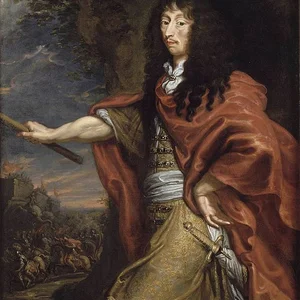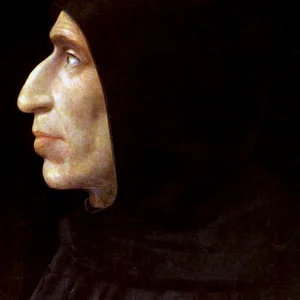

Italian Dominican friar (1452–1498), Savonarola seized control of Florence after the expulsion of the Medici in 1494. A fiery preacher, he imposed a rigorist theocracy before being excommunicated and executed.
Girolamo Savonarola(1452 — 1498)
Girolamo Savonarola
République florentine, duché de Ferrare
9 min read
Frequently asked questions
Famous Quotes
« The swords are drawn, and pestilence and famine move through the world.»
« O Florence, for your sins, your misery, your lust, your avarice, comes upon you this great scourge.»
Key Facts
- 1452: born in Ferrara
- 1490: arrives in Florence, begins his apocalyptic preaching at San Marco
- 1494: expulsion of the Medici, Savonarola becomes the de facto ruler of Florence
- 1497: organizes the 'Bonfire of the Vanities', destroying objects deemed immoral
- 1498: excommunicated by Pope Alexander VI, arrested, hanged, and burned in Florence
Works & Achievements
An account of his prophetic visions in which Savonarola claims to have received from God the mission to reform the Church. Widely circulated, this text established his legitimacy as a prophet in the eyes of both his followers and his opponents.
A collection of sermons on the biblical prophets Amos and Zechariah in which Savonarola denounces the corruption of Florence and Rome and announces an imminent divine punishment. These sermons represent the peak of his eloquence and political influence.
An apologetic treatise defending the truth of Christianity against skeptical philosophers and unbelievers. More scholarly than his sermons, it reveals the solid theological training that underpinned Savonarola's thought.
A political treatise written shortly before his execution in which he outlines his vision of a Florence governed by divine law, with a republican Grand Council. It stands as one of the earliest examples of Christian political thought applied to a Renaissance city-state.
His most significant political achievement: following the expulsion of the Medici, Savonarola established a republican government founded on Christian virtue, sumptuary laws, and the banning of secular festivities — a unique experiment in Renaissance Italy.
Anecdotes
In 1497, Savonarola organized the famous "Bonfire of the Vanities
(*Falò delle vanità*) in Florence: his followers
nicknamed the *Piagnoni* (the Weepers)
roamed the city collecting mirrors
poetry books
paintings
and ornamental objects deemed immoral
before burning them on the Piazza della Signoria. Some Florentine artists — including Botticelli
according to some accounts — are said to have thrown their own works into the flames.
Savonarola openly defied Pope Alexander VI (Rodrigo Borgia), whom he publicly accused of corruption and debauchery. In 1497, the pope excommunicated him and banned him from preaching; yet the Dominican friar continued his sermons, defying papal authority and worsening his political situation until his eventual arrest.
In April 1498, a Franciscan friar challenged Savonarola to a trial by fire: both men were to walk through a blazing pyre so that God might settle their dispute. Savonarola waited for hours in the rain on the square; the ordeal was ultimately called off. The crowd, disappointed and weary, turned against him — this episode directly precipitated his downfall.
Arrested in April 1498, Savonarola was subjected to torture to extract confessions of heresy and false prophecy. On **23 May 1498**, he was hanged and then burned alive alongside two companions on the Piazza della Signoria — the very place where he had preached his fiery sermons. His ashes were cast into the Arno to prevent any veneration of relics.
The young Michelangelo, who had grown up in Florence, was profoundly marked by Savonarola's eschatological sermons. Decades later, he still spoke of the friar's thundering voice with a mixture of admiration and dread, and some art historians see in the themes of the *Last Judgment* in the Sistine Chapel a lasting echo of that influence.
Primary Sources
Savonarola recounts his prophetic visions and declares that God has entrusted him with the mission of announcing the imminent reform of the Church and the punishment of Florence. He describes celestial signs and revelations concerning the coming of a new Cyrus who would chastise a corrupt Italy.
"Florence, you are more guilty than Rome, more guilty than the nations that do not know the law. You have received the light and you have rejected it. Therefore your punishment shall be the greater."
In this apologetic treatise, Savonarola defends the Christian faith against skeptics and philosophers, arguing that the Cross of Christ is the true triumph of truth over the error and corruption of the world.
Savonarola sets out his vision of a republican government founded on divine law, inspired by the Venetian model but centered on Christian virtue. He advocates for an elected Grand Council and strict moral laws to govern the city.
"You are not the vicar of Christ, you are the enemy of Christ. You sell the sacraments, you sell benefices, you sell indulgences." This text, widely circulated in Florence, illustrates the radicalism of his opposition to the Holy See.
Key Places
Savonarola's birthplace, at the time one of the most brilliant Renaissance courts under the Este family. It was there that he received a humanist education before breaking with that world to enter religious life.
The Dominican convent of which Savonarola became prior in 1491, the center of his community and his Florentine political activities. Decorated by Fra Angelico a few decades earlier, it embodies the paradox between the artistic beauty of the Renaissance and the austerity he championed.
From this monumental cathedral, Savonarola delivered his most celebrated sermons, sometimes drawing crowds of up to 10,000 faithful. The grandeur of the setting amplified the power of his prophecies and calls for collective penance.
The central square of Florentine power, it was both the stage for the Bonfires of the Vanities (1497–1498) and the site of Savonarola's execution (23 May 1498). A commemorative plaque still marks the exact spot of his execution there today.
Founded by Saint Dominic himself, it was in this historic convent that Savonarola took the Dominican habit in 1474, marking his definitive break with the secular world. This place marks the beginning of his radical religious vocation.
Typical Objects

The white robe topped with the black cloak and hood of the preaching friars was the garment Savonarola wore on every occasion. This habit signified his vocation as a preacher and gave his silhouette a recognizable austerity in the streets of Florence.

It was from the pulpit of the cathedral of Santa Maria del Fiore that Savonarola delivered his sermons before thousands of Florentines. The pulpit was the seat of his power: a space from which his striking voice transformed eschatological dread into a political program.

Savonarola read the prophets of the Old Testament — Amos, Zechariah, Ezekiel — with great diligence, annotating his copies with references to fuel his sermons foretelling divine punishment. These books formed the intellectual arsenal of his preaching.

The Bonfire of the Vanities erected on the Piazza della Signoria was both a symbolic act and a political statement. To throw one's jewels, books, or paintings onto the pyre meant embracing Savonarola's moral program and rejecting the temptations of Renaissance Florence.

The processions organized by Savonarola and his young followers wound through Florence bearing crucifixes and singing penitential laudes. These marches embodied the public piety the friar sought to impose on the city as a whole.

The bell of the convent of San Marco, of which Savonarola was prior, rang out to rally his supporters in times of danger. During his arrest in 1498, it called the Piagnoni to his defense in vain before the Signoria seized him.
School Curriculum
Vocabulary & Tags
Key Vocabulary
Daily Life
Morning
Savonarola rose before dawn to celebrate the offices of Matins and Lauds with the community of San Marco. The early hours of the day were devoted to silent prayer, meditation on Scripture, and the preparation of his sermons, for which he wrote dense notes in Latin.
Afternoon
In the afternoon, he received visitors — Florentine nobles, ambassadors, ordinary faithful — who came to seek his counsel or share political intelligence. He also oversaw the library of San Marco, one of the richest in Italy, and corresponded with theologians and princes across the peninsula.
Evening
After Vespers, Savonarola would often preach in the cathedral or in the churches of Florence, sometimes for several hours at a stretch. His evening sermons, by the light of candles, blended prophecy, political denunciation, and calls to repentance, frequently leaving the crowd in tears.
Food
As an austere Dominican friar, Savonarola strictly observed the fasts prescribed by the Rule: no meat on Wednesdays, Fridays, or Saturdays, and a very spare diet throughout Advent and Lent. His ordinary meals consisted of vegetables, bread, legumes, and occasionally fish, in keeping with the conventual practices of the time.
Clothing
Savonarola wore at all times the habit of the Order of Preachers: a long white woolen robe (the tunic), a scapular, and a black hooded mantle. This deliberately austere dress stood in stark contrast to the opulence of Florentine fashion, reinforcing his image as a prophet detached from worldly vanity.
Housing
Savonarola lived in a monastic cell at the convent of San Marco: a bare, minimal space containing a straw mattress, a *prie-dieu*, a writing table, and a few books. This convent, built by Cosimo de' Medici and decorated by Fra Angelico, was paradoxically one of the most beautiful places in Florence — a beauty the prior strove to ignore in favor of prayer.
Historical Timeline
Period Vocabulary
Liens externes & ressources
Références
Œuvres
Compendium Revelationum
1495
Prediche sopra Amos e Zaccaria
1496
Triumphus Crucis (Triomphe de la Croix)
1497
Trattato circa il reggimento e governo della città di Firenze
1498
République théocratique de Florence
1494–1498