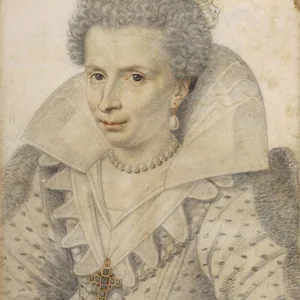

An Italian favorite and lady of the wardrobe to Queen Marie de' Medici, she wielded great influence at the French court during the regency alongside her husband Concino Concini. Accused of witchcraft, she was beheaded and then burned at the Place de Grève in 1617.
Leonora Galigaï(1568 — 1617)
Léonora Dori
6 min read
Frequently asked questions
Key Facts
- Arrives in France in 1600 in the retinue of Marie de' Medici, whose confidante and lady of the wardrobe she becomes
- Marries Concino Concini, who becomes Marshal of Ancre and an all-powerful favorite during the regency (from 1610 onward)
- The Concini couple amass wealth and offices, arousing the hatred of the great nobles and of the young Louis XIII
- After Concini's assassination on the orders of Louis XIII (April 1617), she is arrested and tried for witchcraft and high treason
- Beheaded and then her body burned at the Place de Grève in Paris on 8 July 1617
Works & Achievements
By becoming the confidante and manager of Marie de' Medici's wardrobe, she gained daily access and a rare ascendancy over the sovereign.
Together with Concini, she amassed one of the greatest fortunes in the kingdom through pensions, offices and lands, becoming the object of universal jealousy.
The couple purchased the lordship of Ancre and had it raised to a marquisate, transforming foreign servants into great French lords.
Through her intercession with the queen, she swayed the choice of ministers and favourites, making and breaking careers at court.
Her lucid and proud answers before her judges, denying any diabolical pact, remained in memory as a testimony to the absurdity of the accusations of magic.
Anecdotes
Léonora Dori grew up alongside Marie de' Medici in Florence and followed her to France when she married Henri IV in 1600: the little servant became the queen's most intimate confidante, to the point that it was said no important decision was made without her advice.
She and her husband Concino Concini amassed a colossal fortune and prestigious titles, including the marquisate of Ancre. This meteoric rise of a foreign couple aroused fierce hatred among the French nobility, who scornfully nicknamed them the “Florentines”.
When she was accused of having bewitched the queen, her judges asked her what spell she had used. According to tradition, she proudly replied: “My spell was the power that strong minds must have over weak ones”, a retort that has remained famous.
To support the accusation of witchcraft, her house was searched and books, talismans and pieces of wax were found there; rumour claimed that she sacrificed roosters and consulted rabbis and magicians to maintain her hold over Marie de' Medici.
After Concini's assassination on the orders of the young Louis XIII in April 1617, Léonora was arrested, tried for witchcraft and lèse-majesté, then beheaded and her body burned at the Place de Grève on 8 July 1617: the Parisian crowd seized her possessions and desecrated her remains.
Primary Sources
Questioned about the charm she had used to govern the queen's mind, she replied that her charm had been the power that strong souls have over weak minds.
Concini and his wife, having risen from nothing to so dazzling a fortune, drew upon themselves the hatred of the entire nobility, which could not bear the elevation of these foreigners.
On the eighth of July, the Marquise d'Ancre was beheaded in the Place de Grève, then her body reduced to ashes, having been declared guilty and convicted of the crime of divine and human lèse-majesté.
The Court has declared and declares the said Leonora Galigaï duly guilty and convicted of magic, sorcery and the crime of lèse-majesté, and as reparation has sentenced her to be beheaded.
Key Places
Birthplace of Léonora Dori, where she grew up in the service of the Medici before following Marie to France.
Royal court residence where Léonora exerted her influence over the queen regent and where her husband was assassinated in 1617.
Fortress-prison where Léonora was confined after the assassination of Concini, while awaiting her trial.
Public execution square where she was beheaded and then burned on 8 July 1617, before a hostile crowd.
A lordship raised to a marquisate from which the Concini couple drew their titles, a symbol of their territorial elevation.
Typical Objects

Objects found in her home and presented at her trial as evidence of witchcraft: pieces of wax, parchments engraved with signs, and amulets believed to wield occult power.

Works seized from her house that were used to support the accusation of magic; merely possessing them was enough at the time to ground a suspicion of dealings with the devil.

Rumor accused her of sacrificing roosters in secret rituals to keep her power over the queen; this folkloric motif fed the dark legend of the “Florentine witch.”

Sumptuous finery amassed thanks to royal favor, symbols of the dizzying enrichment of the Concini couple that scandalized the French nobility.

The insignia of the marshalate obtained by her husband Concini without any feat of arms, an emblem of the couple's political rise and of the jealousy it provoked.

Often described as reclusive and veiled, pleading nervous ailments; this veil contributed to her reputation as a mysterious woman given to occult practices.
School Curriculum
Vocabulary & Tags
Key Vocabulary
Daily Life
Morning
Léonora would rise in her apartments near those of the queen at the Louvre. Often plagued by migraines and nervous disorders, she willingly remained secluded, receiving few visitors but already keeping watch over the parade of petitioners who came to beg for a favour.
Afternoon
The afternoon was spent in the service of Marie de' Medici: whispered counsel, management of the wardrobe and jewels, and discreet mediation between the queen and the courtiers. It was here that the true decisions of the regency were made.
Evening
In the evening, she would discuss with her husband Concini their affairs and their growing fortune. She was accused of secretly consulting astrologers, Jewish physicians and magicians to preserve her health and her hold on power.
Food
At the court of the regency dominated by the Medici, refined cuisine was served, blending French and Italian traditions: meats in sauce, poultry, pastries, candied fruits and wines, all in ostentatious abundance.
Clothing
As lady of the wardrobe, she knew luxurious fabrics better than anyone: gowns of velvet and silk, lace, pearls and jewels. Yet she is also often described as veiled and soberly dressed, shunning prying eyes.
Housing
The Concini couple occupied rich apartments at the Louvre and sumptuous Parisian residences adorned with tapestries, precious furnishings and works of art, testifying to their insolent fortune.
Historical Timeline
Period Vocabulary
Liens externes & ressources
Références
Œuvres
Ascension à la fonction de dame d'atours de la reine
1600-1610
Constitution d'une immense fortune
vers 1610-1616
Acquisition du marquisat d'Ancre
1610
Influence dans les nominations de la régence
1610-1617
Défense lors de son procès pour sorcellerie
1617